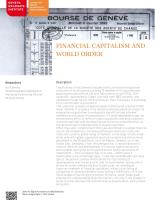


The collection consists of approximately 6,000 bound volumes (1,000 linear meters). It is unique in its temporal and geographical scope, its exhaustive nature (often covering both the official and informal markets), and its state of preservation. If it were assembled today, an extraordinary effort in terms of rights acquisition and data collection would be required, and the result would not be as comprehensive, as the documentation has disappeared in several countries.
When they exist, collections of this type are limited to a single financial centre. By comparison, our collection covers a global range of markets, some large, others small, some central to global capitalism (such as London), and others more peripheral in the Global South, such as Algiers, Istanbul, or Shanghai. From this perspective, it can be said that it reflects the birth and development of financial capital across the entire planet during the entire period known as the second era of imperialism — from its beginnings to its end — which gives it inestimable cultural heritage value. It also has considerable use value due to the period covered, which allows for the tracking of developments over the long term, and its multimarket nature, which allows for cross-referencing and, in
particular, for tracking an important element of financial capitalism, which is the listing of companies on several markets (“cross-listing”).
particular, for tracking an important element of financial capitalism, which is the listing of companies on several markets (“cross-listing”).
The CDHM team leading the project has already identified preliminary geographic foci for the first round of digitisation, which will likely centre on identifying the financial impacts of decolonisation. Discussions are underway on virtual platforms that will house the newly digitised data and methods of dissemination. Overall, the project initiative holds great promise for understanding financial markets, not only in the academic world, but also among international finance stakeholders, both private and public, including multiple types of users; and beyond, to the general public:
- Specialists in international economic and financial history around the world will be able to extract comparative or cross-referenced information from digitised data on the development of capital markets, economic branches, or specific companies, and cross-reference them with sociopolitical data.
- Finance professors, particularly in business schools, who use this type of data for case studies.
- Analysts from major banks or stock markets will be able to refer to it to build long-term indexes.
The CDHM is confident that even more interdisciplinary avenues among researchers in the Digital Humanities will open up with access to this valorised financial data via its planned Portal of Multilateralism or an associated platform.