




Presentation
An emerging consensus in the human sciences holds that money is an intangible credit rather than a material thing or physical commodity. Nonetheless, despite long-standing instance that money is “social,” most work in anthropology and sociology identifies credit as an effect of either state power or market action.
Based on ethnographic and archival research on a community currency known as a Local Exchange Trading System (LETS), this talk describes a form of money in which sociality lies not in communication, meaning, or recognition, but rather in the social relation itself.
In drawing attention to the potential of “immanent credit”, rather than transcendental credit reliant on state or market, the talk seeks to conceptualize how money may be remade to benefit as broad a cross-section of society as possible.
Speaker

Daromir Rudnyckyj is Professor of Anthropology at the University of Victoria, where he serves as Director of the Counter Currency Laboratory and co-principal investigator of the Futures of Money Project. He is past president of the Society for the Anthropology of Religion (2021–23). His research and writing address money, development, religion, economic inequality, and emergent financial alternatives.
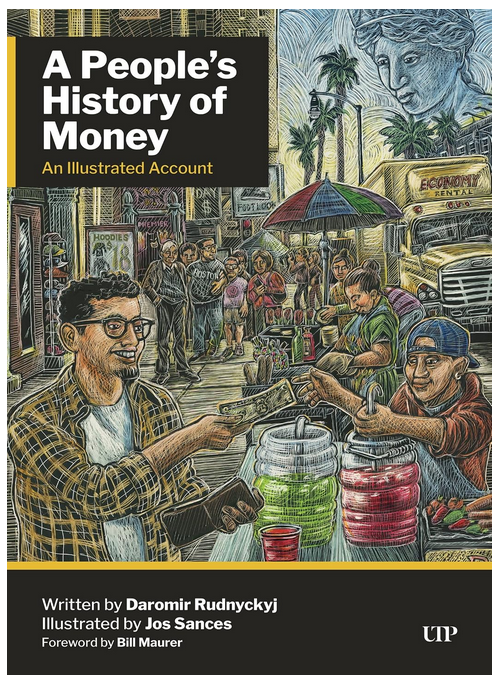
Daromir Rudnyckyj is the author of A People's History of Money: An Illustrated Account, illustrated by Jos Sances (to be published on April 20, 2027).
He is also the author of Beyond Debt: Islamic Experiments in Global Finance (Chicago 2019) and Spiritual Economies: Islam, Globalization, and the Afterlife of Development (Cornell 2010), which was awarded the Sharon Stephens Prize by the American Ethnological Society. He is also co-editor, with Filippo Osella, of the volume Religion and the Morality of the Market (Cambridge 2017). He holds a PhD in Anthropology from the University of California, Berkeley.
Registration
Registration not required.
CO-OrganiseRS
This event is co-organised by the Geneva Graduate Institute's Centre for Finance and Development and Department of Anthropology and Sociology.