


How did you come to choose your research topic?
My inspiration for this topic arose from the intense boredom I experienced during the Covid-19 pandemic in 2020. At that time, I was working as a candidate attorney in South Africa, but the courts were closed for three months, so we were stuck at home. Those who know me can attest that I don’t handle boredom well, so I decided to take advantage of the situation by enrolling in several online courses. One of these was “Child Protection: Children’s Rights in Theory and Practice” by Professor Bhabha, who later became my external examiner. I received the opportunity to apply for a Swiss Government Excellence Scholarship, but I needed a topic and a university in Switzerland. As I worked on children’s rights in South Africa, it made sense to continue in the field, drawing on the inspiration from the short course. I emailed Professor Chetail to see whether he would be interested in such a research project, and the rest is history. In the four years that I pursued my PhD research, the topic has remained the same. However, my PhD content continuously evolved; more than one draft chapter did not make it into the thesis, and I aim to transform those chapters into journal articles.
Can you describe your research questions?
My main research question was, “What is the role of the BIC in the context of migration?” And the sub-question that informed the main question was, “How is the BIC utilised within the International Migration Law (IML) framework to ensure the protection of children on the move?” My research aimed to analyse the extent to which international and regional legal frameworks recognise the best interests of the child as a binding legal standard, one that creates and shapes obligations of protection for children on the move. It then examined how the BIC is utilised across three key areas of migration: family reunification, asylum procedures, and detention. To explore this, I analysed how international and regional bodies, through hard and soft law instruments and regional jurisprudence, engaged with the BIC to guide their interpretation and decision-making in child migration cases. Broadly, the thesis sought to assess the normative influence and practical operation of the BIC within IML to understand to what extent it has evolved from a guiding principle into a concrete legal tool that informs and constrains State behaviour.
What methodology did you use to address these questions?
Methodologically, my research is grounded in doctrinal legal analysis, meaning I systematically examined the relevant treaties, case law, and soft law instruments that shape how the BIC operates within IML. To capture a broad yet coherent picture, I adopted a comparative regional approach, focusing on the three regional human rights systems: Europe, the Americas, and Africa. I deliberately excluded domestic courts, not because they are unimportant, but to maintain a clear focus on international and regional norms, avoid linguistic and jurisdictional imbalance, and ensure the research remained methodologically consistent. The underlying rationale for this approach was simple: before we can reform or critique the law, we must first understand its internal logic and coherence. By first mapping the existing legal framework in these specific areas, the thesis aimed to lay the necessary foundation for deeper analytical and policy-oriented work, as well as to understand what role the BIC has played in the context of IML to develop protections for children on the move.
What are your major findings?
The BIC is emerging as a transformative normative lens in IML. Rather than functioning merely as a child-centred consideration, the BIC increasingly challenges the sovereignty-centred foundations of IML. It exposes tensions within migration governance and could significantly constrain State discretion if current interpretive trends consolidate. Soft law and regional courts are the primary drivers of the BIC’s evolution within international law on migration. While core IML treaties predate the Convention on the Rights of the Child, instruments such as UNHCR guidelines, Joint General Comment 4/23, and regional advisory opinions have filled the gaps. These bodies reinterpret existing frameworks through a BIC-focused lens, gradually expanding children’s rights within migration processes.
Across all three substantive areas — family reunification, asylum procedures, and detention — the BIC reshapes State obligations to varying degrees. In family reunification, the BIC reorients the analysis from parental claims to the child as a rights-holder. In asylum procedures, the BIC strengthens procedural guarantees and has become a key tool for ensuring child-sensitive decision-making. In immigration detention, the BIC reveals the deepest tension with State sovereignty: while international bodies move toward a de facto prohibition, State practice remains resistant.
The BIC highlights structural problems in IML, particularly the continued treatment of children as a derivative of adults. Even where protections exist, children often access them only through parental claims. The BIC reveals these inconsistencies and offers a framework for recognising children as autonomous rights-holders. A normative shift is underway, but the gap between law and practice remains significant. International interpretation is moving toward recognising certain practices, especially child immigration detention, as inherently incompatible with the BIC. However, State behaviour still reflects sovereignty-driven priorities, and many legal advances remain aspirational rather than operational. The BIC in the context of migration has the potential to reshape State obligations towards children on the move and could eventually act as a powerful constraint on State sovereignty.
What are you doing now?
I returned to South Africa in August 2025 and started working as an attorney at a law firm in Cape Town. I plan to expand my thesis into a published book. I hope to build on this and to continue publishing in international law.
* * *
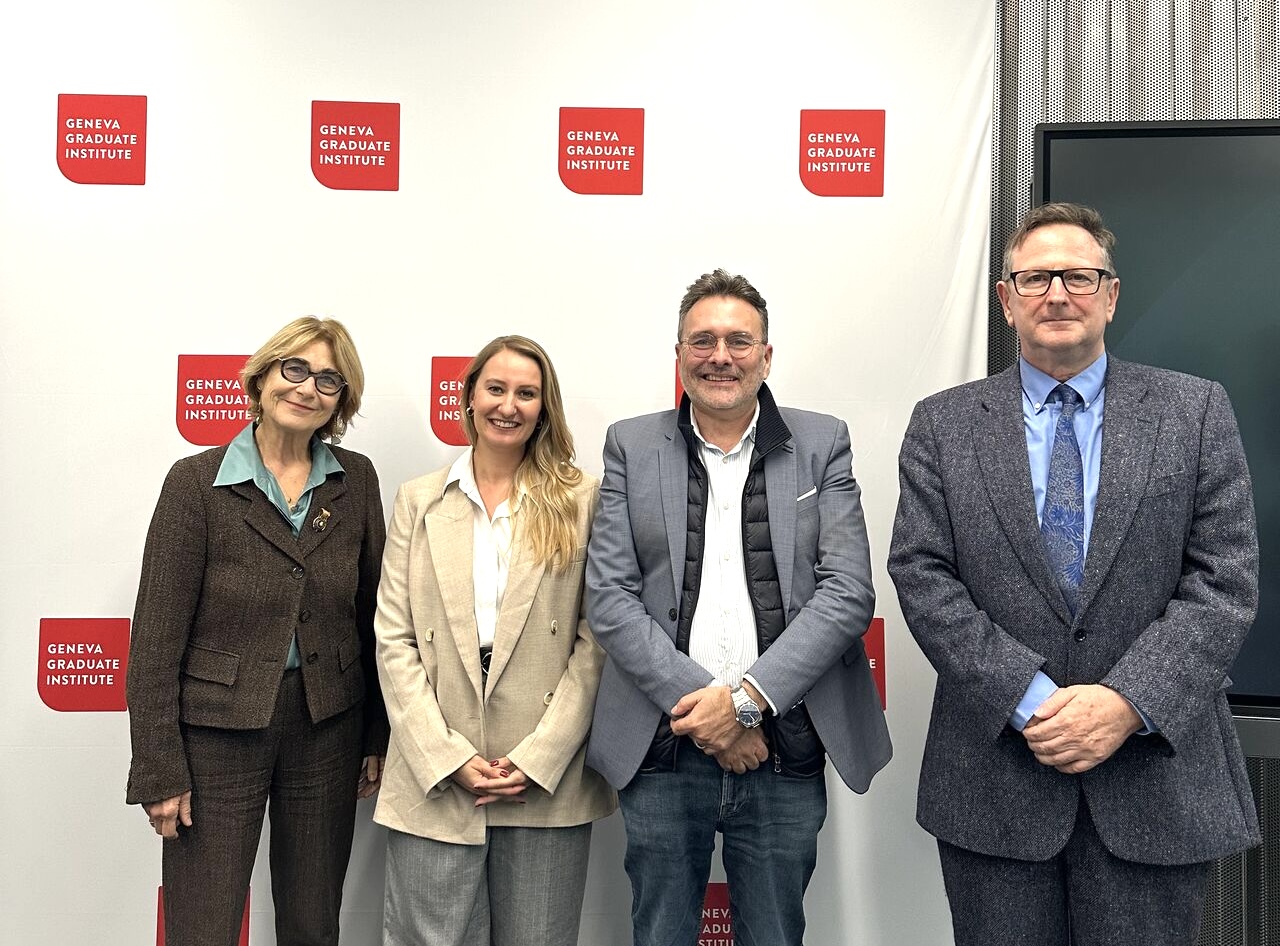
Liline Steyn (second from the left) defended with summa cum laude her PhD thesis in International Law, titled “The Best Interests of the Child in the Context of Migration under International Law”, on 16 October 2025. Committee members were Professor Vincent Chetail (second from the right), Thesis Supervisor; Professor Andrew Clapham (right), President of the Committee and Internal Member; and Professor Jacqueline Bhabha, Department of Global Health and Population, Harvard T.H. Chan School of Public Health, USA.
Citation of the PhD thesis:
Steyn, Liline. “The Best Interests of the Child in the Context of Migration under International Law.” PhD thesis, Graduate Institute of International and Development Studies, Geneva, 2026.
Access:
An abstract of the PhD thesis is available on this page of the Geneva Graduate Institute’s repository. As the thesis itself is embargoed until January 2029, please contact Dr Steyn for access.
Banner image by Pressmaster / Shutterstock.
Interview by Nathalie Tanner, Research Office.