


How did you come to choose your research topic?
I came to inspections somewhat sideways, through investigations. Before starting my PhD, I had already spent several years working as an investigator in international organisations on matters ranging from war crimes and crimes against humanity to fraud, corruption, and workplace misconduct. I knew the mechanics of an investigation well — from receiving an allegation and planning an investigation to interviewing witnesses, assessing evidence, and eventually arriving at findings.
What began to interest me increasingly, however, was everything that sits around that apparently orderly process. Investigations are meant to establish facts objectively, but investigators are human beings making judgments at every stage. I had seen how the same facts could lead to different conclusions depending on who was conducting the investigation, where it was taking place, and even the gender, race, geography and institutional position of the complainants, subjects, and witnesses. Overall, I became very interested in these sociological dimensions of fact-finding and in the broader question of how institutions decide what they are prepared to regard as an established fact.
That curiosity gradually drew me towards international inspections. Around the time I was beginning my career, the work of the Organisation for the Prohibition of Chemical Weapons (OPCW) in Syria was becoming increasingly prominent. I was fascinated by the idea that international officials could enter facilities inside a sovereign state and independently verify whether that state was complying with its treaty obligations. I was equally interested in torture prevention and in how the international community could keep watch over what happens inside prisons and other closed places, where abuses are particularly easy to conceal. And then came the whales! Whaling was, in many ways, the least intuitive of the three regimes I eventually chose to study, but it also turned out to be the most foundational as it is the oldest of the three and it is also based on a system that is far more dependent on domestic sensibilities and continuing state cooperation.
I should confess that when I wrote my original research proposal, I was using the terms “investigations” and “inspections” almost interchangeably. I arrived at the Institute thinking that my investigative experience would give me a head start, even though I had never been a weapons or anti-torture or whaling-regulation inspector. In hindsight, that mix of familiarity and ignorance served me well. I knew enough about fact-finding to stand on solid ground and the substantive fields of my analysis were unfamiliar enough that I was never at risk of becoming bored.
My supervisor, Professor Andrew Clapham, helped me turn my rather sprawling initial interest into a disciplined comparative project. We finally settled on three regimes in which inspections operate very differently and with very different degrees of success. Once placed alongside one another, they offered a fascinating way of asking what gives inspections their authority, what makes them credible, and why some systems of international oversight work so much better than others.
Can you describe your thesis questions and the methodology you use to approach those questions?
My thesis examines inspections across three treaty regimes that could hardly be more different in subject matter, institutional design, or political context. One concerns chemical weapons, another the prevention of torture in places of detention, and the third the regulation of whaling. What links them is that each uses inspections, in a different form and with a different degree of authority, as a means of checking states’ compliance with their international obligations.
The Chemical Weapons Convention represents one of the most developed systems of international verification, administered through the OPCW. The Optional Protocol to the Convention against Torture establishes preventive visits to places of detention through an international body and national preventive mechanisms. The International Convention for the Regulation of Whaling, by contrast, has historically relied principally on national inspectors and state-administered oversight. Placing these regimes alongside one another allows the thesis to test the same comparative questions across security, human rights, and environmental conservation without assuming that inspections operate identically in each field.
The thesis asks four related questions: How are inspections defined and structured within these three regimes? What legal instruments and institutional arrangements authorise them? What implications do they have for compliance, sovereignty, and related legal processes within each regime? Finally, what similarities and differences emerge when inspections in the three systems are compared?
The analysis is framed by a thesis-specific definition of inspections, which are defined as formal, principally on-site visits conducted under international authority to monitor and verify a state’s compliance with its obligations. The study focuses on preventive verification rather than on reactive mechanisms, which are used to determine whether a violation has already occurred. Investigations, inquiries, and fact-finding missions therefore fall outside this core definition, though they are considered in the text where they bear on the operation or legal consequences of the three regimes.
Methodologically, the thesis combines doctrinal and comparative legal analysis. I begin with the primary legal materials governing each regime, principally the treaties and associated instruments, and examine the provisions that establish inspection powers, define their scope, and allocate authority among states, international institutions, and inspectors. Those texts are interpreted in light of travaux préparatoires where useful, state and institutional practice, domestic implementation, and relevant jurisprudence. The analysis then considers how those legal arrangements operate in practice.
Taken together, this approach allows the thesis to move from the legal foundations of inspections to the authority exercised through them and finally to their consequences in practice. The comparison shows how different legal and institutional choices shape the reach, credibility, and effectiveness of inspection mechanisms across the three regimes.
What are your major findings?
The central finding of the thesis is that while inspections occupy a distinctive position within international law, they do not by themselves compel compliance, impose sanctions, or determine legal responsibility. Instead, their importance lies in producing an authoritative factual basis from which those other processes can operate.
Across the three regimes, it was found that the quality of verification has significant consequences. Where inspections generate credible and independent findings, they strengthen diplomatic responses, institutional decision-making, judicial scrutiny, and the practical authority of the underlying treaty obligations. However, where verification is weak or heavily dependent on state self-reporting, those subsequent processes are correspondingly less secure. The comparison also shows that inspection effectiveness is closely connected to legal and institutional design. The Chemical Weapons Convention provides the strongest example in this regard because its inspection obligations are firmly embedded in the treaty itself and inspectors operate through a highly institutionalised international body with extensive powers and procedural safeguards. The Optional Protocol to the Convention against Torture reaches a different balance. The cooperative structure of its inspections, combining international visits with national preventive mechanisms, has produced meaningful but uneven improvements in detention conditions. The whaling regime, on the other hand, demonstrates the limitations of a system that relies heavily on national inspectors, conditional consent, and limited independent oversight. In that setting, formal obligations have not always translated into credible verification or effective compliance.
Overall, the three case studies show that inspections are neither merely technical procedures nor substitutes for enforcement and that their effectiveness depends on clear legal mandates, meaningful access, institutional independence, credible follow-up, and sustained political support. Their deeper significance, however, is that they make compliance — and non-compliance — visible, and that visibility provides international law with the factual foundation necessary for accountability to move beyond assertion and become capable of legal and institutional consequence.
What does your thesis contribute to the way international lawyers understand inspections?
For the purposes of the thesis, I needed a way to separate inspections from the other fact-finding mechanisms international law uses, because the literature often tends to blur them together. The working definition I developed treats inspections as preventive mechanisms, which verify that a state’s legal obligations are being met before any compliance-related problems arise, whereas investigations, inquiries, and fact-finding missions are reactive in nature, responding to alleged violations after the fact. Although international law itself has not drawn this distinction, it is not arbitrary. It reflects the functional difference between regular verification and mechanisms triggered by a specific allegation or concern. That distinction carries real consequences, as once these mechanisms are no longer conflated with one another, it becomes possible to assess what an inspection body is actually designed to accomplish and to understand why it succeeds in some settings and fails in others.
The analytical framework the study builds around legal basis, authority, and implications is meant to be usable beyond the three regimes examined in my work. There are over 85 inspection systems operating across different areas of international law, yet there is almost no comparative scholarship that examines them together. This approach gives lawyers a way of asking consistent questions across very different fields while still accounting for the legal and institutional differences between inspection systems in different regimes.
A further point that emerged from the comparative analysis was the relationship between verification and adjudication, which I had not anticipated at the outset. The extent to which inspection findings feed into domestic and international legal proceedings tracks closely with how the underlying inspection system is designed. Strong systems produce findings that courts are prepared to rely on, whereas weak ones produce findings that courts either cannot use or do not trust enough to use. That connection between the design of an inspection system and the legal value ultimately attached to its findings had not previously been examined across different inspection systems. For lawyers working on treaty compliance, I think that connection will matter increasingly as inspections continue to solidify or multiply across regimes.
* * *
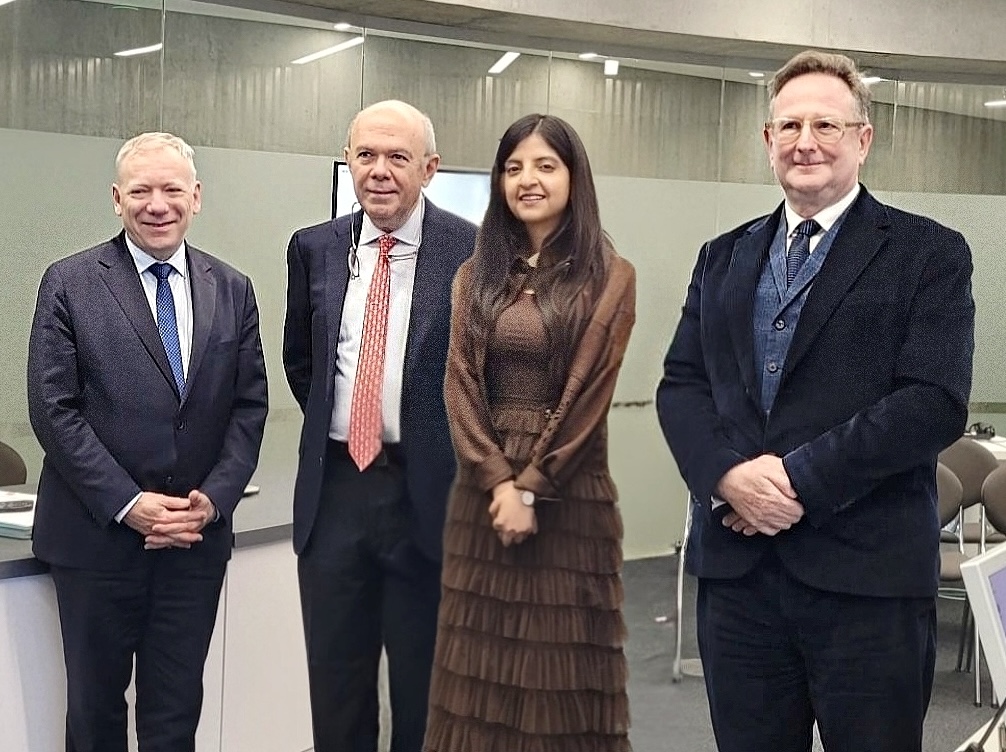
On 15 December 2025, Swati Malik defended her PhD thesis in International Law, titled “The Legal Basis, Authority, and Implications of Treaty-Based Inspection Mechanisms: A Doctrinal and Comparative Study of On-Site Verification in the Chemical Weapons Convention, the Optional Protocol to the Convention against Torture, and the International Convention for the Regulation of Whaling”. Committee members were Professor Andrew Clapham (right), Thesis Director; Senior Visiting Professor Gian Luca Burci (second from the left), President of the Committee and Internal Member, and Professor Thilo Marauhn, Law Faculty, Justus Liebig University Giessen, Germany.
Citation of the PhD thesis:
Malik, Swati. “The Legal Basis, Authority, and Implications of Treaty-Based Inspection Mechanisms: A Doctrinal and Comparative Study of On-Site Verification in the Chemical Weapons Convention, the Optional Protocol to the Convention against Torture, and the International Convention for the Regulation of Whaling.” PhD thesis, Graduate Institute of International and Development Studies, Geneva, 2026.
Access: An abstract of the PhD thesis is available in the Geneva Graduate Institute’s repository. As the thesis itself is embargoed until May 2029, please contact Dr Malik for access.
Banner image: Photo collage made from photos by PEO ACWA (CC BY 2.0, via Wikimedia Commons), Gobierno de la Ciudad Autónoma de Buenos Aires (CC BY 2.5 AR, via Wikimedia Commons), and NPS / Kaitlin Thoreson (Public domain, via Wikimedia Commons).
Interview by Nathalie Tanner, Research Office.