


How did you come to choose your research topic?
The choice of my research topic emerged from my previous work experience in the criminal justice field, both as part of the Prosecution Service in my home country, Argentina, and from an academic perspective at the University of Buenos Aires. I felt uncomfortable with two paradoxical moves in the human rights field: an apparently inflexible endorsement of punitivism as a necessary way of responding to crimes against humanity and gender-based violence; and the simultaneous acceptance that punitivism and prison are neither constructive nor “human” responses to other type of crimes.
My curiosity about restorative justice, one of the most prominent frameworks initially proposed as an alternative way of responding to crime, thus emerged naturally. After completing a Master’s in Transitional Justice, Human Rights and the Rule of Law at the Geneva Academy, my interest deepened further. I confirmed that international human rights law and international criminal law seemed to prefer traditional criminal justice as the due response to international crimes and gross human rights violations. Yet, I learned about diverse justice mechanisms in a variety of contexts labelled as “restorative justice”, even if this framework was initially developed for ordinary crimes of minor gravity. At the same time, the term “restorative justice” was used very broadly, and not necessarily in the context of criminal justice.
Hence, I decided to devote my PhD journey to clarifying the meaning of restorative justice when applied to addressing the criminal dimension of gross human rights violations, and to examining the implications of using this approach. More specifically, I chose to focus on the concept of truth. The aim was to critically reflect on international law in light of the idea of truth in restorative justice theory and practice for atrocities.
Can you describe your thesis questions and the methodology you used to approach those questions?
The thesis addressed two research questions. The main research question was: How is “truth” conceptualised within restorative justice theory and operationalised in practice, particularly in cases of gross human rights violations? Building on the answer to this question, the study then explored a second question: What are the implications of introducing the concept of truth, as understood in restorative justice, into criminal justice processes dealing with gross human rights violations?
To explore these research questions, I adopted a sociolegal, qualitative approach that combined traditional doctrinal legal analysis with empirical and theoretical perspectives from various fields. Moreover, I used a case study design, selecting two cases of restorative justice mechanisms: the Special Jurisdiction for Peace, created in 2016 in Colombia, and the Restorative Justice Encounters of 2011–2012 in the Basque Country, Spain. The sources consulted to explore the cases included literature, legal and other types of documents, audiovisual material, direct observation regarding the Special Jurisdiction for Peace, and in-depth semi-structured individual interviews with persons involved in the respective mechanisms or who, although not participants, could provide important perspectives on them and/or their context.
What are your major findings?
The thesis first clarified the concept of truth as understood in restorative justice theory and practice, mainly developed in the context of ordinary crimes. It found that truth was conceptualised as a complex notion with multiple dimensions, and that restorative justice dialogue constituted the primary truth-seeking method.
The thesis then found that this concept of truth, as developed in restorative justice theory and practice for ordinary crimes, resonated in the two case studies of restorative justice mechanisms applied in situations of gross human rights violations. At the same time, certain adjustments were required in light of the particular nature of such violations, and specific challenges had to be taken into account.
Regarding the implications of introducing this concept of truth into criminal justice processes addressing gross human rights violations, the thesis identified consequences at various levels. For instance, considering criminal justice as delineated by international human rights law standards, it examined the implications for both the scope of truth and the processes through which such truth was produced. The thesis identified certain tensions, as well as synergies, with human rights law standards as they were predominantly interpreted. Moreover, it reflected on the implications concerning the functions that criminal justice was purported to fulfil in the context of gross human rights violations according to the literature. It identified particular aspects in which applying the restorative justice concept of truth could actually have assisted criminal justice in performing these functions.
How can your thesis contribute to improving the functioning of the justice system?
The driving force behind the thesis, and its underlying hope, was that this research would contribute to understanding how restorative justice approaches to truth could improve criminal justice responses to gross human rights violations. Restorative justice approaches offer an opportunity to construct a much more comprehensive truth that seeks to respond to victims’ demands for justice while also facilitating perpetrators’ responsibility-taking. Moreover, as the thesis argued, a restorative justice approach could help better align criminal justice with the aim of non-recurrence, thus moving closer to the ideal of “Never Again”.
* * *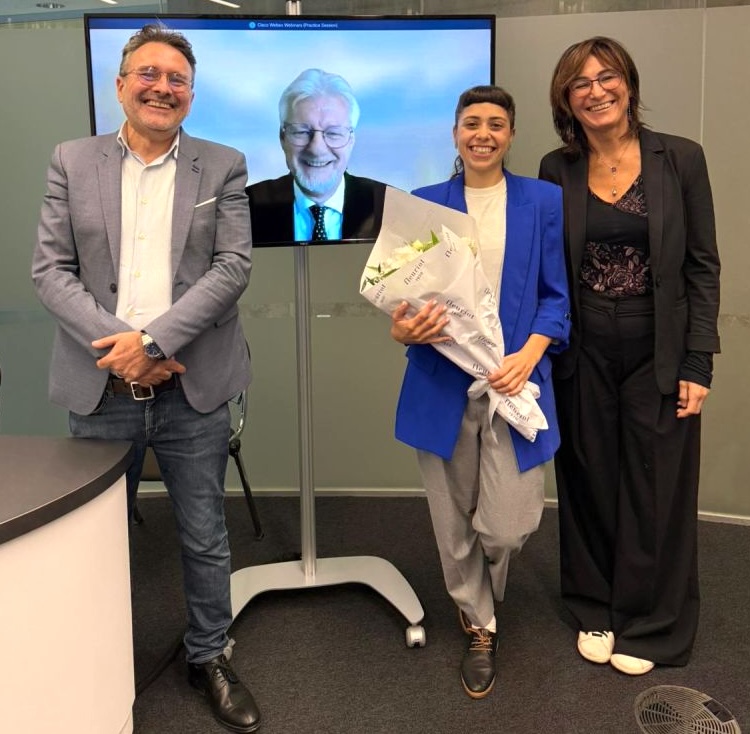
Agustina Becerra Vazquez (second from the right) successfully defended her PhD thesis in International Law, titled “Truth in Restorative Justice and Its implications for Criminal Justice in Cases of Gross Human Rights Violations”, on 7 October 2025. Committee members were Professor Paola Gaeta (right), Thesis Supervisor; Professor Vincent Chetail (left), President of the Committee and Internal Member; and Professor Stephan Parmentier, Professor, Faculty of Law and Criminology, KU Leuven, Belgium.
Citation of the PhD thesis:
Becerra Vazquez, Agustina. “Truth in Restorative Justice and Its Implications for Criminal Justice in Cases of Gross Human Rights Violations.” PhD thesis, Graduate Institute of International and Development Studies, Geneva, 2025.
Access to the PhD thesis:
An abstract of the PhD thesis is available on this page of the Geneva Graduate Institute’s repository. As the thesis itself is embargoed until December 2028, please contact Dr Becerra Vazquez for access.
Banner image by G Leo Gue / Shutterstock.
Interview by Nathalie Tanner, Research Office.