


How did you choose your research topic?
The research topic is strictly connected to my biography. I was born and raised in a very small village in the Italian Alps, in a region called Friuli, at the borders of Austria and Slovenia (see banner image). What is special about it is that within a 50-km radius Romance, Slavic and Germanic languages overlap in all possible variations and dialects. Arguably, this is a unique case in Europe and makes the region an extraordinary prism for broader reflections on processes of nation-building, bordering and de-bordering. I myself understood soon that I was born in a complex area of contacts and intersections: communities there speak four official languages (Italian, Friulian — which is very similar to Grisons’s Romansh —, German and Slovenian), and it is absolutely normal to cross national borders for all sorts of activities, from hiking to smuggling! Yet, the region is shaped by the trauma of being one of the main European battlefields of competing nationalisms. Leaving aside the two World Wars, during the Cold War Friuli was one of the most militarised regions in Europe, because it bordered Yugoslavia. With Trieste, which became the capital of the Autonomous Region Friuli-Venezia Giulia, the territory found itself directly on the “Iron Curtain” dividing Europe into East and West, socialism from capitalism, “Slavs” from “Italians”, etc. Linguistic borders entangled with social boundaries and memories of everyday cross-border practices intertwined with threatening stories of an “Eastern danger”. Thinking about my family, sometimes I have the impression that they underwent a dissociative identity disorder. How could my parents and grandparents live with a capillary military control yet crossing the border as if it was a daily routine? The border was at the same time overinvested and banal. As you can see, with this background on my shoulders, I doubt I could have done something different in my life but being an historian and researching, interpreting and understanding those fascinating lines on maps…
What were your research questions and methodology?
Borderlands occupy a paradoxical position in political imaginaries. They are overburdened in a sacred nationalistic aura as the embodiment of the nation’s fate. At the same time, they are marginalised as “sensitive zones” and described as spaces that must be secured, developed or even civilised. This tension offers a powerful entry point for questioning authority as well as how borderland populations reimagine it. In the case of my territory, the emergence of an alternative imaginary that highlighted common development and friendship beyond national borders occurred through the daily activities of intellectuals, local politicians and touristic operators who developed the concept of “Alpe-Adria”. This idea portrayed the space “from the Alps to the Adriatic Sea” as an integrated region, where different populations could live in peace and borders were reinterpreted as windows to see what existed on the other side. “Alpe-Adria”, therefore, identifies an alternative perspective on the territory at the crossroad between Italy, Austria and (ex-)Yugoslavia, challenging the mainstream vision that highlighted hostility, resentment and ethnic hate.
In my thesis, I wanted to question how these two narratives could coexist. Therefore, the central question that guided the research was: How do “borderlanders” develop alternative territorial imaginaries beyond national categories? This is the broader angle that I have chosen for my work, where I showed how local cross-border practices created situations of economic exchange and political cooperation, aiming at reducing national conflicts and imagining transnational regions. Arguably, the analysis of these alternative imaginaries is the principal justification for studying borders. The operational questions that follow are: What forms of contact and exchange took place in the Alps-Adriatic space after 1945? Who created them and with what interests? Which social, political, or economic players give shape to cross-border networks, and how? How do actors from the local to the international level negotiate the definition of cross-border cooperation between Italy, Austria and (ex-)Yugoslavia?
Answering these inquiries can correct the distortion inherent in state-centred histories and enables the interpretation of the past through a more comprehensive framework, within which the focus is on the interdependence between local, regional, national and European developments. The thesis attempted to tell the “macroscopic” political and diplomatic history and the “molecular” history of local communities as one. Since it is on frontiers that this interplay can be seen at best, the Alps-Adriatic borderlands are veritable laboratories to shuttle between levels. Moreover, by assigning a historical role to borderlands and their populations, the latter acquire independence, challenging the idea that they are passive subjects of history.
In terms of “methodology”, I drew on archival research and oral history. The quantity and quality of material that I had to gather was truly impressive. Putting together the different perspectives that concurred to create the concept of “Alpe-Adria” meant not only researching local, regional and national archives — travelling between Vienna, Ljubljana, Rome, Florence, Paris, Trieste, Klagenfurt, Udine and other smaller places — but also contacting and interviewing around thirty “key witnesses” of cross-border cooperation, not to mention the consultation of several online archives such as those of the CIA and the NATO. Eventually, however, I was able to combine anthropology and history in a truly transdisciplinary way that was praised by the commission, and I am very satisfied with the final result.
What are your major findings?
To answer this question, I must introduce a concept that formed the backbone of my thesis. It comes from the reflections of anthropologist Chiara Brambilla, who argued that describing today’s flows and mobility across borders by simply looking at them as “lines in the sand” is not enough. On the contrary, we should see the border as a landscape or, as she calls it, a “borderscape” where multiple perspectives overlap beyond geopolitical categories to create different dialectics and critical imagination. Methodologically, this means to work “with” borderlanders rather than “on” them and to pay attention to small stories, mockeries of authorities, experiences and day-to-day representations of borders. In this way, the “borderscape” becomes a space of creative conflict where non-state and local actors challenge the state’s hegemonic discourse of security and control to create a space of political innovation.
The analysis of archival sources, the interviews I conducted and the observation of the behaviour of borderland communities in the Alps-Adriatic space allowed me to conclude that to name this territory as “Alpe-Adria” was part of a deliberate strategy to depict the area as a transnational region where friendship, peace and common development could be cultivated. In this way, the thesis questioned the binary vision of a divided continent and challenged the history of Cold War Europe by highlighting the perspectives from borderlands. There are multiple examples of these processes: from the “Alpe-Adria” fair in Ljubljana (see photo), conceived in 1962 by the local Chamber of Commerce to connect producers and products from the border provinces, to Hans Sima, the President of the Austrian Land of Carinthia between 1965 and 1974, who employed it in all his radio and television speeches, the use of the name identifies a wish to strengthen economic, political and cultural relations, often in conflict with the strategies of central authorities.
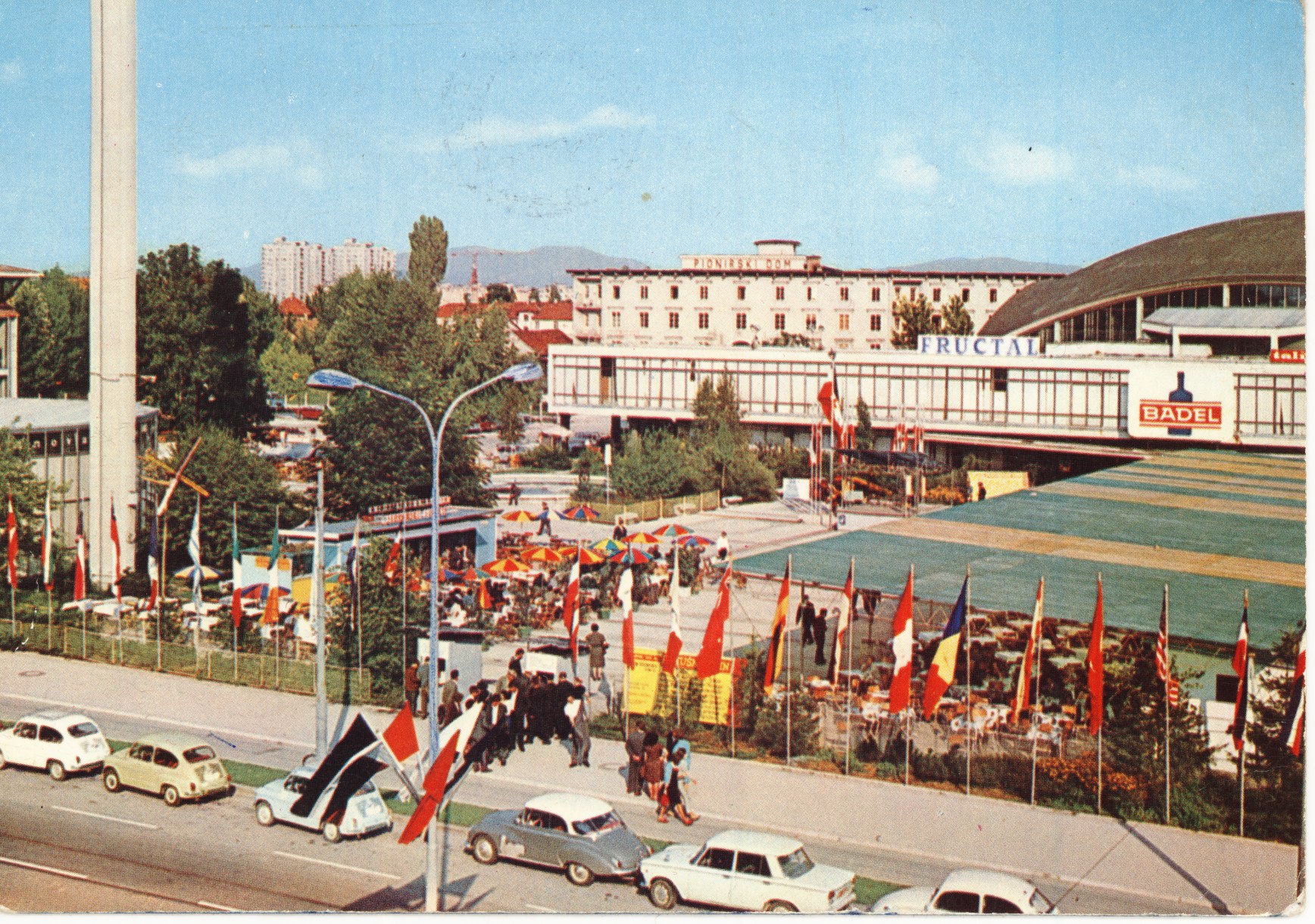
Gospodarsko Razstavišče (today GR Ljubljana), here shown in the 1970s, was built between 1955 and 1958 to host the seventh congress of the League of Communists of Yugoslavia. “It became the flagship for the Chamber of Commerce and hosting jazz legend Louis Armstrong less than one year after the party congress. This cemented the GR credentials but, many argued, its potential would only be fully realised by hosting an international fair, resuming prewar traditions. Considering the point well-founded, in March 1958 Leopold Krese, GR’s General Secretary, advanced the idea of organising a ‘border trade fair’ named ‘Alpe-Adrija’. The proposal … mirrored the optimism of those years, outlining how border agreements fostered mutual understanding among border populations”, writes Dr Ambrosino in his thesis (p. 154–155). The “Alpe-Adria” fair’s first edition ran from 11 to 20 May 1962. Photo by Mirko Kambič, Ljubljana. Mladinska knjiga.
The main institutional result, however, was the creation of the “Alpe-Adria Working Community” in 1978, which represented a cross-border “platform” for regional authorities to tackle common political, environmental and cultural issues. It was the first “forum” that connected regions from Eastern and Western countries, signalling the shift from rigid geopolitical separation toward transnational cooperation and the gradual construction of a “bottom up” integrated Europe.
Far from being only the ultimate expression of state power, therefore, borders emerged as sites of possibilities, where local actors are not subordinated to centres but influence national and international networks as much as central authorities. The study of cross-border cooperation in the Alps-Adriatic region thus illuminates the autonomy of borderlanders and stands out as a paradigmatic example to reorient the focus towards the lived experience of the nation-state in borderland contexts. Last but not least, the study of “Alpe-Adria” opened a critical reflection on historical definitions of time. In particular, the thesis challenged the idea that 1989 was the annus mirabilis of Europe. Sure, the epochal changes connected to the end of socialist regimes in Eastern Europe and the end of the Cold War accelerated the integration of the continent and globalisation, but if we look at the Alps-Adriatic region we notice that an integrated Europe emerged slowly and gradually, also thanks to daily interactions of common people that started in the early days after 1945. This means being careful in assuming clear-cut periodisations, as history does not follow linear trajectories but is unpredictable as human life.
What social and political lessons for our time could be drawn from your historical analysis?
I am not a fan of the idea of history as the “teacher of life”. For example, in 2021, sociologist Philippe Hamman and border studies expert Birte Wassenberg published Mémoire d’Europe – mémoire de paix: Témoignages de la région frontalière d’Alsace, in which they trace the life trajectories of policymakers, administrators, cultural workers and economic actors who worked on cross-border cooperation in Alsace-Lorraine over seventy years and shed light on how the challenge of building contemporary Europe was experienced locally. From a region scarred by the memory of the French-German conflict, the authors distil the general lesson that lasting peace is both the major result and the most overlooked success of the European project. However, one wonders at what cost this success was obtained. Western Europe and the US accounted for around 70% of arms exports during the Cold War decades (based on SIPRI data) — a number that increased to 73% in 2020–2024 due to the ongoing wars (see this SIPRI Fact Sheet). This makes it rather problematic to juxtapose the memory of Europe and the memory of peace without acknowledging that the removal of war from the imagination of European citizens has not meant its disappearance, but only its shift to non-Western contexts. Therefore, even the most ardent pro-European might wonder what future remains for this “memory of peace” and whether it is already becoming just that: a memory!
To be sure, it is understandable that most “key witnesses” in the Upper Rhine region saw their territory as a model for the totality of Europe. But the lack of a critical reflection on the nature of that experience — rooted in affluent, Western European communities and forged in the context of the Franco-German rapprochement — reveals that Hamman and Wassenberg adopt a Western-Eurocentric perspective that fails to recognise the diversity of other experiences. To clarify, these remarks are not a critique of their work, which I found extremely useful for my thesis, but rather a caution against viewing history as inherently pedagogical. History does not obey to laws, following a linear path. At best, it fulfils its ethical role most effectively when it remains attentive to the reality of everyday life, where individuals are constantly confronted with difficult choices such as whether to conform or resist. Therefore, one of history’s main lessons is to cultivate humility, in the recognition of how intricated and unpredictable the world often proves to be.
I believe that what we can bring home from the study of the Alps-Adriatic (open) border practices during the Cold War lies in its treatment of cross-border cooperation as a human adventure. The research pays more attention to migration, mobility and culture, including the diffusion and contestation of borders. Scholars should pay closer attention to border experiences and produce research on everyday realities that conceptualise the residents of border regions as agents in the interplay of borderisation and deborderisation. From this perspective, borders become arenas of possibility and sociocultural ferment, where people mobilise skills and resources to negotiate borders’ meaning and their effectiveness. This approach is vast and offers a still unexplored potential for contributing to history, anthropology, and European, Cold War and border studies beyond local filters. Critical distance emerges when analysing contradictions within “Alpe-Adria”. While insiders celebrate the entanglement of Romance, Slavic and Germanic languages and praise cross-border cooperation as healing 20th-century fractures, they rarely acknowledge that historical fault lines have returned in new forms: migration flows, post-Covid recovery struggles, climate change impact, new wars, walls and resurgent security imperatives.
Much can be understood about the significance of authority by adopting the perspective of those who bear its consequences most acutely: refugees and migrants, on the one hand, and borderlanders, on the other. The former suffer from “too little state”, that is, travelling illegally and without documents, they challenge the authorities’ control machine, complicating categorisation and governance. The latter endure “too much state”: in territories marked by barriers, watchtowers and other devices to control people, their loyalty is constantly put into question. While my thesis focuses on the second group, it is evident that examining the interplay between national policies and local reactions in borderlands has greater implications for studies of migration and mobility. Therefore, my regional case enables a critical assessment of Europe’s “borderless” rhetoric, which rests on the irony of “policing in the name of freedom”. In other words, the celebration of internal openness is shadowed by ever-tightening controls at external borders.
What bearing will your doctoral experience have on your career plans?
I cannot fail to thank my co-supervisors, Davide Rodogno and Alessandro Monsutti, as well as Chiara Brambilla, Jussi Hanhimäki and Mario Del Pero, who formed my doctoral commission and with whom I had intense intellectual exchanges. Moreover, I would like to thank the team of the ERC project “Open Borders”, which works on similar topics and with which we have developed a great collaboration that helped me most to reach this result. I should also thank all archivists, admin people, interviewees, friends and family who supported me during these years — but this is not the venue to name them one by one. What I can say is that I am fully content and happy with the result and that it helped me not only academically but as a human being. I am now employed in UniDistance, in Brig, where I work on a project that looks at the influence of business and industrial associations in shaping the environmental debate in the 1970s. I see many connections between this project and my PhD, especially in seeing the 1970s as a decade of great transformations: from regional reforms to emergent environmental awarenesses, not to mention the political conflict that shaped Europe and the Integration process. Yet, my origins and my love for mountains will remain intact and I hope to develop more projects on Alpine identity, minority languages and contacts between Switzerland and Friuli, the two places that now I call home.
* * *
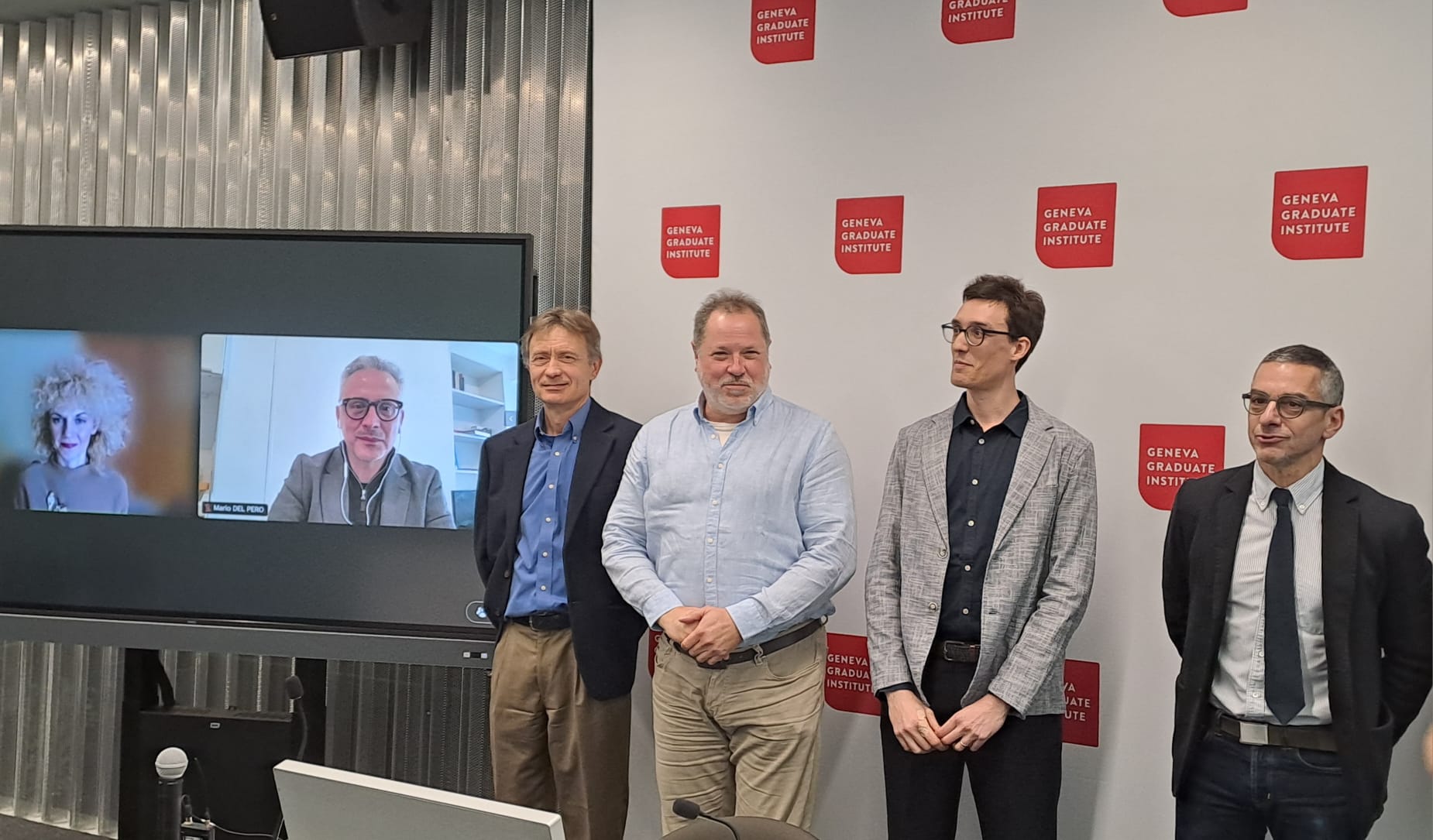
On 10 February 2026, Alessandro Ambrosino (2nd from the right) defended his PhD thesis in International History, titled “The Origins of Alpe-Adria: Inventing Borderscapes across Austria, Italy and Yugoslavia against the background of Nationalistic Conflicts (1945–1978)”. Committee members were Professor Davide Rodogno, Thesis Co-Supervisor; Professor Alessandro Monsutti, Thesis Co-Supervisor; Professor Jussi Hanhimäki, President of the Committee and Internal Member; Professor Chiara Brambilla, Department of Human and Social Sciences, University of Bergamo, Italy; and Professor Mario Del Pero, Centre for History, SciencesPo, France.
Citation of the PhD thesis:
Ambrosino, Alessandro. “The Origins of Alpe-Adria: Inventing Borderscapes across Austria, Italy and Yugoslavia against the background of Nationalistic Conflicts (1945–1978).” PhD thesis, Graduate Institute of International and Development Studies, Geneva, 2026.
Access: The PhD thesis is publicly available on the Geneva Graduate Institute’s repository.
Banner image: photo by Diego Cruciat, CC BY-SA 3.0, via Wikimedia Commons.
Interview by Nathalie Tanner, Research Office.