


How did you come to choose your research topic?
Before starting the PhD, I was working on labour rights in the global garment industry. During this period, I became interested in subcontracting and the precarious conditions faced by workers at the “bottom rungs” of supply chains, even extending to raw materials such as cotton. A combination of personal and professional circumstances brought me to Southeast Turkey, which is a region long considered underdeveloped and unruly by the Turkish state and home to a large number of refugees from Syria.
Despite massive investments in regional development, most notably through the Southeastern Anatolia Project (“GAP” from the Turkish acronym), which is the longest-running, most expensive development programme in the history of the Turkish Republic, supported by international organisations such as the World Bank, the region’s residents continue to face poverty and inequalities. Many work as itinerant farmworkers in cotton, among other agricultural crops, with precarious working conditions. I was drawn to this contradiction and wanted to understand it more deeply.
At the beginning of my PhD, I also began working on the project Gendering Survival from the Margins, funded by the Swiss National Science Foundation, of which this thesis is a part. Over time, my topic evolved towards examining how labour comes to be extractive and devaluing in a specific context, and what effects this produces. In this sense, the issue is not simply about labour, but about a broader condition of existence, one that affects the lives of families and communities and reverberates across generations. In this way, what I refer to in the thesis as the “politics of life” became central to my research.
Can you describe your thesis questions and the methodology you use to approach those questions?
This thesis begins with the experiences of people labouring in the cotton fields of Southeast Turkey and asks: How do people sustain their lives in this agro-industry, and how do state and non-state actors support or undermine their efforts?
My approach draws on “everyday life as method,” which provides a grounded approach to theorising by attending to the seemingly mundane aspects of daily life. Specifically, I used participant observation and interviews conducted during several months of fieldwork across repeated visits between 2021 and 2023. I collaborated with translators fluent in Turkish, Kurdish, and Arabic, who held Turkish or Syrian nationality, and I was guided by feminist research ethics, which recognises the importance of treating participants as experts of their own experiences and practicing an ethic of care.
What are your major findings?
My main argument is that the violences of capitalist extraction, particularly the precarious working conditions experienced by workers at the “bottom rungs,” and the violences of securitisation and nation building are mutually constitutive. In other words, understanding the extractive nature of labour in cotton production warrants attention to geopolitics. I analyse this mutual constitution by looking at practices of neglect and control by both state and non-state actors that connect war and peace, public and private spaces, and the practices of production and social reproduction. In terms of theory, this argument contributes to ongoing discussions about the need to better connect feminist political economy and security studies.
The findings are organised around three empirical chapters. The first examines what it means for labour to be treated as a cheap commodity: how this comes about and the effects it has on workers and their families, both in their daily lives and across generations, for example with respect to divisions of tasks at home, impacts on health, housing, and care burdens. Gendered and racialised inequalities play a central role, particularly to the detriment of Kurdish women and Syrian refugee farmworkers.
In the second chapter, I examine the role of the state in supporting the cotton agro-industry in the region. I focus on development policy through GAP and how the selective allocation of resources, such as water for cotton cultivation, served counterinsurgency and nation-building purposes, while unevenly affecting the lives of the region’s residents.
Lastly, I turn to the ways in which responsibilities for social protections and services are “contracted out” across multiple state and non-state actors who enact different forms of security and insecurity. These arrangements make sustaining life for cotton labourers particularly difficult, as responsibilities are distributed and diffused among labour brokers, the state, NGOs, multinational brands, and other producers and commercial actors.
Nonetheless, there is a positive aspect to social reproduction. In fact, people actively negotiate their identities, assert claims to belonging, and create meanings of home and hope for the future.
What could be the social and political implications of your thesis?
My thesis has important implications for both labour and development issues. It calls for understanding labour dynamics not in isolation, but as articulated through social relations of gender, race, and citizenship status, as well as the specific histories and contexts of the places where people live. In practice, this means that efforts to improve working conditions cannot be separated from other struggles for rights, such as citizenship, housing, education, healthcare, and ecological well-being. In addition, it demonstrates that development policy can reproduce the harms of past conflicts. Recognising this is particularly urgent in the current period of intensifying geopolitical tensions, environmental degradation, and ongoing attacks on civil and human rights across the world.
What key takeaways have you gained from conducting this research?
This research has taught me a great deal about perseverance, generosity and humanity, and that research is ultimately a collaborative effort. I hope to continue engaging with the themes of this work and will always be deeply grateful for the connections I made along the way.
* * *
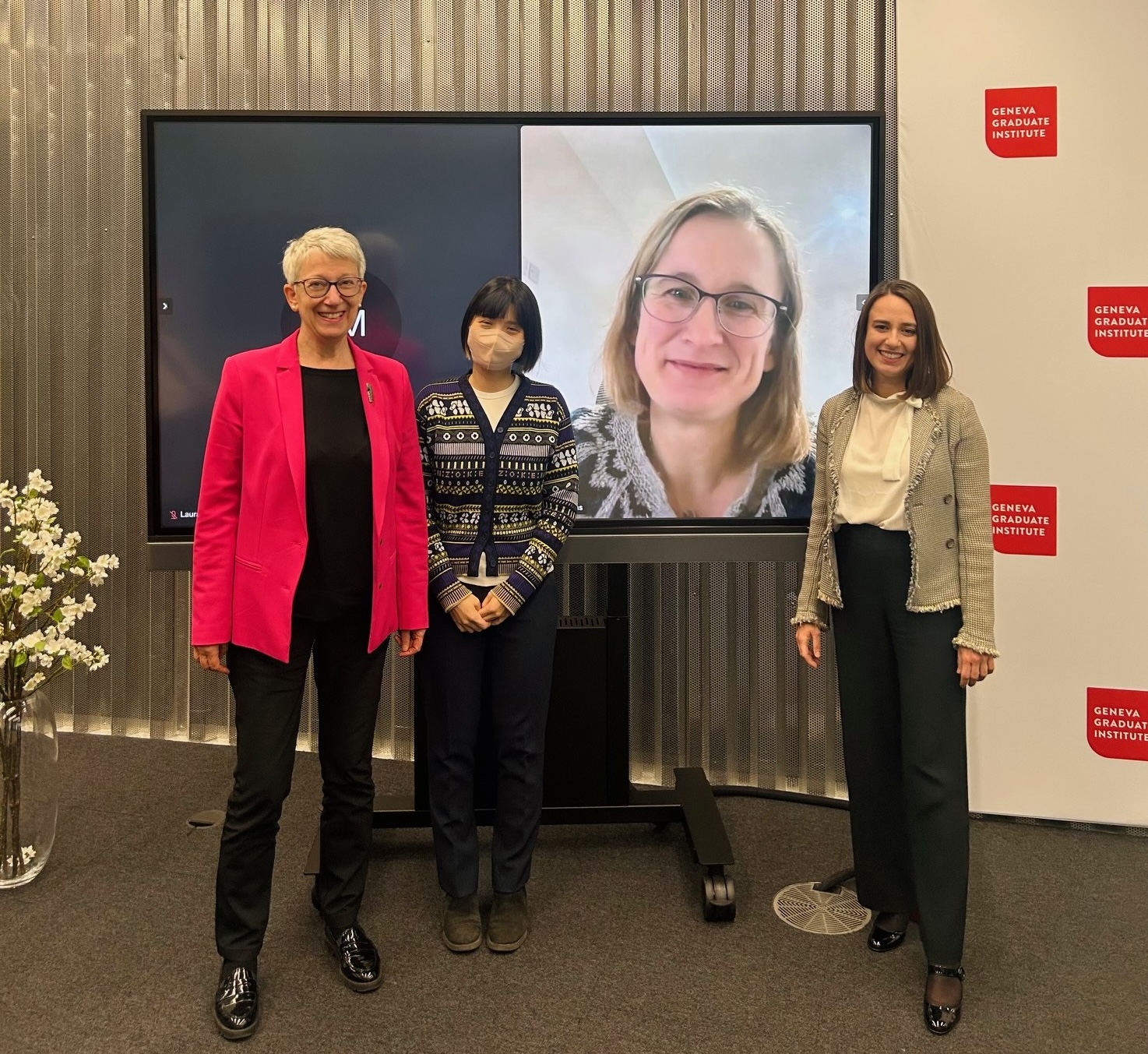
Luisa Lupo (right) defended her PhD thesis in International Relations/Political Science, titled “Cotton Wars: The Politics of Life and Labor in Southeast Turkey”, on 14 November 2025. Committee members were Honorary Professor Elisabeth Prügl (left), Thesis Director; Associate Professor Sung Min Rho (second from the left), President of the Committee and Internal Member; and Professor Juanita Elias, Politics and International Studies, University of Warwick, UK.
Citation of the PhD thesis:
Lupo, Luisa. “Cotton Wars: The Politics of Life and Labor in Southeast Turkey.” PhD thesis, Graduate Institute of International and Development Studies, Geneva, 2026.
Access:
An abstract of the PhD thesis is available on this page of the Geneva Graduate Institute’s repository. As the thesis itself is embargoed until January 2029, please contact Dr Lupo for access.
Banner image: Sweater of a school-aged girl who is accompanying her mother to the field during the 2022 cotton harvest, Şanlıurfa province, Türkiye. (Luisa Lupo ©)
Interview by Nathalie Tanner, Research Office.