


How did you come to choose your research topic?
There are really two answers to this question, because my thesis covers two different areas: development economics and political economy.
The development side goes back to when I was younger and spent six months after high school volunteering in Senegal. That got me thinking about how economic growth and life opportunities can be created for people, in particular in very remote villages with little infrastructure and few economic opportunities. Originally, I wanted to work on small business development and microcredit, but during the coursework phase of the PhD my interest shifted towards education policy, and in particular whether education actually pays off later in the labour market. The answer to that question is very clear in high-income countries, but sometimes much less so in low-income ones. Given that most of the existing work in economics at that time looked at primary schools, I decided to study secondary education instead, using a Ugandan programme that cut school fees. I wanted to know whether reducing secondary school fees actually has an effect, and if so, how large; who benefits from it, boys or girls; and which types of schools gain the most, private or public, urban or rural. I also plan in the future to look more directly at labour market outcomes rather than only education outcomes, but that will be a separate paper. After presenting that work to Lee Crawfurd at the Center for Global Development in London, I was asked to join the evaluation of a randomised controlled trial in Rwanda that trained primary school head teachers in management skills. I agreed, and I was able to carry out my own research relatively freely. The question was whether training head teachers has an effect on students’ learning outcomes, but also on the school and working environment for teachers. Most development programmes are very expensive and this one is not, so it was well worth testing whether it worked.
Alongside my interest in development economics and human capital, I have always been very interested in history and long-run social change. When I was looking for my third chapter, I was fortunate enough to join a project I had already worked on as a research assistant during my master’s. It asks to what extent the Dreyfus Affair, one of the moments when modern antisemitism became a mass political force in France, created social divisions, whether those divisions were still present forty years later, and whether they affected collaboration and resistance during the Second World War.
So overall, my PhD topics reflect my own interests over the last six years, but to some extent they also reflect the influence of all the amazing people and professors I have met during that time.
Can you describe each chapter?
In the first chapter, “Closing the Gender Gap: Public and Private School Subsidies in Uganda”, I ask to what extent a reduction in schooling costs helps boys and girls attend secondary education, and in which contexts that reduction helps most. School and registration fees are a real barrier at secondary level in low-income countries, much more so than at primary level.
I study Uganda’s Universal Secondary Education programme, introduced in 2007, which removed schooling fees at both public and private secondary schools. The challenge in measuring its effects is that the policy applied to the whole country at once, so there is no obvious comparison group. What I use instead is that districts differed in how exposed they were to the programme, and that only children of a certain age were young enough to benefit. Comparing those younger cohorts across more and less exposed districts gives me the effect of the policy.
On average the programme worked: it raised the chance of attending secondary school by six percentage points, the chance of completing lower secondary school by eight, and added about a third of a year of schooling. But the main finding is that this average hides almost everything interesting. Children living near a public school saw no improvement at all, while those living near a private school gained substantially, and among them girls gained 0.66 additional years of schooling compared with only 0.14 for boys.
There are several possible explanations. Demand for private schooling was higher, and public schools were already close to full when the policy began, so they could not absorb more students, whereas private schools had room. With my data I cannot fully explain why the gains are so much larger for girls than for boys, but I can show that distance also matters: the gains are concentrated among girls living within five kilometres of a private school. That leaves a difficult policy question at the end of the chapter: targeting fee reductions more narrowly, for example only at private schools or girls, would be more cost-efficient, but it also means deciding that some children receive help and others do not.
The second chapter, “Improving School Leadership in Rwanda”, written with Lee Crawfurd, Jocelyne Kirezi, Aimable Nsabimana and Jef Peeraer, moves from access to schools to the quality of schools. Most low-income countries have already achieved near-universal enrolment in primary education, so unlike at secondary level, the pressing problem is no longer getting children into primary school but how much they actually learn once they are there. We ask whether training head teachers to be better managers improves that.
Therefore, we evaluate a school leadership professional development programme rolled out to 525 primary schools in Rwanda’s six lowest-performing districts in 2018 and 2019. Because the schools were assigned to three cohorts at random, we can compare those that had already received the training with those still waiting for it.
The result on learning is a precise zero. We find no effect on pupil test scores, and no differences by pupil gender or by whether the school is government-run or privately managed. What we do find is on the teacher side: retention rose by five to six percentage points, meaning more teachers stayed at the same school the following year. Interviews conducted after the programme also suggest that head teachers were giving their staff more support, particularly new arrivals.
So the programme improved the working environment for teachers, but that did not translate into better results for pupils, at least within one to two years. The policy implication is not that leadership training does not work at all, but rather that we still do not know exactly what makes it work. Should more people in the school be trained rather than the head teacher alone? Should the training itself be designed differently? These are open questions. And they are worth answering, because the programme does have the potential to be highly cost effective, which is in particular important for implementing organisations.
Despite the null result on short-term test scores, the chapter was published last year in the Journal of Development Economics.
In my last chapter, “The Dreyfus Affair and the French Resistance”, written with Roberto Galbiati and Benjamin Marx, we ask whether deep social divisions still shape a society decades later. In the 1890s a Jewish army officer, Alfred Dreyfus, was wrongly convicted of treason, and the case split France in two: the Dreyfusards, who wanted a retrial and put justice above the reputation of the army, against the anti-Dreyfusards, who defended the army and the Church and whose newspapers made antisemitism a mass political force. Forty years later, under Nazi occupation, some municipalities produced far more resistance members than others. Our idea is that where the split ran deepest, people trusted each other less, and the Resistance depended on exactly that trust.
First, we collected new data on pro- and anti-Dreyfus activity across France. The two sides mobilised in the same places, which is what makes a place genuinely divided, and it is those places that produced less resistance activity during the war.
Second, showing that the divisions are causally responsible for the lower resistance activity is harder, so we rely on a second scandal. The Panama Canal Company had gone bankrupt and bribed politicians to hide it, and in 1895 the French antisemitic press published the names of every member of parliament involved. What we do is compare municipalities just inside the constituency of one of these named politicians with those just outside it, on the other side of the border. Two neighbouring villages a few kilometres apart are alike in almost every way, such as same region, same economy, same population, except that one lies in a constituency whose politician was named in the press and the other does not, so one was far more exposed to the scandal and to the antisemitic campaign built on it. And this is indeed what we find in our data: that exposure led to more polarisation, and in turn to less resistance forty years later.
The wider lesson is that polarisation has a cost that appears long after the conflict itself. A society that splits into two camps may find, decades on, that it cannot organise itself when it really needs to. So, this is worth keeping in mind as politics in many countries polarises again.
What bearing will your doctoral experience have on your career plans?
Honestly, that is a difficult question, because I do not yet know where my career will end up. What I can say is that the skills I use every day as a policy analyst at the OECD are the ones the PhD gave me: how to design a piece of research, how to work with data, and how to write and present so that other people can follow an argument. Some of that I could probably have learned elsewhere. But for research positions, whether in academia, in international organisations or in research institutes, the doctorate opens doors, and the training behind it is hard to replace. Last, it was also a real privilege to have the freedom to work on topics that fascinated me, while being paid to do so!
* * *
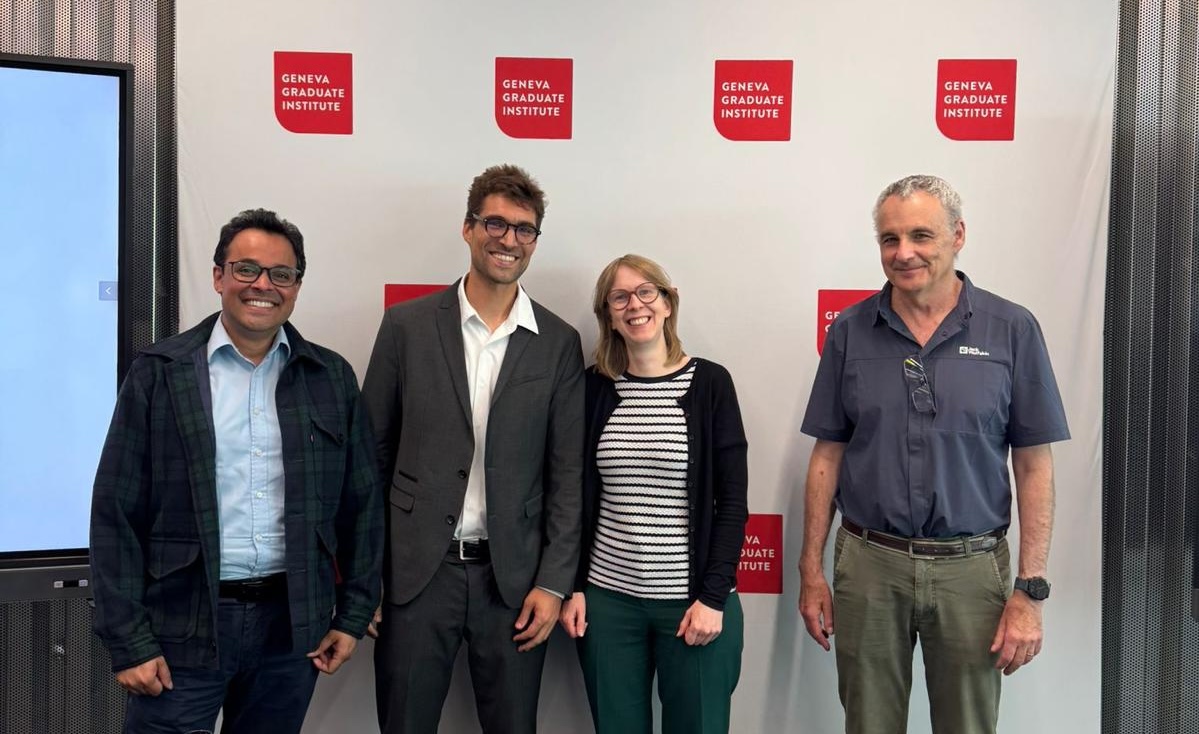
On 29 May 2026, Simeon Lauterbach (second from the left) defended his PhD thesis in Development Economics, titled “Three Essays in Development Economics”. He graduated summa cum laude with congratulations from the jury, which was presided over by Professor Nathan Sussman (right) and which included Professor Lore Vandewalle, Thesis Director, and Associate Professor Abhijeet Singh, Department of Economics, Stockholm School of Economics, Sweden.
Citation of the PhD thesis:
Lauterbach, Simeon. “Three Essays in Development Economics.” PhD thesis, Graduate Institute of International and Development Studies, Geneva, 2026.
Access:
The PhD thesis is publicly available on the Geneva Graduate Institute’s repository.
Banner image: Photo collage made from photos by SuSanA Secretariat (CC BY 2.0, via Wikimedia Commons) and by Henri Meyer (Public domain, via Wikimedia Commons).
Interview by Nathalie Tanner, Research Office.