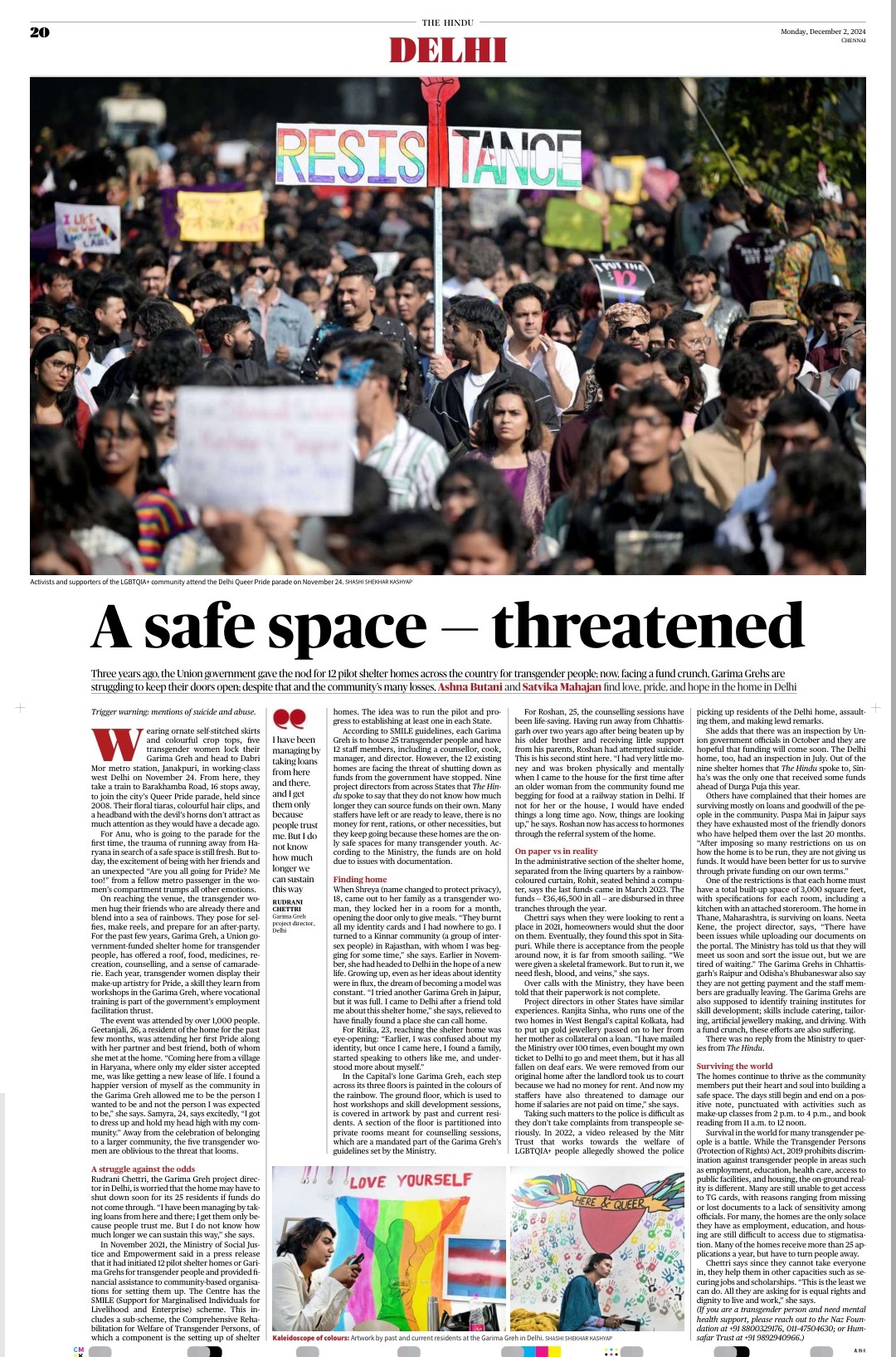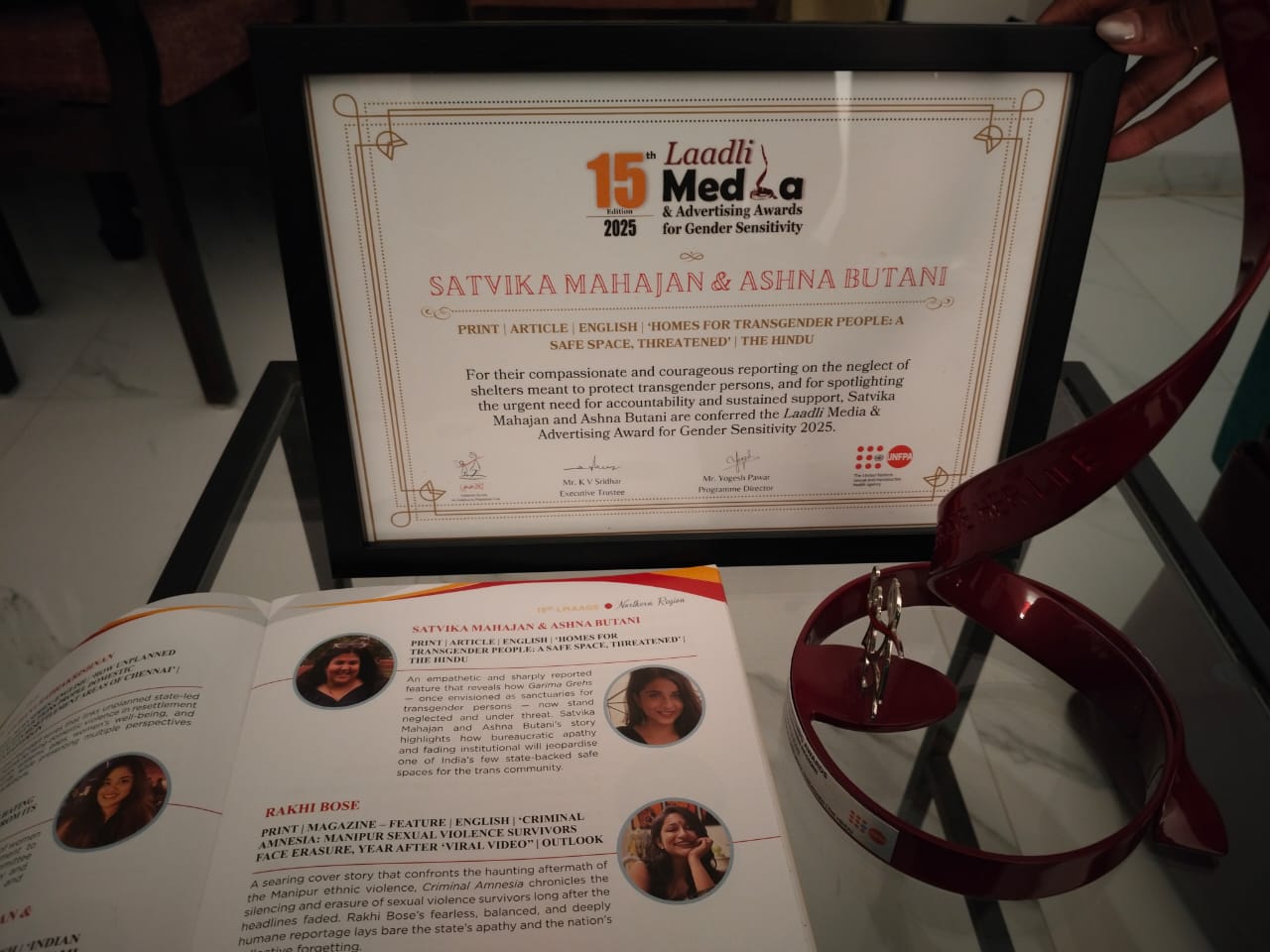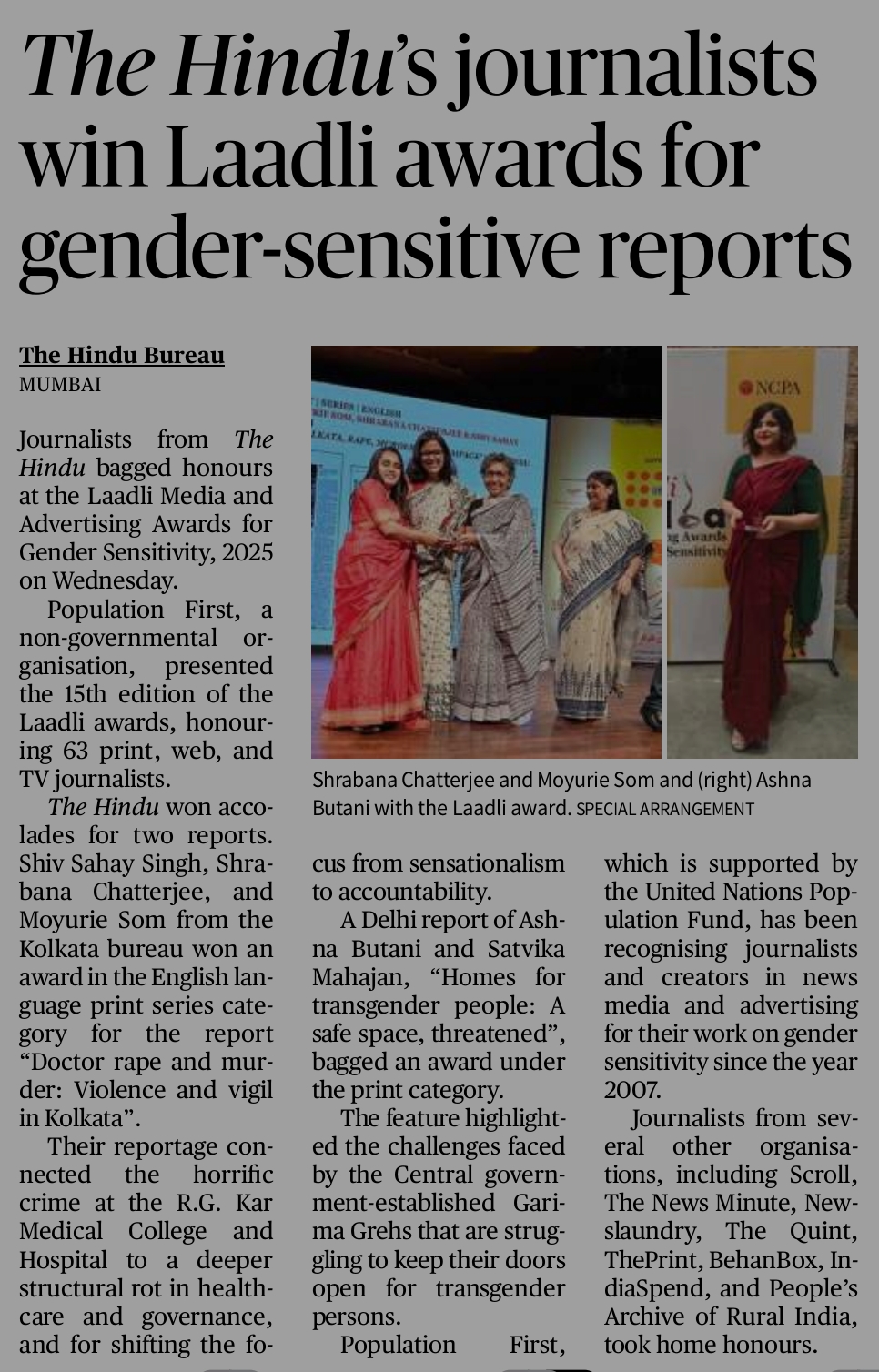


Satvika Mahajan, MINT student specialising in Gender, Race and Diversity is the recent winner of the Laadli Media Award for Gender Sensitivity 2025, granted by Population First and United Nations Populations Fund (UNFPA), for her journalistic work: “Homes for Transgender People | A safe space, threatened” published in The Hindu on 2 December 2024.
Mahajan’s article, co-written with her colleague Ashna Butani, centers on the story on the Indian Ministry of Social Justice and Empowerment pilot project - Garima Rehs - and 12 shelter homes for transgender youth across the country, and on how funding for the project was delayed and not distributed properly by the Ministry.
The Laadli Media Award celebrates gender-sensitive journalism, storytelling and communication. Specifically, it honors those whose work challenges stereotypes and amplifies the voices of women and gender-diverse communities. The 2025 award was particularly meaningful, marking 15 years of partnerships between Laadli and UNFPA, grounded in the shared conviction that communication can be a powerful force for gender justice. The winning stories shed light on gendered violence in digital spaces, women’s resilience in rural economies and inclusive narratives across science, cinema and public policy.
Mahajan discusses further:
What drew you to choose the MINT programme and the Gender, Race and Diversity Specialisation?
The MINT programme stood out to me because of how thoughtfully it is designed to engage students with international development and policy in a forward-looking way. It encourages critical engagement with global challenges and equips students to think about sustainable, future-oriented solutions. That forward-facing perspective of the MINT programme particularly attracted me to the Institute.
As for the Gender, Race and Diversity specialisation, I was eager to study these themes through the lens of international development. I wanted to better understand how gender, race and diversity shape, and are shaped by contemporary global dynamics and how they influence policy-making in the current world context
How has the specialisation shaped your perspective on gender, race and diversity in a global policy context?
During my first semester, Professor Aditya Bharadwaj guided us through a critical exploration of how gender, race and diversity operate as powerful social and political constructs. The course helped me understand why these categories matter now more than ever, and how they inform, shape and transform social structures across the globe.
Together with other courses I took during the semester, the specialisation strengthened my ability to critically assess policy interventions, institutional practices and public discourse. It pushed me to question whose voices are prioritised, whose experiences are marginalised, and how policies can either reinforce or challenge structural inequalities.
Have you been able to complement your interest in journalism with your current studies?
As a former journalist, when I began the MINT programme in September 2025, I had some apprehensions. I was concerned about whether I would be able to meaningfully connect my four years of field experience with the theoretical frameworks discussed in the classroom.
However, I found that my professional background significantly enriched my academic experience. Many professors were genuinely interested in engaging with students’ lived and professional experiences, creating space for dialogue between practice and theory. For example, a course I took with Professor Miloon Kothari on displacement, urbanisation and global development resonated with me. Having reported on development-led displacement during my time as a journalist, I was able to approach the subject from a practical perspective while also gaining a deeper theoretical understanding of the structural forces at play. The combination of experience and academic insight has been really valuable.
In what ways has the programme helped you think about your future career path, especially in journalism, advocacy or gender policy work?
Although I am still reflecting on my long-term career direction, the MINT programme and the Geneva Graduate Institute have significantly broadened my perspective. Being based in Geneva offers unique exposure to international organisations, advocacy networks and policy actors. The Institute frequently hosts conferences, panels and professional events that allow students to engage directly with practitioners in the field. These opportunities have helped me better understand potential career trajectories in journalism, advocacy and gender policy work, while also encouraging me to think more strategically about how to position myself within these spaces.
Do you feel the programme helped you connect to networks in Geneva — such as international organisations, NGOs or media — that supported your professional development?
Yes, the programme’s structure and location have provided meaningful access to professional networks in Geneva. The proximity to international organisations and NGOs, combined with the Institute’s events and academic environment, has facilitated valuable connections. In addition, student-led and institutional initiatives such as C4SI have further expanded my network and exposed me to professionals working across different sectors. These interactions have played an important role in supporting my professional development and broadening my understanding of opportunities in International Geneva.