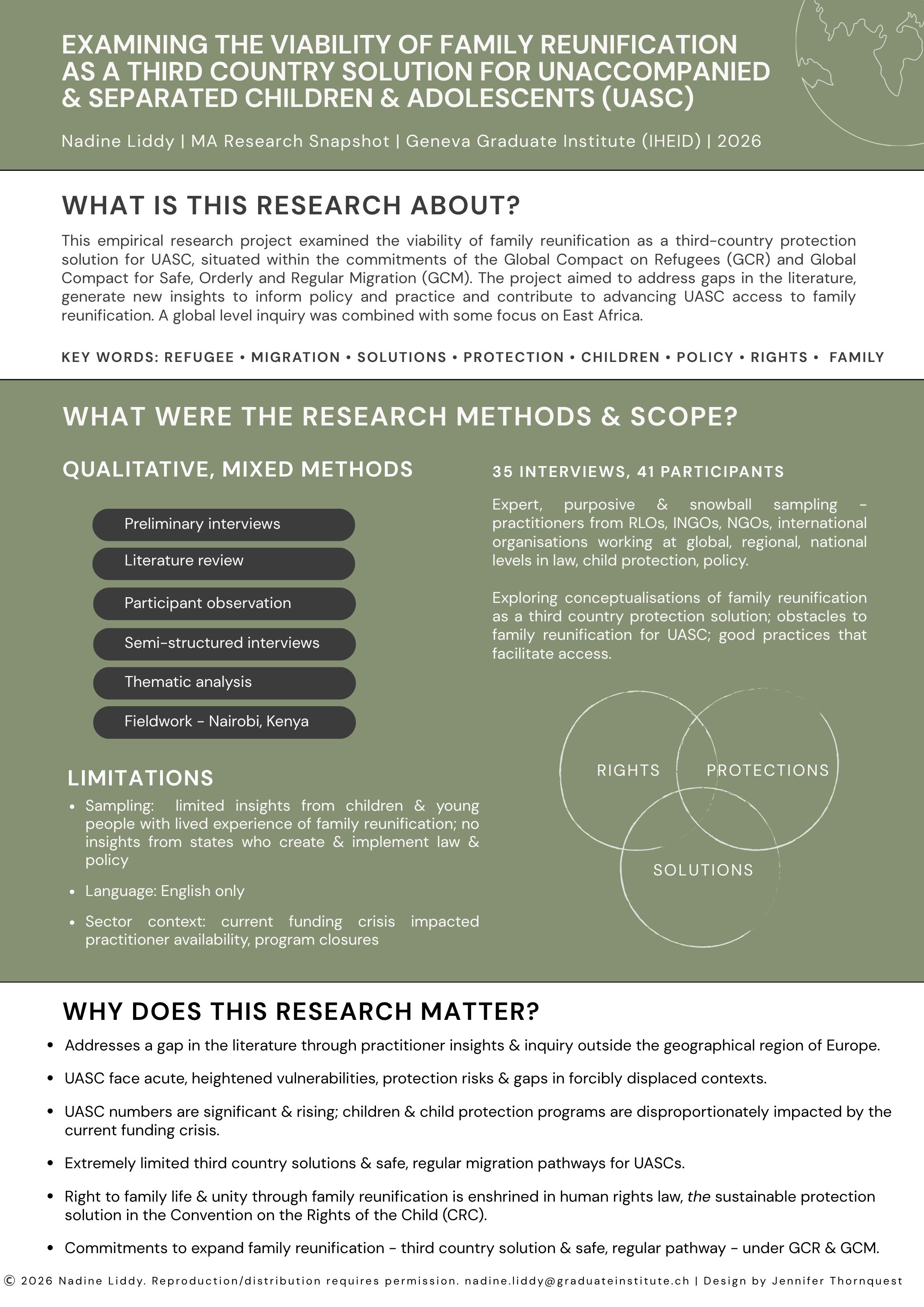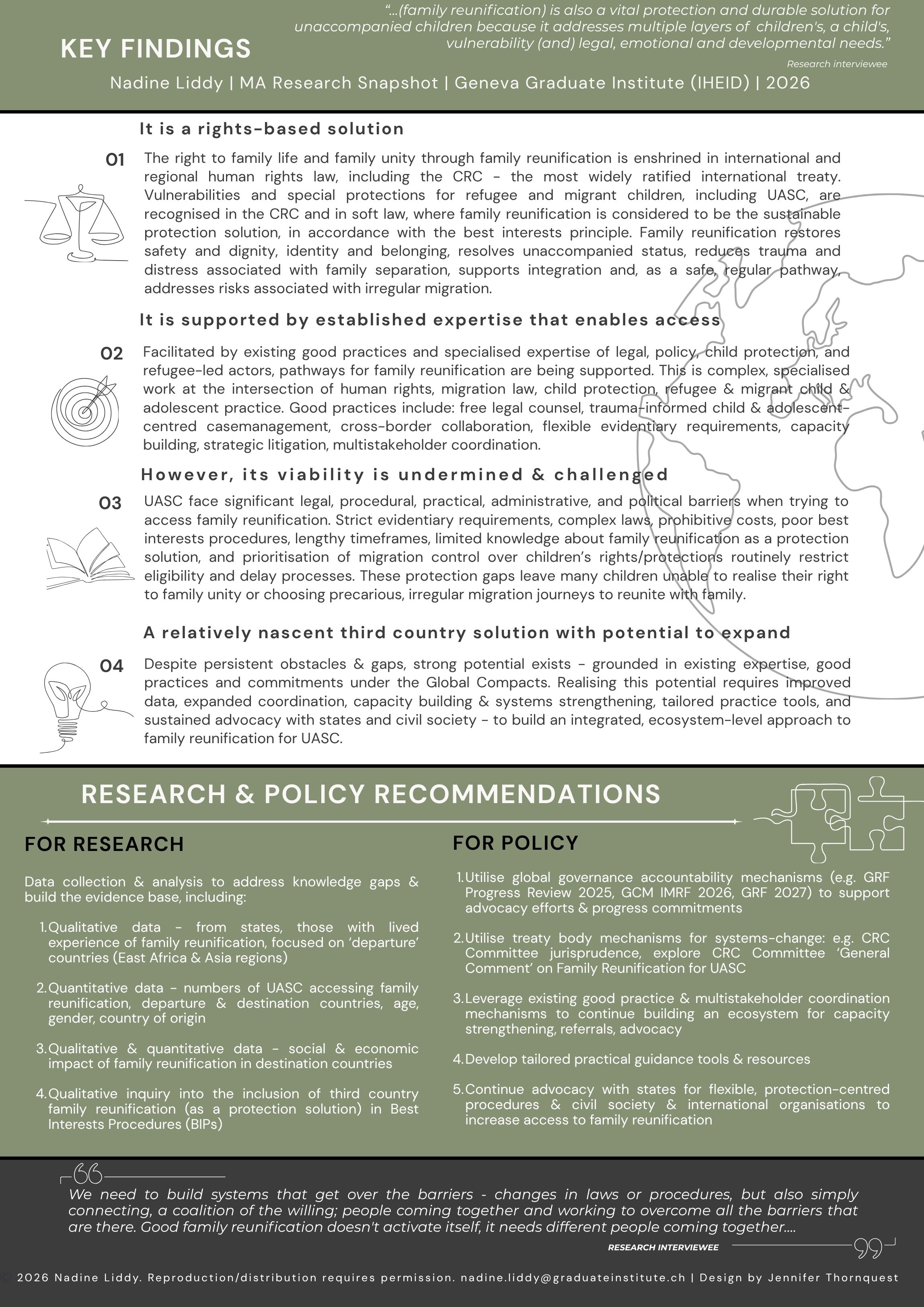


CCDP Research Associate and panelist Nadine Liddy shares her reflections from the discussion, drawing on her research on family reunification as a protection pathway for unaccompanied and separated children and adolescents.
As access to family reunification becomes increasingly restricted for refugees and people granted international protection, I’ve been reflecting on discussions at the Global Refugee Forum (GRF) Progress Review Linked Event — From commitments to action: advancing child rights and expanding access to family reunification, held at the Geneva Graduate Institute in December 2025.
Moderated by Prof. Vincent Chetail, the event was a spotlight on children’s rights and access to family reunification within GRF stocktaking efforts and the 2023 Multistakeholder Pledges on Child Rights and Family Reunification, creating an important space for dialogue across research, policy, and practice.
Opening remarks from UNHCR’s Assistant High Commissioner set a powerful scene: refugee children remain disproportionately represented in global displacement and face heightened vulnerabilities — particularly unaccompanied and separated children and adolescents (UASC). Amid shrinking resources, child protection programmes are under strain and disproportionately impacted. The effects of family separation on children’s health, development, and education are profound. Realising the right to family unity through family reunification — where it is in the child’s best interests — is a protection imperative enshrined in human rights law. It is foundational to long-term psycho-social wellbeing and integration.
I was honored to join colleagues from Government of Uganda, UNICEF Kids in Need of Defense (KIND) and Plan International, as a panellist sharing findings from my recent empirical research examining the viability of family reunification as a protection solution for UASC.
A few reflections from the discussion that resonated with my practitioner-focussed research:
- Securing sustainable protection solutions for UASC is urgent and complex The convergence of rising global numbers of forcibly displaced children, their acute vulnerabilities and protection risks, safeguarding complexities, and a retreat from normative frameworks has amplified protection gaps and the urgency and complexity of securing solutions.
- Family reunification is one of the few third-country pathways available With significantly reduced resettlement quotas and education or labour ‘complementary’ pathways largely inaccessible to unaccompanied children, family reunification remains a protection imperative.
- Policy environments are uneven Restrictive legal and policy frameworks in parts of the US and Europe continue to limit access, underscoring the need for sustained and evidence-based advocacy.
- Significant expertise and good practices exist but require scale and investment These include pro bono, child and adolescent-friendly legal aid, trauma-informed case management, robust best-interest procedures, capacity strengthening, cross-border collaboration, flexible evidentiary requirements, strategic litigation, and refugee-led organisations in facilitating access to FR.
- Systems approaches matter Lessons from Uganda highlighted the importance of integrating refugee protection into national child protection systems and investing in early identification and community-based care models.
- Children and adolescents must shape the agenda Hearing directly from young people was a critical reminder that policy and programming must value their perspectives and reflect their lived realities.
- Research and data are essential for policy influence Greater investment is needed in both quantitative and qualitative evidence on family reunification for UASC, and in translating research into accessible, actionable formats.
- Opportunities under the GRF and GCM Accountability mechanisms under both frameworks can promote good practice and advance the right to family unity through family reunification.
In an increasingly challenging policy and urgent protection environment, discussions that bridge research, policy and practice are vital. Strengthening the evidence base on family reunification for refugee and migrant children, including UASC, remains central to rights-based policy and practice.