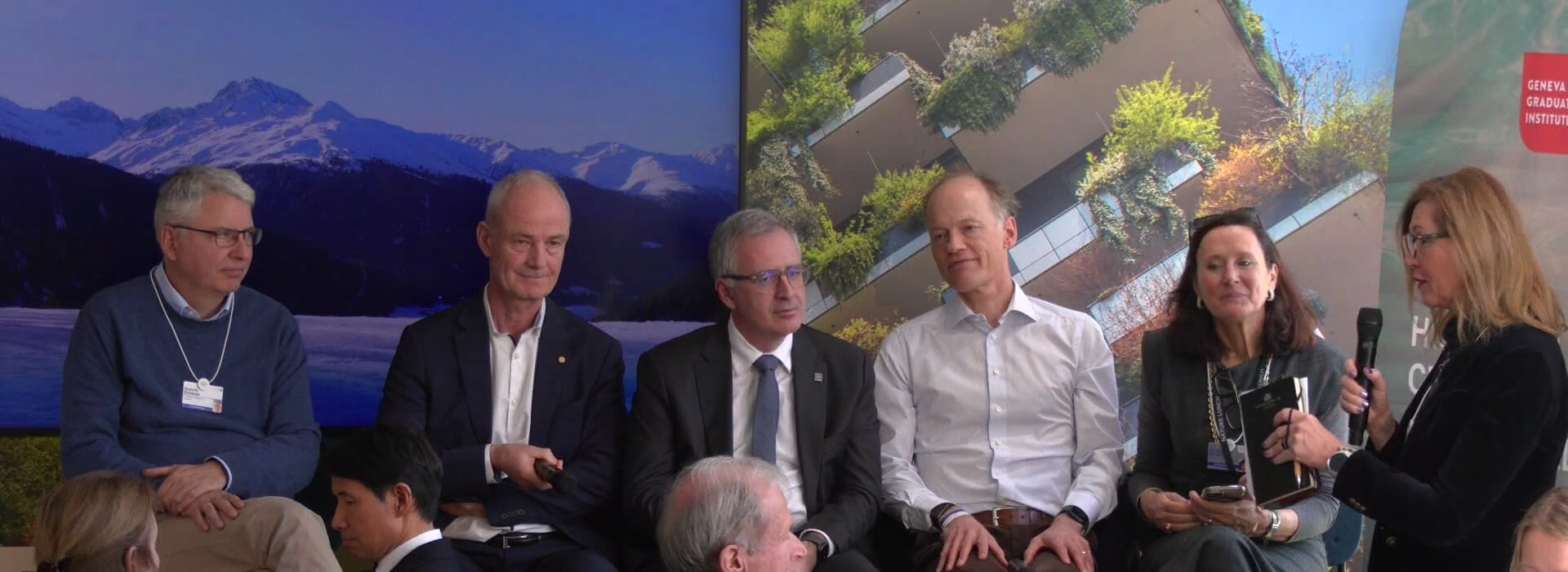


At the heart of the week’s events for the Institute was the Hoffmann Centre’s “Restoring Trust: Strengthening Cooperation and Building the Conditions for Enduring Peace”, an interactive panel and working lunch hosted and moderated by Beatrice Weder di Mauro, Co-Director Hoffmann Center for Global Sustainability , on Thursday, 22 January at the InTent at Davos. The event examined the ways in which the international community can move from intent to action in restoring trust in the international system, strengthening cooperation, and laying the groundwork for a less hostile world.
The session featured speeches from Sergei Guriev, Dean of London Business School and CEPR Fellow; Gilles Carbonnier, Co-Director of Executive Education at the Geneva Graduate Institute and Vice-President of the International Committee of the Red Cross (ICRC); Severin Schwan, Chairman of Roche; Martin Sandbu, European economics commentator at the Financial Times; Sebastian Mallaby, Paul A Volker Senior Fellow and US Council of Foreign Relations; and Sandrine Dixson-Declève, Honorary President/Global Ambassador, The Club of Rome.
The session broke out into five table discussions: “Lessons for Academia” facilitated by Dominic Rohner, Co-Director Hoffmann Center for Global Sustainability and CEPR Fellow; “Lessons for Governments” by Sergei Guriev; “Lessons for Business” by Marie-Laure Salles, Director of the Geneva Graduate Institute; “Lessons for Multilateral Institutions” by Naoko Ishii, Professor at Tokyo University and Former CEO Global Environment Facility; and “Lessons for Civil Society” by Ioana Popp, Managing Director of the Hoffmann Centre for Global Sustainability.
Looking back at the event, Beatrice Weder di Mauro said, “The breakdown of trust is systemic: it affects institutions, the multilateral order, and relationships among allies themselves. Yet without rebuilding trust, we cannot sustain the global commons, defend democracy, or prevent conflict. This is one of the defining challenges of our time.”
The Hoffmann Centre’s participation in Davos 2026 also consisted of Beatrice Weder di Mauro’s participation in 30 high level events at the Congress Centre, throughout the week. Additionally, Ioana Popp moderated the philanthropy workstream during the collaborative session “Beyond Our Bubble: Climate & Nature Messages that Resonate (And Why)” organised by the Nature and Climate Impact Team, University of Exeter and the Sunway Centre for Planetary Health, and delivered firestarter remarks at the closed-door roundtable “Advancing Net Zero and Nature Positive in a Polarized World: One Year On” organised by Marco Lambertini's Nature Positive Initiative.
Achim Wennmann, Director for Strategic Partnerships, attended “Engaging the Private Sector in Humanitarian Contexts”, organised by the Swiss Agency for Development and Cooperation (SDC) with the World Economic Forum (HRI) and the Global Shapers Community in the WEF House of Switzerland.
–
While Davos is meant to bring global leaders together to peacefully and diplomatically address key global and regional issues, Davos 2026 was exceptional due to the participation of Donald Trump, President of the United States, who used the meeting to aggressively criticise allies and to launch his new “Board of Peace”, which undermines the international community. In an interview with Léman Bleu, Marie-Laure Salles described the Board of Peace as “authoritarian unilateralism – ultimately with a lord and vassals – the absolute opposite of multilateralism and of the reforms towards greater inclusivity that it badly needs.”
Looking back at the week, Marie-Laure Salles stated that Davos was a “moment of clarity, a moment of realisation that we are entering a new geopolitical era” where she believed that “for the first time, heads of state and economic leaders realised that the world as we’ve known it will not return.”