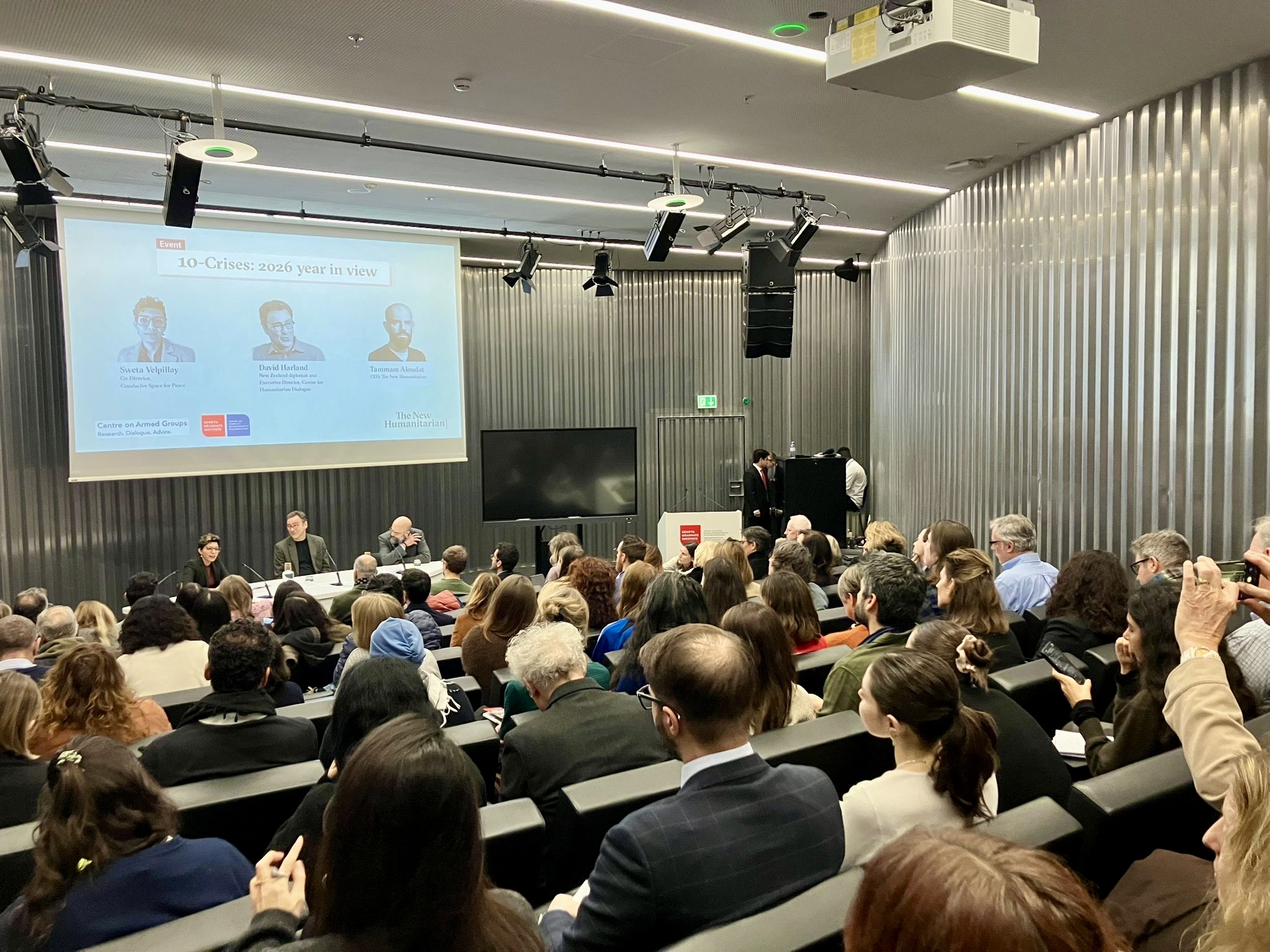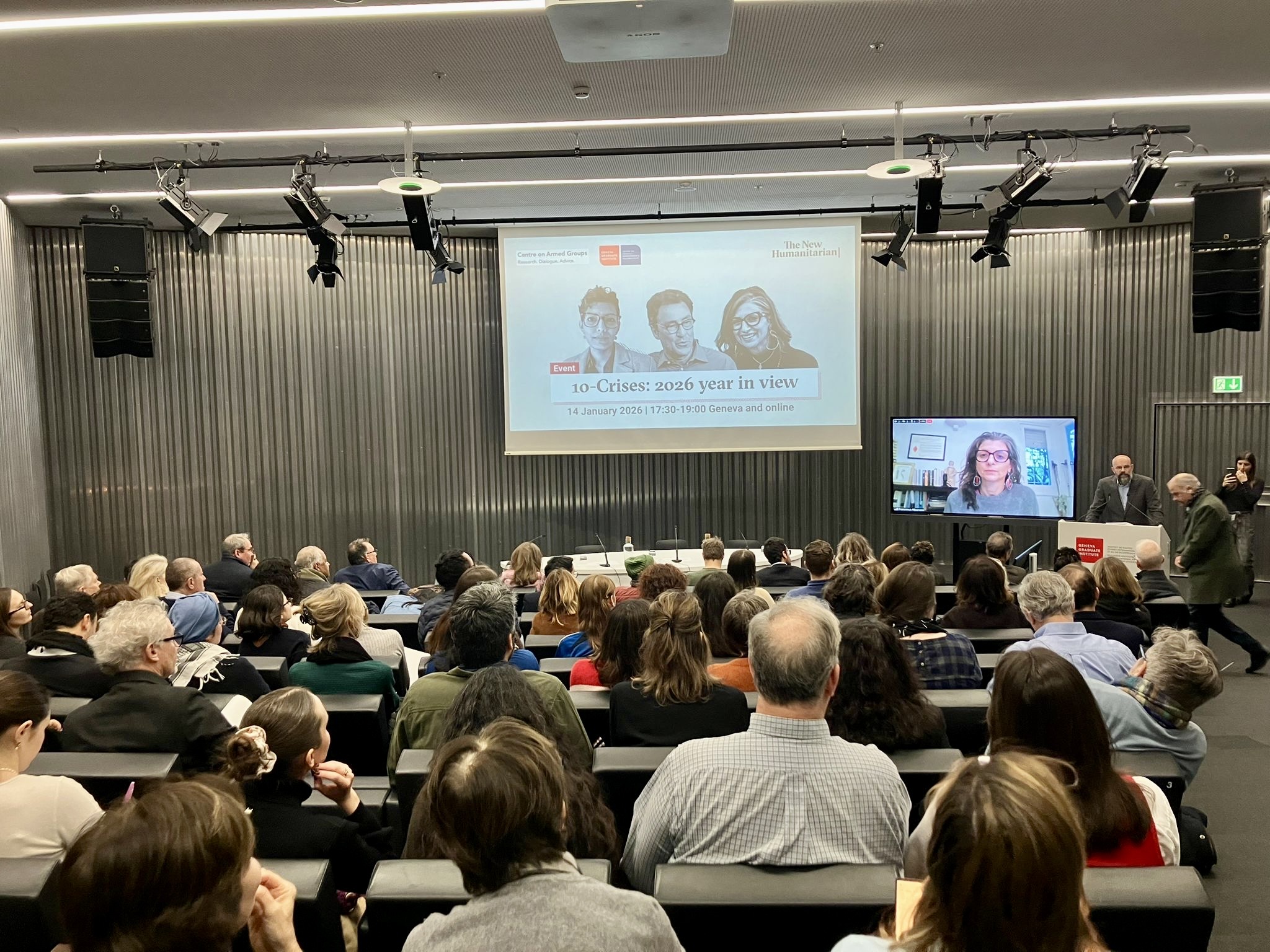



On 14 January 2026 The New Humanitarian (TNH), together with the Centre on Conflict, Development and Peacebuilding and the Centre on Armed Groups convened a conversation bringing together leading voices from across the humanitarian and peacebuilding sectors.
Ahead of the event, the team of editors from TNH forecasted troubling trends shaping 2026 will include resurgent HIV, the global gender backlash, deal-making replacing peacemaking, and migration all in a time of far-right populism. The discussion asked what political decisions, policy gaps, and structural mechanisms are driving these trends and what might be done to “shift the dial”?
The panel was facilitated by Tammam Aloudat, CEO of The New Humanitarian, whose opening remarks set an honest tone. Referencing his own notes, he acknowledged his own reminder to speak with some hope alongside moderating this conversation on the world’s most severe crises. I found this moment striking.
A central moment of the discussion was the participation of Francesca Albanese, international lawyer and UN Special Rapporteur on the Occupied Palestinian Territories. Her presence underscored the gravity of the current global context. As "military strength replaces multilateralism" she pointed to what she described as a growing global movement for human rights, urging humanitarian actors to reclaim their foundation. She said, “In my view, [humanitarian organizations] need today more than ever to critically reassess their role and consider, or conceive, their impact in a [more] holistic way.”
Contrasting but complementary perspectives followed. Sweta Velpillay, Co-Director of Conducive Space for Peace, urged participants to locate hope within their own communities and to engage with grassroots movements as sites of agency and solidarity.
David Harland, Executive Director of the Centre for Humanitarian Dialogue, pushed for broader horizon-scanning. He encouraged the audience to look beyond Europe to China or the Gulf States, and consider how these global actors are shaping humanitarian and mediation practices. Are there lessons to be learned there?
If there was an unintended call to action, it lay in this tension. For many in the room, the discussion landed less as a call to action and more as a prompt for responsibility. The takeaway was clear: those with privilege, access, or platforms cannot afford paralysis.
From my perspective as a researcher and podcast host interviewing leaders in the conflict and peacebuilding sector at the CCDP, this insistence on looking for hope, even when conditions are constrained, feels less aspirational than necessary.
It also resonates strongly with my own research.
My work points repeatedly to a form of “keep going” in conflict and post-conflict areas that characterizes localized peacebuilding initiatives. This is often visible in community-led projects, cultural practices, and artistic forms that sustain relationships, reinforce dignity, and create space for resilience when formal processes stall.
Overall, the 10 Crises 2026 conversation did not offer easy answers. Instead, it modeled something arguably more important: how to hold analytical clarity alongside the human need to not sink into despair. It was a good example of how to speak about hope without denying harm, while at the same time insisting that the work ahead may be uncertain, but inaction is not neutral.
The Centre on Conflict, Development and Peacebuilding is grateful to have co-hosted this exchange and to be part of a wider community committed to sustaining critical reflection and action in a deeply unsettled world.
This event was convened by The New Humanitarian in collaboration with the Centre on Armed Groups and Centre on Conflict, Development and Peacebuilding.