


How did you come to choose your research topic?
The project grew out of three related puzzles. First, I was dissatisfied with the conventional account of pre-liberalisation India as a “socialist” economy characterised by excessive state intervention, regulatory inefficiency, and an unproductive public sector. Even more sophisticated versions tended to work backwards from economic outcomes and reduce complex processes of policymaking to identifiable policy failures, leaving less visible how policies were actually negotiated, implemented, and contested. Second, I was struck by the growing tendency to explain regional inequalities through a South–North divide without paying enough attention to the historical processes that had produced those divergent trajectories. When I began thinking seriously about a historical study of the postcolonial economy, there was therefore a particularly interesting gap to explore: the emerging scholarship on independent India had not yet been matched by enough archivally grounded economic history, especially work attentive to the role of regional governments and political actors.
That combination led me to Madras. It offered a particularly revealing vantage point from which to study economic policymaking as something shaped not only at the national level but also through State governments, regional political forces, and their negotiations with the Centre. By following these processes across food, textiles, planning, and federal finance, I could recover the political and institutional complexity behind economic policies while also asking how regional experiences shaped the working of the Indian economy and federal system.
Can you describe your research questions and the methodology you use to approach those questions?
The thesis asks how economic policymaking and regional state-making interacted in independent India, and more specifically how regional governments navigated the constraints of a centralising, planning-led order. I distinguish economic planning from the broader field of economic policymaking: while planning refers to the institutional machinery through which national priorities and resources were organised, policymaking encompasses the wider processes through which those priorities were interpreted, translated into policy, and debated across different political arenas. I use the concept of regional state-making to describe the efforts of elected State governments to expand their practical capacity to govern within this framework and to negotiate the responsibilities they bore towards the populations they governed.
The analysis takes Madras as its analytical vantage point and follows these processes through food, clothing, and federal finance. The research is based on extensive archival work in India and the UK, bringing administrative correspondence, legislative assembly debates, newspapers, party publications, private papers, and Tamil-language political and cultural material into conversation with one another. Reading these sources together allowed me to connect formal institutions and policy decisions with the political and social worlds in which economic policy took shape.
What are your major findings?
The central finding is that economic policymaking was one of the defining arenas in which federal relations were worked out in practice. The experience of Madras reveals this through three different problems: in food policy, the State government had to ensure affordable supplies while depending on the Centre for grain allocations and other key decisions; in textiles, handloom producers faced shortages of yarn despite the region’s importance as a producer; and in finance, developmental and welfare responsibilities outstripped the resources and fiscal autonomy available to the government.
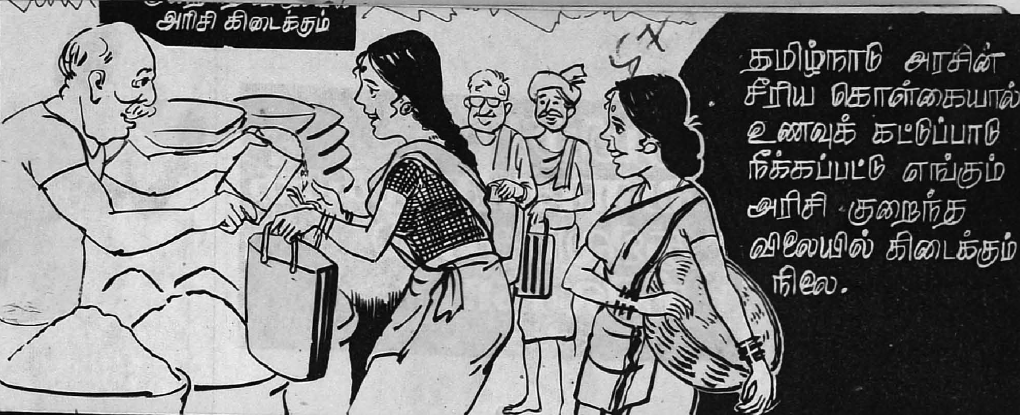
“Rice is available —Thanks to the Tamil Nadu government’s effective policies, food controls have been lifted, and rice is now widely available at affordable prices.” In Tamilarasu, the Tamil Nadu government’s official journal, 1 & 16 February 1971 issue. Tamil Digital Library.
These were not just administrative difficulties; Congress governments negotiated within these constraints, while the Dravida Munnetra Kazhagam (DMK, Dravidian Progressive Federation) and the Communist movement interpreted them through different political traditions. The DMK, in particular, connected material grievances to a broader language of Tamil cultural dignity, recognition, and autonomy.
Viewed together, these cases show that regional governments were neither passive implementers of national policy nor fully autonomous actors. They actively negotiated how national economic priorities would be implemented within the State, seeking through political bargaining and administrative action to expand their room for manoeuvre. The thesis therefore argues that the practical boundaries of Indian federalism were constituted not only through constitutional arrangements, but through these everyday encounters over resources, responsibilities, and the capacity to govern.
What social and political lessons for our time could be drawn from your historical analysis?
One lesson is that apparently technical questions of economic policy and resource allocation can also become questions about political voice and the terms of belonging within a diverse polity. The history of Madras shows how material disputes were repeatedly translated into broader claims about dignity, fairness, and the legitimate place of the State within the national political order. This is particularly relevant today because political actors in Tamil Nadu continue to activate historically sedimented experiences and repertoires of negotiating with the Centre when responding to new conflicts over resources, policy, and representation.
At the same time, this continuity should not be mistaken for simple repetition. The political and institutional circumstances have changed, but earlier struggles left behind ways of interpreting new conflicts and connecting material questions to claims about cultural recognition and regional autonomy. The broader lesson is therefore not that the past determines or structures the present, but that political actors inherit and reactivate older ways of making claims, adapting them to new circumstances.
How might India’s federal system accommodate growing disparities between its states at a time when questions of political representation and fiscal distribution are becoming increasingly contentious?
The impending delimitation of parliamentary constituencies has brought this question into sharp relief. States that have pursued successful population stabilisation now face the possibility that their demographic trajectories could reduce their representation in Parliament, while differences in States’ economic capacities and contributions have also made the distribution of fiscal resources increasingly contentious. Although my thesis does not address these contemporary questions directly, its historical analysis offers a useful perspective on them: the making of Indian federalism has repeatedly involved negotiating how differences between regions are translated into claims over political representation, economic resources, and the authority to govern. What is at stake today is therefore not simply the adjustment of a few distributive formulas, but how a highly diverse federation can reconcile changing demographic and economic realities without unsettling the political basis of its federal compact.
What bearing will your doctoral experience have on your career plans?
The PhD has given me a very particular way of doing research that I want to carry forward: conducting in-depth archival work guided by broader questions about political economy and institutional configurations, while never losing sight of the cultural dimensions of economic life and political conflict. My supervisor, Prof. Gopalan Balachandran, repeatedly reminded me during the PhD that human experience is too rich to be neatly contained within analytical categories, a lesson that has stayed with me in thinking about how historical evidence should be interpreted. Working alongside colleagues with diverse national backgrounds and transnational academic trajectories in Switzerland further changed how I approach history in general, making me more attentive to connections that cross national boundaries.
My next project, which I hope to pursue as a postdoctoral researcher, takes this approach into the history of territorial reorganisation in South India, examining how the remaking of internal boundaries altered the material and economic arrangements on which governance depended. The doctoral training has taught me to move between different scales of analysis, using regional histories to illuminate national processes and placing both in conversation with wider histories where the questions demand it. More broadly, I hope to build on this training in my academic career by continuing to pursue economic history while allowing my research questions to lead me across geographical scales and into new historical problems.
* * *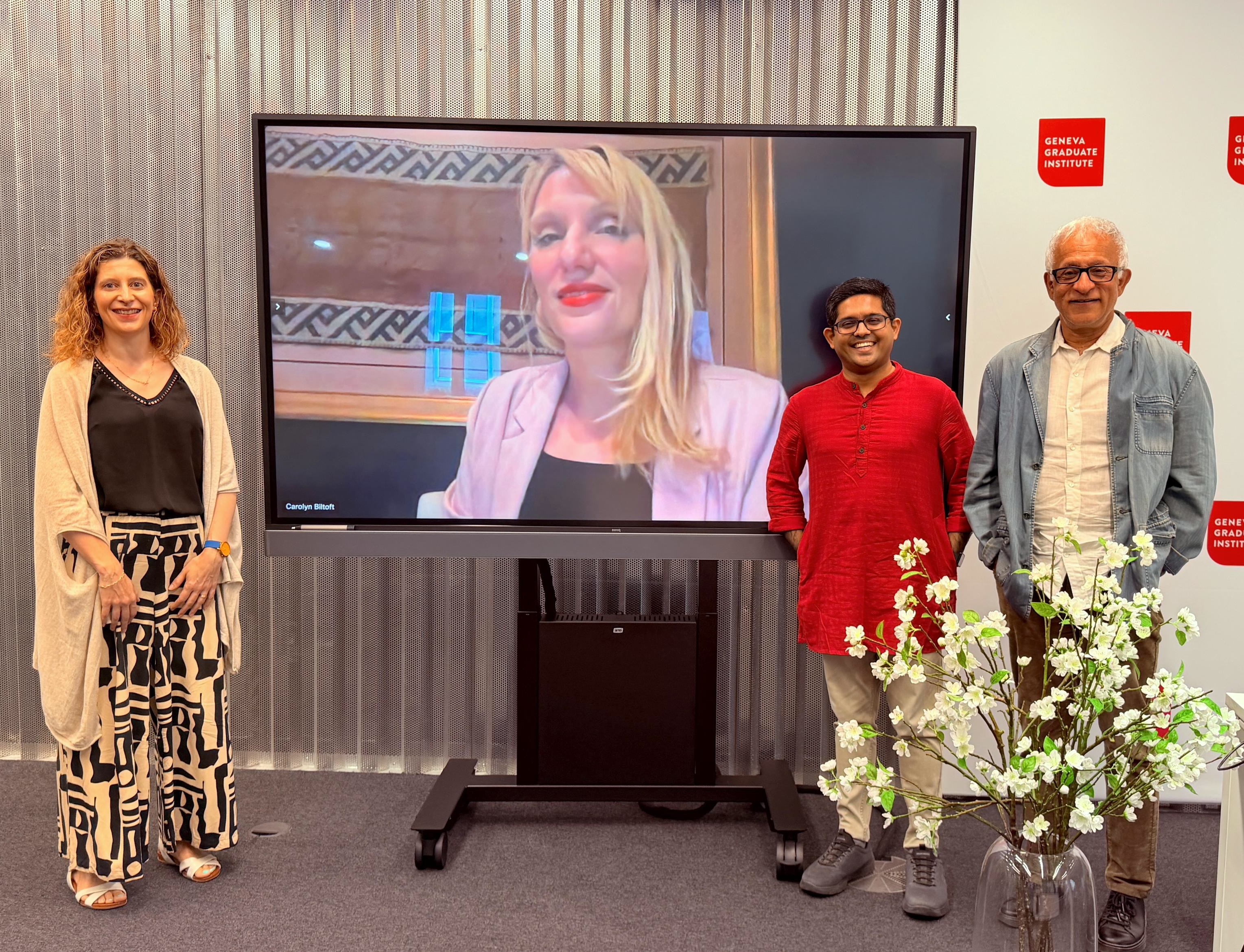
On 18 June 2026, Raghunath Nageswaran defended his PhD thesis in International History and Politics, titled “Economic Policymaking and Regional State-Making in Independent India: Madras State, c. 1947–1976”. Committee members were Honorary Professor Gopalan Balachandran (right), Thesis Director; Associate Professor Carolyn Biltoft (second from the left), President of the Committee and Internal Member; and Professor Louise Tillin, External Examiner, Faculty of Social Science & Public Policy, King’s College London, UK.
Citation of the PhD thesis:
Nageswaran, Raghunath. “Economic Policymaking and Regional State-Making in Independent India: Madras State, c. 1947–1976.” PhD thesis, Graduate Institute of International and Development Studies, Geneva, 2026.
Access: An abstract of the PhD thesis is available in the Geneva Graduate Institute’s repository. As the thesis itself is embargoed until June 2029, please contact Dr Nageswaran for access.
Banner image: Chief Minister C.N. Annadurai presenting the annual budget at the Tamil Nadu Legislative Assembly on 17 June 1967. Tamil Digital Library.
Interview by Nathalie Tanner, Research Office.