


How did you come to choose your research topic?
When taking a class on education and development at the Geneva Graduate Institute, I chose to focus on the secondary education of girls in Tajikistan for several assignments. Through this work, I learned about the specific barriers and challenges that those girls face in accessing education. Analysing these difficulties and inequalities deepened my interest in girls’ and women’s education and strengthened my commitment to promoting their access to educational opportunities.
At the same time, news reports were highlighting the increasingly severe restrictions imposed by the Taliban on girls and women in Afghanistan, including their access to education. Afghanistan became the only country in the world where girls are prohibited from attending secondary school, such that by 2024, 1.4 million girls and women were banned from education, rising to 2.2 million in 2025. These developments convinced me that urgent attention and action are needed to support the efforts of women to continue pursuing education and assert their rights.
When exploring this issue, I was both astonished and impressed to find that several non-governmental organisations (NGOs) were still running educational initiatives, providing alternatives to formal schooling for girls and women in Afghanistan. This motivated me to study these organisations to understand how their efforts could be replicated or scaled up to reach as many women and girls as possible.
Can you describe your thesis questions and the methodology you used to approach those questions?
My goal was to analyse the challenges faced by NGOs providing education to girls and women in Afghanistan and to explore how these organisations are able to sustain and, in some cases, expand their operations despite operating in such a fragile and insecure environment.
To that end, my research questions were aimed at uncovering the resources and adaptive capacities that these NGOs rely on to maintain their educational programmes and build organisational resilience. Drawing on Singh et al. (2022), “adaptive capacities” refer to the resources organisations possess and their ability to use these resources flexibly and strategically in response to challenges and shocks. Additionally, my thesis investigates the strategies that NGOs deploy to strengthen their resilience, analysing more closely how adaptive capacities and resources are translated into concrete actions. For this, I drew on Szemző et al.’s (2022) framework on resilience strategies. Overall, my conceptual framework is grounded in organisational resilience theory and adaptive management theory, which I applied to NGOs in crisis and conflict-affected settings.
Methodologically, I conducted semi-structured interviews with eleven individuals who worked for an organisation offering education to girls in Afghanistan. The interviewees included both leadership and operational staff, allowing me to capture perspectives across organisational levels. Given the sensitive context, I ensured complete confidentiality and anonymity to protect the participants and their organisations.
What are your major findings?
In practical terms, I found that NGO team members are at the heart of sustained educational initiatives, as they often work for free or with very little pay, at times even risking their own lives. For many, intrinsic motivation is partly rooted in their personal connection to Afghanistan. The findings also show that a supportive team environment, open communication, as well as the opportunity to access psychological support are vital for the well-being of staff.
To reach as many girls as possible, some NGOs work with digital solutions, particularly those accessible with mobile phones, delivering classes via WhatsApp, YouTube, self-learning apps or AI tools. At the same time, offline alternatives, such as hard-copy learning materials, remain essential given the slow, expensive and limited internet connection in Afghanistan.
My study further revealed that NGOs often form partnerships to combine complementary expertise and benefit from one another. For example, one organisation may provide technological infrastructure while another one develops course content. Collaboration between local and international organisations may be especially rewarding, as international actors can ensure funding and visibility, while local organisations are able to contribute local knowledge and are often trusted by local communities. Importantly, international actors should always ensure the independence and flexibility of local organisations, who best understand the local context.
Financial constraints emerged as one of the organisations’ biggest challenges. To cope, NGOs try to diversify their funding through small grants, crowdfunding, campaigns, and individual donors. Yet, financial struggles persist, highlighting the need for reliable long-term support from international actors.
For organisations operating on the ground, another constant concern is safety, given, for instance, Taliban inspections in underground schools. Many NGOs have established security protocols, such as disguising classrooms as Quran study groups, while local communities often provide essential protection by not exposing their members to the Taliban. Generally, NGOs highly depend on local knowledge and people on the ground who understand the context and can navigate the grey areas of Taliban policies.
Regarding the theoretical framework, the study demonstrates that resilience is built continuously by mobilising limited resources through adaptive capacities. These capacities translate into three interlinked strategies as suggested by Szemző et al. (2022): adaptability, diversification and ecosystem-building. Adaptability refers to NGOs reacting flexibly to changing circumstances and risks in the short term. Diversification involves building new learning modalities, tapping into financial sources, and establishing additional partnerships. Lastly, ecosystem-building, the most long-term strategy, refers to NGOs engaging in ecosystems and alliances to build a support network beyond individual partnerships. I found that these strategies are mutually reinforcing, meaning that deploying one strategy often leads the opportunity to develop another one. In this way, NGOs are able to continuously build and sustain resilience in challenging environments.
What are you doing now or going to do?
While writing my master thesis, I did an internship at the Swiss Embassy in Colombia, which ended in January. In March, I will work as a project associate with International Organization for Migration (IOM) Sri Lanka in Colombo in the context of the Swiss-funded UN Youth Volunteers programme.
* * *
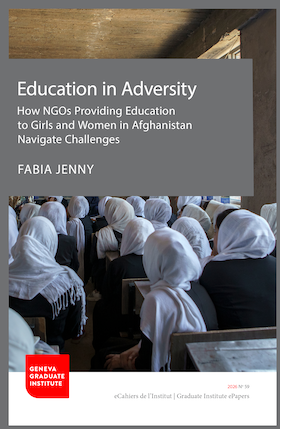
In 2022, the Taliban prohibited girls and women in Afghanistan from attending secondary school. Still, a range of NGOs continues to provide educational opportunities. This study examines how these organisations navigate challenges and build organisational resilience in fragile and high-risk environments. Eleven interviews with NGO representatives were conducted. The findings reveal that NGOs rely on interlinked adaptive capacities, defined as resources and the ability to mobilise them, and resilience-building strategies, understood as concrete strategic actions enabled by these capacities, to respond to external challenges and build resilience. In practical terms, this study emphasises the importance of fostering intrinsic motivation and psychological well-being among volunteers and staff, promoting collaboration among organisations, and strengthening local grassroots efforts. It further highlights the role of local actors, especially women, in ensuring context-sensitive programme design and implementation. These insights contribute to a deeper understanding of how NGOs adapt to sustain education in crisis settings.
How to cite:
Jenny, Fabia. Education in Adversity: How NGOs Providing Education to Girls and Women in Afghanistan Navigate Challenges. Graduate Institute ePaper 59. Graduate Institute Publications, 2026. https://doi.org/10.4000/15jpy.
Banner picture: Shutterstock/solmaz daryani.
Interview by Nathalie Tanner, Research Office.