


How did you come to choose your research topic?
When I moved from Egypt to Geneva, something unexpected happened: while my feminist identity had been questioned at home, my spiritual identity was questioned here. Suddenly, I was in spaces where my faith prompted others to doubt whether I was “truly” feminist. I felt caught between two worlds, too feminist for some, not feminist enough for others. This tension, this feeling of being misread from multiple directions, profoundly shaped the trajectory of my PhD.
I became increasingly interested in how Muslim women navigate their identities, rights, and daily lives in Europe, especially because the hijab remains one of the most contested and visible markers of Muslim womanhood. During a seminar with Professor Neus Torbisco Casals, I came across a series of cases of the European Court of Human Rights (ECtHR), in which the Court ruled against hijab-wearing women. Although these cases had been widely examined in academic scholarship, I sensed a gap: very little attention had been paid to how dominant Western feminist narratives might influence legal reasoning and public attitudes toward veiled Muslim women.
It was from this combination of intellectual curiosity and personal experience, feeling the strain between feminism and faith, visibility and belonging, that my central research question emerged.
Can you describe your thesis questions and the methodology you used to approach those questions?
My central research question is: How do Western feminist ideas about freedom, gender equality, and autonomy influence European legal decisions on the hijab, particularly in ECtHR rulings?
To answer this, I brought together several approaches:
- feminist legal theory to examine how gender is interpreted in law
- intersectionality to understand how gender, religion, race, and visibility interact in the experiences of Muslim women
- critical discourse analysis to study how judges and policymakers talk about the hijab, and what assumptions lie beneath their language
- postcolonial critique to trace how older colonial narratives about “saving” Muslim women appear in contemporary legal discourse
In practice, this meant reading and analysing key ECtHR rulings on the veil, comparing their reasoning with dominant feminist debates on the hijab, and showing where these two discourses overlap.
What are your major findings?
My thesis shows that rulings on the hijab are not shaped by law alone; they are also shaped by cultural narratives, feminist debates, and ideas about what a “modern” or “emancipated” woman should look like. I outline five main findings:
1. The Court’s approach lacks intersectionality and is shaped by assumptions, not by women’s voices. In three key cases — Dahlab v. Switzerland, Şahin v. Turkey, and Dogru v. France — the Court interprets the hijab as a threat to democracy, gender equality, or public order, without genuinely engaging with the women’s own explanations or motivations. The rulings rely on assumptions about the meaning of the hijab rather than lived experience. In fact, Muslim women are the least successful group in freedom of religion cases, and bans affect them far more than any other group.
2. Secularism is applied inconsistently. The Court treats Christian symbols as cultural and harmless, while seeing the hijab as political or dangerous. This reveals a form of secularism that is not neutral, but one that polices Muslim visibility. This inconsistency reinforces the idea that some identities belong in public space, and others do not.
3. The rulings echo colonial narratives. The idea that Muslim women must be “saved,” “unveiled,” or made visible to be free has deep colonial roots. These narratives persist, even if now expressed in the language of rights and equality. In both colonial and contemporary contexts, the woman’s voice is missing; she is spoken about, not listened to.
4. Gender equality and religious freedom are framed as opposites. Human rights law protects both rights, but often treats them as if they were in conflict. Instruments like the UN Convention on the Elimination of All Forms of Discrimination against Women (CEDAW) do not address religion, while free-religion instruments do not address gender. As a result, Muslim women are forced into a false choice: their gender or their faith. I argue that the ECtHR has an important role to play in bridging this gap.
5. The hijab can express autonomy. One of my key findings is that veiling can be a form of agency. For many women, modesty is about boundaries, consent, identity, and dignity, not oppression. But the Court’s reasoning recognises autonomy only when it aligns with a secular, visible, sexually liberal ideal. Women who express autonomy through modesty or faith become legally unintelligible. Overall, my thesis argues for a more nuanced understanding of agency, one that recognises the many ways women choose to live meaningful, dignified, empowered lives.
The three key cases you analysed date back to the 2000s. Are your findings still relevant today?
My research remains deeply relevant today. Portugal is currently debating a bill to ban the niqab and burqa, echoing a broader European trend in which Muslim women’s visibility becomes a site of political anxiety. In addition, last year, in Mikyas and Others v. Belgium, concerning the ban on visible symbols of belief in public education in the Flemish Community, the European Court of Human Rights once again upheld restrictions justified by neutrality and social cohesion. This decision reflects the same reasoning identified in my thesis, where equality is equated with uniformity and religious expression is treated as incompatible with public order. These debates show that the questions at the heart of my thesis are not historical, they are unfolding right now, shaping policies, legal standards, and everyday lives. I hope my work contributes to a more inclusive and accountable feminism, one that listens to Muslim women rather than speaking for them, and one that recognises how even well-intentioned rights-based arguments can unintentionally reinforce exclusion. More broadly, I hope the thesis provides policymakers, jurists, and advocates with a nuanced analytical framework so that laws concerning religious dress are shaped not by fear or assumption, but by a genuine commitment to autonomy, dignity, and pluralism.
What are you doing now?
I am currently working with a publisher on transforming the PhD into a book manuscript and continuing to develop this research into a broader project on visibility, autonomy, and Muslim women’s rights in Europe.
* * *
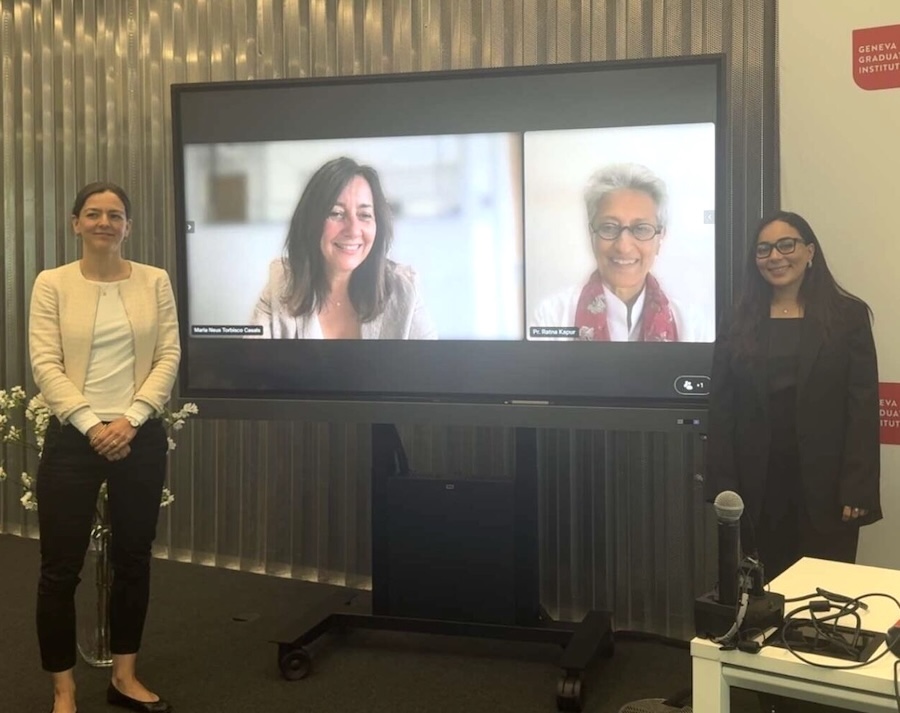
On 27 May 2025, Merna Abouelezz (right) defended her PhD thesis in International Law, titled “Reconciling Faith and Feminism: Western Feminism, the ECtHR, and Muslim Women in Europe”. Adjunct Professor Maria Neus Torbisco Casals (second from the left) presided over the committee, which included Associate Professor Anne Saab (left), Thesis Director, and Professor Ratna Kapur, School of Law, Queen Mary University of London, UK.
Citation of the PhD thesis:
Abouelezz, Merna. “Reconciling Faith and Feminism: Western Feminism, the ECtHR, and Muslim Women in Europe.” PhD thesis, Graduate Institute of International and Development Studies, Geneva, 2025.
Access:
Members of the Geneva Graduate Institute can access the thesis via this page of the Institue’s repository. Others can contact Dr Abouelezz.
Banner image by Domenichini Giuliano / Shutterstock.
Interview by Nathalie Tanner, Research Office.