


How did you come to choose your research topic?
The idea came from observing a gap between rhetoric and reality. Politicians and trade negotiators constantly invoke the “level playing field” to justify all sorts of measures — anti-dumping duties, carbon border taxes, labour standards in trade agreements, rules on state-owned enterprises — but nobody had really asked what this concept means as a matter of law. Is it just a political slogan, or does it carry genuine normative weight? I started my research during the Covid-19 pandemic, a time when governments were rethinking the relationship between trade, public health, and the environment. The EU had just concluded its Trade and Cooperation Agreement with the UK, which placed “level playing field” provisions at its heart, and new instruments like the Carbon Border Adjustment Mechanism were being designed. It felt like the right moment to take a step back and examine whether there is a coherent legal and economic logic behind these measures, or whether they are simply tools of protectionism dressed up in the language of fairness.
Can you describe your research questions and the methodology you use to approach those questions?
The central question is: can the “level playing field” be understood as a legal norm — not a traditional rule or custom, but something that guides how existing rules interact? To answer this, I use the concept of “interstitial norms”, which does not create new rights or obligations on its own. Instead, it operates in the gaps between existing rules, helping to resolve tensions when different legal obligations pull in different directions, for example, when trade commitments clash with environmental protection duties.
The dissertation is interdisciplinary, drawing on philosophy, law, and economics. It adopts a law and economics approach, combining legal analysis with economic tools such as game theory, welfare economics, and the theory of the second best to assess how trade measures perform against their stated goals. The legal analysis is positivist in orientation: it examines what the law currently says, rather than what it ought to say in the abstract. At the same time, the dissertation is proposal-oriented: after identifying gaps and inconsistencies in how existing measures operate, it puts forward concrete suggestions for how the concept of the level playing field could improve the existing legal framework.
In practice, the dissertation proceeds in three steps. First, I map all the measures and agreements that invoke the level playing field, from carbon border adjustments to anti-subsidy rules to forced labour regulations, and classify them according to what they actually do. Second, I examine the concept through the three lenses of fairness, economics, and law. Third, I bring these perspectives together and test the framework against real-world measures, proposing adjustments where they fall short of their objectives.
What are your major findings?
Three main findings stand out.
First, the level playing field is not just rhetoric. It reflects a real and growing need in international law: states are increasingly adopting trade and investment measures that address social and environmental concerns beyond their borders — climate change, deforestation, forced labour — and existing legal frameworks do not always provide clear answers on when such measures are justified. As non-economic objectives become a more interoperable part of traditional economic objectives and measures, the level playing field, understood as an interstitial norm, can fill that gap by weaving together principles like due diligence, the polluter-pays principle, non-discrimination, and permanent sovereignty.
Second, many existing measures do not fully match their own stated objectives. The framework I propose helps identify these inconsistencies and suggests how they can be corrected.
Third, there is a meaningful distinction between measures that address genuine “distortions”, such as subsidies, and those that address “divergences”, like differences in environmental regulation. Treating them the same, as many current instruments do, leads to inconsistent outcomes that undermine the goals and objectives of the measures.
What social and political lessons for our time could be drawn from your analysis?
We live in a time of growing tension between economic openness and the desire to protect domestic industries, workers, and the environment. The temptation for governments is to use trade policy as a blunt instrument, imposing conditions on trading partners without much regard for their circumstances or efforts. My research suggests that fairness in trade is not about forcing everyone to adopt identical rules. It is about ensuring that the process of integrating social and environmental goals into economic policy is transparent, consistent, and grounded in international law rather than in the political interests of the most powerful actors. This matters especially for developing countries, which often bear the costs of measures designed in capitals far removed from their realities.
What bearing will your doctoral experience have on your career plans?
My interdisciplinary experience during my doctoral studies is already proving essential in my postdoctoral research. At iCourts, the Centre of Excellence for International Courts and Governance at the University of Copenhagen, it allows me to engage with questions about international adjudication from multiple angles, as part of the Avant-Courts project. In my practice as a trade lawyer, it helps me adapt to a regulatory landscape that is changing rapidly, where trade measures increasingly intersect with climate policy, labour rights, and supply chain regulation. The ability to move between economic reasoning and legal analysis, while remaining grounded in the principles of international law, is precisely what this environment demands. I expect the level playing field to become even more central to how countries negotiate and regulate their economic relationships, and I hope to remain part of that conversation, both in research and in practice.
* * *
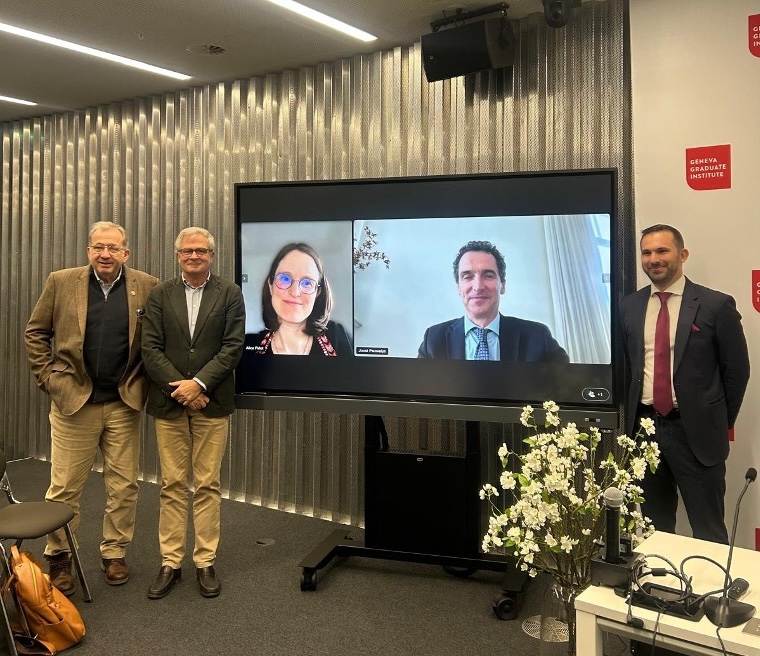
Marios Tokas (right) defended his PhD thesis in International Law (Minor in International Economics), titled “Level Playing Field as an Emerging Norm in International Economic Law”, on 25 February 2026. Committee members were Professor Joost Pauwelyn (second from the right), Thesis Co-Supervisor; Professor Damien Neven (second from the left), Thesis Co-Supervisor; Assistant Professor Alice Pirlot, President of the Committee and Internal Member, and Professor Petros C. Mavroidis, Columbia Law School, USA.
Citation of the PhD thesis:
Tokas, Marios. “Level Playing Field as an Emerging Norm in International Economic Law.” PhD thesis, Graduate Institute of International and Development Studies, Geneva, 2026.
Access:
An abstract of the PhD thesis is available on this page of the Geneva Graduate Institute’s repository. As the thesis itself is embargoed until March 2029, please contact Dr Tokas for access.
Banner image by TW Farlow Media/Shutterstock.
Interview by Nathalie Tanner, Research Office.