


How did you come to choose your research topic?
My interest in antimicrobial resistance (AMR) emerged from a broader engagement with questions about pharmaceuticals and contemporary medicine. An early impetus came from the NDM-1 controversy, which cast India as a global “epicentre” of resistance and, in doing so, drew attention to hospitals as key sites in the production and circulation of microbial threat. What struck me about this moment was not only the scale of the concern but how it framed resistance as a problem located in particular geographies and practices, often obscuring the everyday realities of clinical care. AMR is frequently described as a looming crisis caused by misuse — particularly in the Global South — but I became interested in how this narrative elides the conditions under which antimicrobials are actually used. I wanted to understand how resistance is encountered and managed within hospitals, and what it reveals about the workings of modern medicine itself. This led me to conduct ethnographic research in a tertiary-care hospital in southern India, where I examined how antimicrobials are used in practice and how clinicians navigate the tensions between care, cure, and uncertainty. Over time, the project shifted from studying AMR as a problem “out there” to analysing it as something that emerges from within the very infrastructures and aspirations of contemporary medical care.
Can you describe your research questions and the methodology you use to approach those questions?
The dissertation asks how AMR reshapes contemporary medical care, and more specifically, how hospitals become sites that both promise cure and generate new forms of susceptibility. It examines how antimicrobials function not only as therapeutic agents but as infrastructures that make high-intensity medicine — such as chemotherapy, transplantation, and intensive care — possible. It also asks how clinicians, particularly infectious diseases physicians, navigate antimicrobial stewardship under conditions of uncertainty and competing obligations.
Methodologically, the project is based on fourteen months of ethnographic fieldwork at a large tertiary-care corporate hospital. I conducted participant observation and shadowed infectious disease physicians, microbiologists, pharmacologists, and clinical teams across general wards, intensive care units, and oncology settings. This was complemented by semi-structured interviews and close attention to institutional practices such as infection control protocols and stewardship programmes. Ethnography allowed me to move beyond abstract policy discussions and attend to the everyday dilemmas, negotiations, and judgments that shape the use of antimicrobials in clinical practice.
Alongside this, I also draw on a broader archive of materials, including policy documents, scientific publications on emerging epistemic entities such as plasmids, and even graphic narratives that circulate around AMR. Bringing these different forms of knowledge into conversation allows me to trace not only how resistance is managed clinically, but also how it is imagined, visualised, and rendered affectively compelling across scientific and public domains.
What are your major findings?
The central argument of the thesis is that AMR is not simply the result of misuse or regulatory failure, but a structural condition of modern medicine itself. Contemporary hospital care depends on antimicrobials as infrastructural supports, yet the very practices that rely on them — such as invasive procedures and immunosuppressive therapies — also create conditions in which resistant infections emerge and proliferate. To capture this paradox, I develop the concept of the “infectious hospital”, which frames the hospital as a site where cure and infection are not opposed but entangled. Rather than treating hospital-acquired infections as isolated failures, the thesis shows how they are internal to the functioning of high-intensity care. I also argue that antimicrobial stewardship is not simply a technical or regulatory exercise, but a form of temporal and ethical labour through which clinicians attempt to balance immediate patient needs with the long-term sustainability of antimicrobial efficacy. Finally, the thesis demonstrates how global narratives of AMR — such as the designation of India as an “epicentre” — are shaped by geopolitical anxieties that obscure the broader systemic conditions under which resistance emerges.
What could be the social and political implications of your thesis?
The thesis challenges dominant narratives that locate the problem of AMR in individual behaviour or weak regulation, particularly in the Global South. By showing how resistance is embedded within the infrastructures of modern medicine, it calls for a rethinking of responsibility — away from blame-oriented frameworks and toward a more systemic understanding of care. It also has implications for how we think about medical intervention more broadly. Rather than assuming that technological expansion necessarily leads to greater control over disease, the thesis highlights the fragility and contingency of contemporary care. This suggests the need for approaches that emphasise stewardship, sustainability, and coexistence with microbial life, rather than the pursuit of an anti-biotic politics.
Ultimately, what does your work suggest about the future of medicine in our AMR era?
I would say that the thesis points to a shift from a model of medicine grounded in certainty and control toward one characterised by negotiation and uncertainty. AMR reveals that the promise of definitive cure is increasingly difficult to sustain, and that care must instead be understood as an ongoing effort to manage fragile therapeutic ecologies. This does not mean abandoning medical intervention, but rather rethinking its aims and limits — recognising that sustaining life often involves navigating complex relationships between humans, microbes, and therapeutic agents rather than achieving complete control over them.
What bearing will your doctoral experience have on your career plans?
My doctoral research has consolidated my commitment to pursuing an academic career at the intersection of medical anthropology and science and technology studies (STS). It has also shaped my approach to teaching, particularly in a course I am currently teaching on the anthropology of pharmaceuticals at the University of Lucerne, where I encourage students to think critically about the social life of medicines and the broader systems through which care is organised. Moving forward, I hope to build on this work by developing new research on AMR, pharmaceutical infrastructures, and the ethics of contemporary medical practice, while continuing to contribute to interdisciplinary conversations in critical global health and STS.
* * *
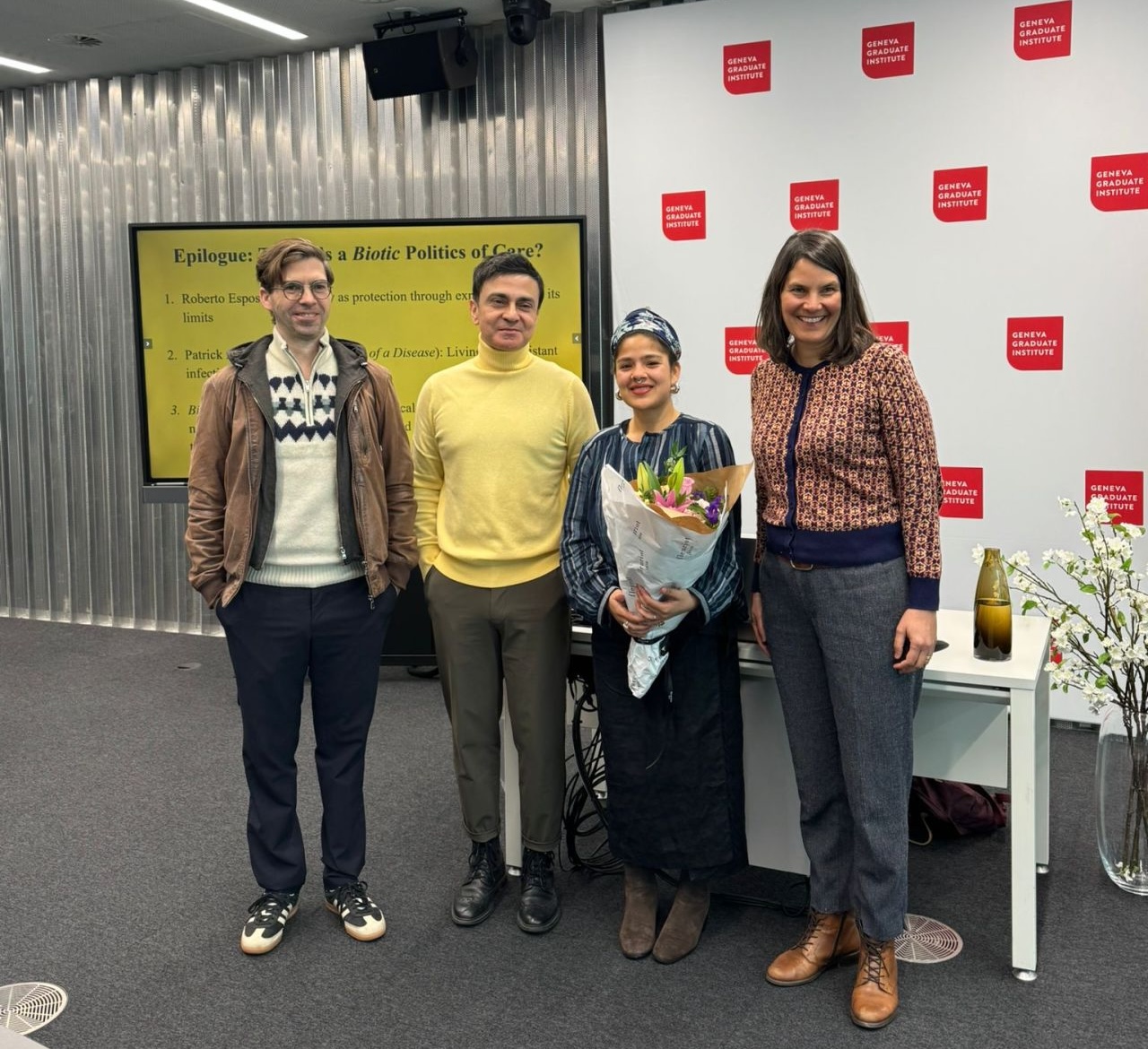
Purbasha Mazumdar defended her PhD thesis in Anthropology and Sociology, titled “The Hospital after Infection: An Ethnography of (Resistant) Infections in a Hospital in India”, on 27 February 2026. Committee members were Professor Aditya Bharadwaj, Thesis Director (second from the left); Associate Professor Shaila Seshia Galvin, President of the Committee and Internal Member; and Professor Carlo Caduff, Department of Global Health and Social Medicine, King’s College London.
Citation of the PhD thesis:
Mazumdar, Purbasha. “The Hospital after Infection: An Ethnography of (Resistant) Infections in a Hospital in India.” PhD thesis, Graduate Institute of International and Development Studies, Geneva, 2026.
Access to the PhD thesis:
An abstract of the PhD thesis is available on this page of the Geneva Graduate Institute’s repository. As the thesis itself is embargoed until March 2029, please contact Dr Mazumdar for access.
Banner image by Saiful52/Shutterstock.
Interview by Nathalie Tanner, Research Office.