


How did you come to choose your research topic?
The starting point was a report published by the ICRC in 2019, titled “International Humanitarian Law and the Challenges of Contemporary Armed Conflicts”, which I came across while I was a graduate student at the Geneva Academy of International Humanitarian Law and Human Rights. The report highlighted the challenge of applying international humanitarian law (IHL) to conflicts involving multiple non-state armed groups. That single reference led me to explore much further: I began reading UN reports, ICRC studies, and other materials on conflicts such as those in Syria, Libya, Sudan, the DRC, and Yemen, and quickly realised how much the landscape of armed groups operating in these conflicts had changed. What used to be, in many cases, a fairly straightforward confrontation between a State and a single rebel group has become, in conflict after conflict, a shifting web of coalitions, splinter factions, and armed groups with very different relationships to the State and to each other. That gap between how international law still frames armed hostilities involving non-state armed groups (NSAGs) and what conflicts actually look like today is what drew me into this thesis.
Can you describe your research questions and the methodology you used?
My central question was: how should international law respond to the increasing multiplicity and fragmentation of NSAGs in contemporary armed conflicts? I broke this down into several more specific questions, addressing four areas in turn: how armed hostilities involving multiple armed groups should be legally classified; which rules of international humanitarian law apply once such a conflict is classified, especially where different groups meet different legal thresholds; how international human rights law obligations operate in contexts involving multi-armed groups with diverse levels of organisation; and how these groups — and the States that sometimes support them — can be held accountable and responsible for violations.
Methodologically, the thesis combines doctrinal legal analysis with an empirical, case-based approach. I examined treaty law, jurisprudence from international courts and tribunals, and the practice of UN bodies, and tested this doctrinal analysis against the realities of specific conflicts marked by multiple, interacting armed groups.
What are your major findings?
The thesis makes four main arguments. First, I argue that the intensity of violence needed to legally classify a conflict as a non-international armed conflict can, in defined circumstances, be assessed by looking at the combined violence of several armed groups, rather than only through isolated, one-on-one assessments — which better reflects how these hostilities actually unfold. Second, I show that the traditional distinction between different bodies of international humanitarian law applicable to non-international armed conflicts, namely, Common Article 3 of the 1949 Geneva Conventions and Additional Protocol II, has been substantially eroded by later legal developments, which supports applying humanitarian law more consistently across an entire conflict and to all parties involved, rather than fragmenting the legal analysis group by group. Third, on human rights law, I argue for a graduated approach: all armed groups bear a minimum obligation to respect human rights, regardless of whether they control territory, while groups that do exercise territorial control bear the fuller obligation to protect and fulfil those rights. Finally, I evaluate existing UN and non-governmental organisations initiatives, including the UN Security Council’s compliance promotion and monitoring mechanisms and the work of the NGO Geneva Call, and propose a broader, more coherent global framework for holding armed groups accountable, along with an approach to attributing responsibility to armed groups and to territorial states that use them as proxies.
What are the implications of your findings for international law?
Multi-armed group insurgencies (conflicts) are not a marginal or temporary phenomenon. They are, increasingly, the norm rather than the exception in contemporary armed conflicts. When the law struggles to classify a conflict clearly, or to determine which rules apply to which armed group, the practical cost is borne by civilians, whose protection depends on these rules being applied coherently, consistently and without gaps. My thesis argues that international law does not need to be rebuilt from scratch to respond to this reality; it already contains the interpretive tools to adapt, if applied functionally. The thesis suggests that greater legal clarity and, ultimately, more effective humanitarian protection is achievable within the existing legal order.
What bearing will your doctoral experience have on your career plans?
The doctoral experience confirmed for me that the questions I engaged with in the thesis are far from settled, and that I want to keep working on them. In particular, I would like to build on the doctrinal groundwork of the thesis by exploring further the humanitarian impact of the multiplicity and fragmentation of armed groups, how this fragmented landscape plays out on the ground for civilians, for humanitarian access, and for the practical delivery of protection, beyond the legal-doctrinal analysis the thesis was able to cover. The PhD gave me both the grounding and the appetite to pursue that next step.
* * *
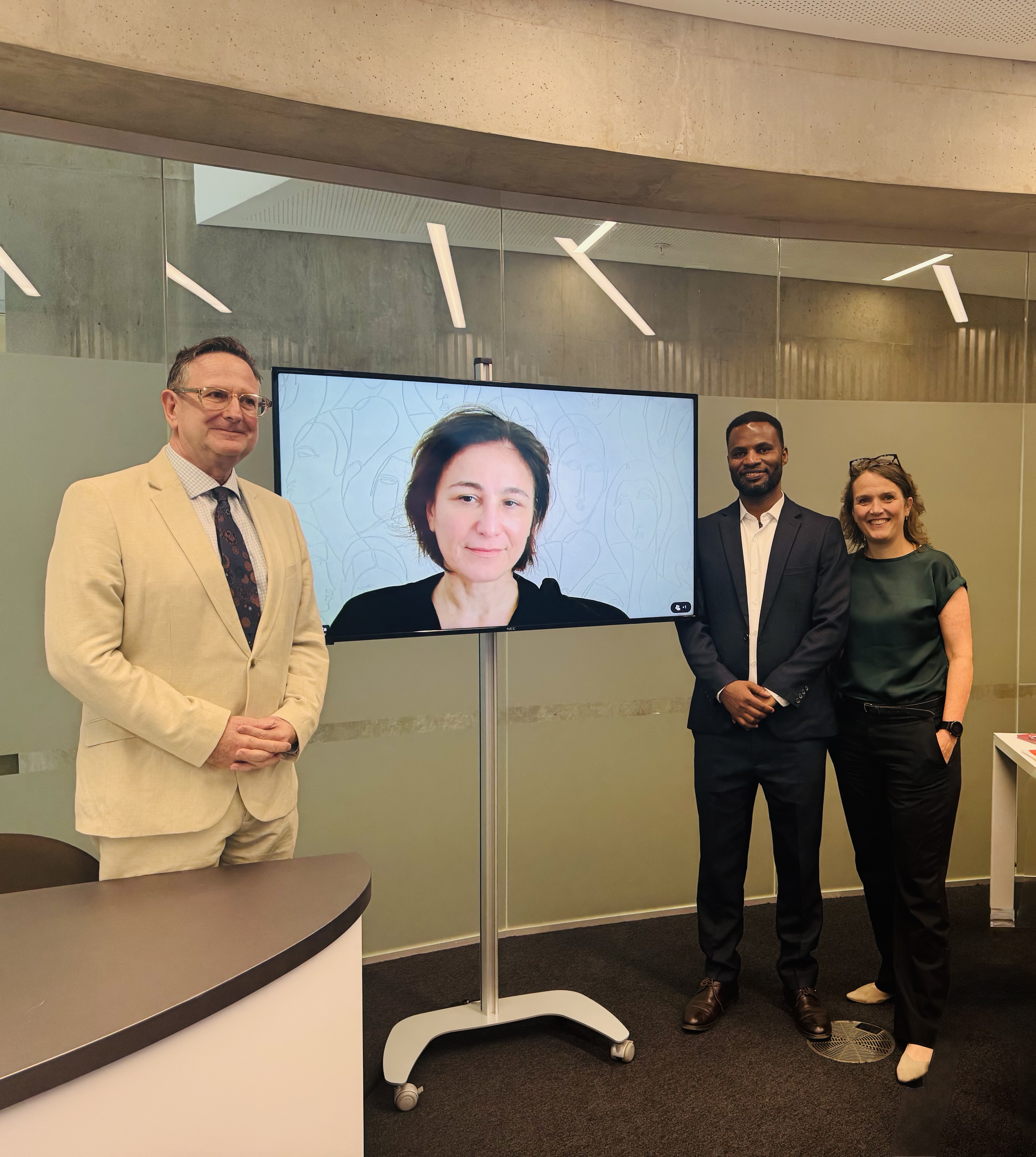
On 26 May 2026, Marishet Hamza (second from the right) successfully defended his PhD thesis in International Law, titled “The Proliferation and Fragmentation of Non-State Armed Groups in Contemporary Armed Conflicts: Normative and Practical Challenges”. The jury was presided over by Professor Paola Gaeta (second from the left) and included Professor Andrew Clapham (left), Thesis Director, and Associate Professor Katharine Fortin (right), Law, Economics and Governance, Utrecht University School of Law, the Netherlands.
Citation of the PhD thesis:
Hamza, Marishet Mohammed. “The Proliferation and Fragmentation of Non-State Armed Groups in Contemporary Armed Conflicts: Normative and Practical Challenges.” PhD thesis, Graduate Institute of International and Development Studies, Geneva, 2026.
Access to the PhD thesis:
An abstract of the PhD thesis is available on this page of the Geneva Graduate Institute’s repository. As the thesis itself is embargoed until August 2029, please contact Dr Hamza for access.
Banner image by UN Photo/Tim McKulka / CC BY-NC-ND 2.0
Interview by Nathalie Tanner, Research Office.