


Why were you interested in macro- and climate economics in the first place?
My interest came from two childhood experiences: being a scout in my school years and growing up in Budapest.
Enjoying nature responsibly is one of the ten Hungarian scout laws: a scout loves nature, is kind to animals, and treats plants gently. This law started as a rule that we had to know by heart, but it transformed into a conviction during the many summers we spent in the woods. We learnt how to take care of nature while also benefiting from it. We relied on it for shelter, for warmth, for water, but also for amazing experiences, such as the clearest night sky I have ever seen, or encountering wild boars during the night. To make sure that these gifts of nature remained after we left, we learnt how we can minimise our impact. Since then, I had the chance to discover other natural wonders. Living in Switzerland even further deepened my appreciation of nature with its unrealistically scenic views and fit backpackers. As we kept learning how climate change can endanger nature, I wanted to understand the phenomenon better and contribute to the solution, so the woods that gave me so much would be there for the next generation as well.
Growing up in a socially diverse part of Budapest motivated me to understand how economic systems work and shape people’s lives. I had a loving family, excellent teachers, great classmates and friends. However, not everyone around me had the same. The diverse life experiences I witnessed, along with my mum’s work helping families in need, showed me what the same neighbourhood meant for those with fewer resources. I was lucky that my family urged me to be open, curious, and to look for ways to improve our lives and the world around us. They encouraged me to find my own way of engaging with these questions, which eventually led me to economics.
How did you come to choose your research topic?
My first professional experience at the Swiss National Bank was influential to build my initial ideas for my PhD. I had the chance to see up close how a central bank works for the benefit of the population and how textbook theories function in real life. I worked on cross-border investment topics, which might seem technical at first but are at the centre of exciting questions with direct impact on our day-to-day lives. Specifically, they can affect financial crises, inequality, and are also important for longer-term questions, such as how aging societies invest their savings or how we handle climate change.
I brought this new world of cross-border investment closer to my long-standing interest in nature. I wanted to make the effects of climate risks less abstract and more macro-relevant by focusing on investment reactions to natural disasters. This project was ideal for me, as it combined my interests in nature and economics in a relevant and rapidly evolving field.
To come up with research questions, I benefited a lot from serendipity, collaborations, and drawing on knowledge from outside economics. When I began working on Peruvian bank lending, I knew El Niño mattered for the economy, but it was fascinating to discover by reading outside economics how much information and infrastructure existed in other fields. For example, agencies conducting research on oceanic and atmospheric changes dedicated to monitoring and forecasting El Niño events regularly publish new findings and insights. Drawing on this knowledge from the natural sciences is what led me to ask whether financial institutions care about these forecasts and actually respond to them, which became the central finding of my PhD thesis’s first chapter. My collaboration with Gerald Cisneros and Alvaro Hinostroza at the Banco Central de Reserva del Perú (BCRP) also happened by chance, through the BCC programme at the Geneva Graduate Institute. We did not know each other beforehand but were open to collaborating on a research topic of interest to the BCRP. Their knowledge of the Peruvian institutional setting and local insights strengthened the paper greatly, and I am grateful for the opportunity to work across institutions.
In my second chapter on capital flows and natural disasters, I also use interdisciplinary data sources, such as relying on satellite data to measure disasters’ population exposure more accurately. Data from natural disaster datasets alone can be inconsistent across countries. Combining spatial disaster records with satellite-based population data offered a way to address this, and I enjoyed that it required working with methods across disciplines, such as geography.
Finally, I benefited a lot from the interdisciplinarity promoted at the Institute, where professors from different backgrounds are open to collaboration. Professor Joëlle Noailly approached me early in my PhD, and we stayed in touch throughout. Eventually, a collaboration arose that became my third chapter. Working with her introduced me to energy economics, and her expertise in how climate policies drive clean technology investment and green growth gave me a new perspective on the link between policy and investment decisions, broadening my understanding of the field considerably.
Could you tell us more about these three chapters?
In the first chapter, entitled “Financial Institutions and Climate Shocks: Pre-emptive vs. Reactive Lending Adjustments in the Case of El Niño”, written with Gerald Cisneros and Alvaro Hinostroza, we study how forecast revisions of El Niño episodes affect financial institutions’ lending decisions, using granular loan-level data from the Central Reserve Bank of Peru. We show that financial institutions engage in forward-looking climate risk management by responding to climate forecasts rather than reacting to disasters after they have occurred. This finding provides a possible reason why the effects of natural disasters are frequently small in the literature and shows that the prevailing focus of financial institutions is on pre-emptive decisions. It also reveals a new channel through which climate uncertainty influences financial markets.
In the second chapter, entitled “The Impact of Natural Disasters on Capital Flows: Preparedness and Exposure Matter”, I study how international capital flows react to natural disasters. I find that foreign and domestic investors react to countries' disaster preparedness rather than just disaster risk, with capital stopping in unprepared countries after disasters strike and instead reallocating to safer markets within similar country groups. These results suggest that as extreme events become more frequent, countries that have faced low disaster risk before and remain unprepared may face increased financial volatility, as portfolio and banking flows react to perceived vulnerability.
In the third chapter, entitled “The Impact of Renewable Portfolio Standards on Greenfield Environmental Technology Investment and Employment”, written with Joëlle Noailly, we provide an empirical assessment of the effect of the renewable portfolio standard (RPS) policy on greenfield environmental technology investment and job creation. Although we find that the RPS is effective, its effects plateau after several years. These findings have potential implications for future policy decisions. Policymakers should note that even successful policies which generate investment and job creation may take a long time to have an effect, in this case, six to eight years. In addition, for continuing benefits, policies may require updates. These findings emphasise the importance of stable, long-term policy commitments to maintain investor confidence.
What are you doing now?
Last September, I joined the European Central Bank’s Economist Graduate Programme. I currently work in the International Policy Analysis Division, focusing on exchange rates, particularly on their drivers and potential misalignments.
* * *
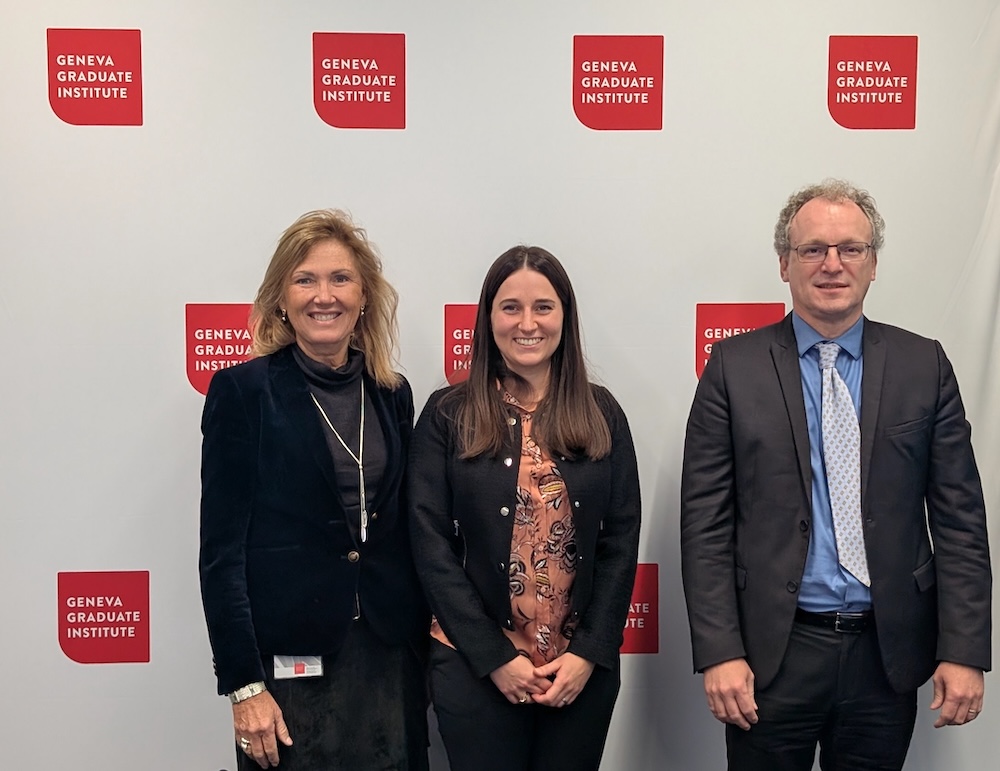
Viktória Vidaházy (middle) defended summa cum laude with special commendation her PhD thesis in International Economics, titled “Essays in Financial Macroeconomics and Climate Risk”, on 29 September 2025. Committee members were Professor Cédric Tille (right), Thesis Supervisor; Professor Beatrice Weder Di Mauro (left), President of the Committee and Internal Member; and Professor Galina Hale, Department of Economics, UC Santa Cruz, USA.
Citation of the PhD thesis:
Vidaházy, Viktória. “Essays in Financial Macroeconomics and Climate Risk.” PhD thesis, Graduate Institute of International and Development Studies, Geneva, 2025.
Access:
An abstract of the PhD thesis is available on this page of the Geneva Graduate Institute’s repository. As the thesis itself is embargoed until November 2028, please contact Dr Vidaházy for access.
Banner image by Toa55/Shutterstock.
Interview by Nathalie Tanner, Research Office.