

How did you come to choose your research topic?
The idea that led to my project emerged from certain unresolved curiosities from my MA dissertation, which examined the history of venereal diseases in colonial Ibadan, a city in southwestern Nigeria, from 1919 to 1945. That study explored the dilemmas venereal diseases such as syphilis posed to colonial health officials prior to the administration of penicillin, an antibiotic used to treat bacterial infections from the early 1940s to much of the postwar period. Drawing on primary sources from the Nigerian archives, I encountered occasional references to WHO’s global venereal disease campaign from 1948. However, these references gradually disappeared from the archival mentions by the 1950s, making it difficult to connect a global health campaign with the local context. But when I began to plan for my doctoral studies, I met Professor Sanjoy Bhattacharya, a global health scholar, now at the University of Leeds, but then at the University of York, UK, and he supported my ambition, offering critical feedback and sharing multiple study materials with me. One of them was Jessica Pearson’s Colonial Politics of Global Health. The book helped me to reinterpret the archival silences I had encountered in my MA research within a broader global health framework. This proved to be a decisive intellectual turning point: it deepened my engagement with the politics of global health and illuminated how colonial powers’ interactions with the emerging UN system shaped the ways in which local authorities in British West Africa designed and implemented public health programmes. This background shaped the evolution and motivation of my dissertation topic. However, as I progressed in my research, several other ideas emerged, and pursuing these discoveries gave my dissertation a uniquely diversified yet coherent outlook and outcome.
Can you describe your research questions and the methodology you used to approach them?
My dissertation sits at the intersections of local, colonial, and international health in Nigeria across the twentieth century. It thus addresses questions that offer deep insights into how health cooperation between the British colonial authority, local actors, and proponents of emerging twentieth-century health internationalism played out through forms of contested collaboration in Nigeria. The international health actors in focus include the Rockefeller Foundation, the League of Nations Health Organization, and the postwar international health institutions.
The dissertation also examines how this cooperation changed in postcolonial Nigeria. It analyses how independent Nigeria engaged with the international/global health system in the context of Cold War politics, challenging scholarship on Africa’s experience during the Cold War, which mostly portrays Africa as a theatre of ideological contestation between the Soviet and Western blocs. In this regard, the dissertation probes divergent meanings of “decolonisation” and “modernisation” of higher education and public health from British and American perspectives, how these differences brought Western actors into conflict, and the role of faculty members at the University of Ibadan, Nigeria’s first university, in locally shaping these competing models of development.
In approaching these questions, the dissertation adopts a thorough historical methodology, combining expansive archival research across Switzerland, the US, the UK, and Nigeria with 20 oral history interviews.
What are your major findings?
My dissertation makes three central contributions to the literature. First, it adopts the term “contested cooperation” as its analytical lens to show how the history of Nigeria’s entanglements with colonial, international and global health institutions played out through forms of resistance and collaboration. It covers a particularly wide range of issues — human trafficking, yellow fever, dried milk, infant and maternal health, among others — and actors — colonial and postcolonial governments, the Rockefeller Foundation, the League of Nations Health Organization, the World Health Organization, the World Bank, and UNICEF — allowing us to think of health dynamics and governance beyond any one subject and actor. I argue that twentieth-century international health in Nigeria was not simply an imposition of policies and ideas, but rather a process involving negotiated collaboration. I reveal how authority, expertise, and agency were produced through shifting interactions among colonial, international, and Nigerian actors, unfolding within unequal political and social contexts.
Secondly, the dissertation shows how broader tensions over colonialism, decolonisation, capitalism, and the growing American international influence shaped the politics and practice of health programmes in Nigeria. These forces manifested in complex ways, influencing which medical research and health programmes received funding and which did not. They also dictated when and how international organisations were allowed in, who occupied positions in public and university departments, and which approaches were pursued or left out. These relationships did not always follow conventional top-down patterns. The dissertation points out, for example, that Africa was not merely a laboratory for European scientists; colonial funds also flowed back to the metropole to pay for labs and salaries.
Lastly, the dissertation illustrates these arguments through a focused intervention in the history of infant and maternal health: the introduction and promotion of breast milk substitutes in Nigeria. It highlights how cultural dynamics interacted with transformations brought about by nutritional technologists and food corporations such as Nestlé, which promoted alternatives to the natural infant-feeding practice in Nigeria. I explore the dilemmas this initiative posed for Nigerian mothers considering infant formula and how they negotiated conflicting assumptions and ideas, creating spaces where breastmilk substitutes were contested. In doing so, the study foregrounds the agency of local actors in the global movement against breastfeeding alternatives, including health professionals, traditional midwives, and “culturally self-designated” nutritionists — husbands, grandmothers, as well as social movements both religious and secular — who appropriated, resisted, or adapted breastmilk substitutes at the local level.
What social and political lessons for our time could be drawn from your historical analysis?
On the socio-political dimension, particularly in relation to the social aspects of global health, I hope my dissertation contributes profoundly to the growing awareness of bioethical concerns. While my dissertation engages with several bioethical principles, including informed consent, it also raises an important question: through what channels are donors of medical specimen such as blood, urine, saliva, and other biological samples, educated in ways that genuinely satisfy the doctrine of informed consent?
However, the fundamental ethical issue I wish to underscore in this interview is communication. In my dissertation, I explore how inadequate communication affected the implementation of major public health interventions, such as yellow fever research and rabies control in colonial Nigeria. In the case of yellow fever research, colonised populations, including schoolchildren and lepers in isolated colonies, were coerced into providing urine and blood samples. Regarding the control of rabies, a zoonotic disease, people’s dogs were seized and native populations compelled to submit their dogs, whether licenced or not, for “destruction”. I use these historical cases to highlight a similar pattern in the more recent Global Polio Eradication Initiative in Nigeria. Here, perceived inadequate communication was exploited to advance political and religious agenda, leading to the rejection of oral polio vaccine in parts of northern Nigeria. In some instances, resistance extended beyond vaccine refusal to threats against, and even the killing of, public health personnel. I therefore hope my dissertation encourages national governments, policymakers, health practitioners, and institutions to critically rethink what counts as medical ethics. More specifically, ethical medical practice should be grounded in meaningful, transparent, and culturally sensitive communication. This is especially relevant in the contemporary world, where organ donation, medical research (including autopsies), and public health interventions continue to raise complex ethical questions across increasingly diverse social and political contexts.
Finally, the history of medicine reminds us that health is inherently political and can lead to the politicisation of knowledge and expertise. On the one hand, international cooperation can produce epistemic hierarchies in which foreign institutions and experts retain greater authority to define problems and determine solutions. On the other hand, it can also create tensions around territorial autonomy, as national governments seek to determine who carries out what health programmes within their geographical territories. These issues are addressed in my dissertation, and I hope its findings will help actors within global health institutions design more equitable and effective responses to present-day health challenges.
* * *
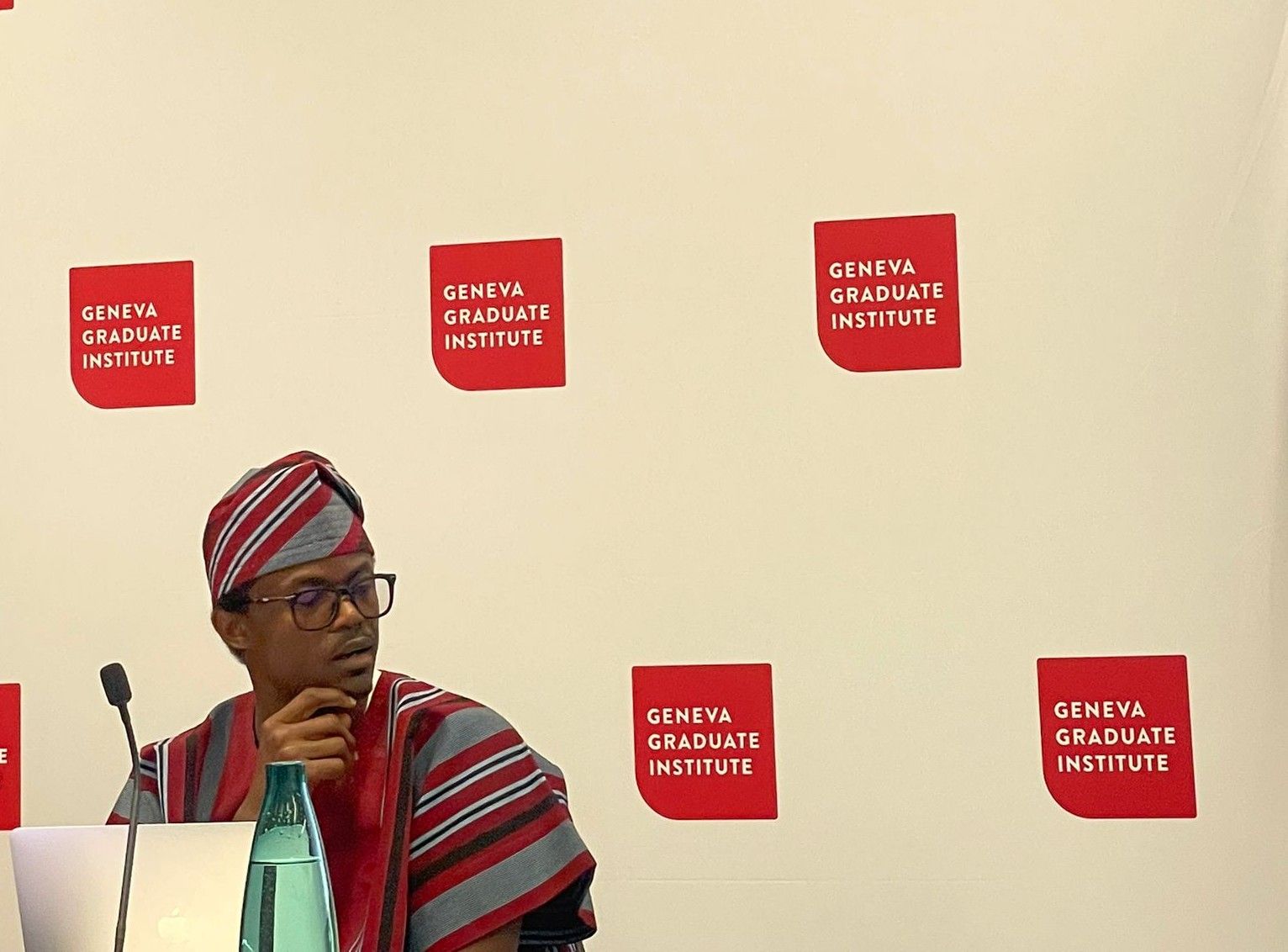
On 12 May 2026, Bidemi Oladayo Balogun successfully defended his PhD thesis in International History, titled “Colonial and Postcolonial Engagements with Emerging Health Internationalism in Nigeria, 1920s-1980s”. The committee was presided over by Associate Professor Aidan Russell and included Associate Professor Nicole Bourbonnais, Thesis Director, and Professor Sanjoy Bhattacharya, University of Leeds, UK.
Citation of the PhD thesis:
Balogun, Bidemi Oladayo. “Colonial and Postcolonial Engagements with Emerging Health Internationalism in Nigeria, 1920s-1980s.” PhD thesis, Graduate Institute of International and Development Studies, Geneva, 2026.
Access to the PhD thesis:
The PhD thesis is publicly available on this page of the Geneva Graduate Institute’s repository.
Banner image: McKay, Vernon, Public domain, via Wikimedia Commons.
Interview by Nathalie Tanner, Research Office.