


“What do you look to in your community to understand whether peace is holding on tight or slipping away?”
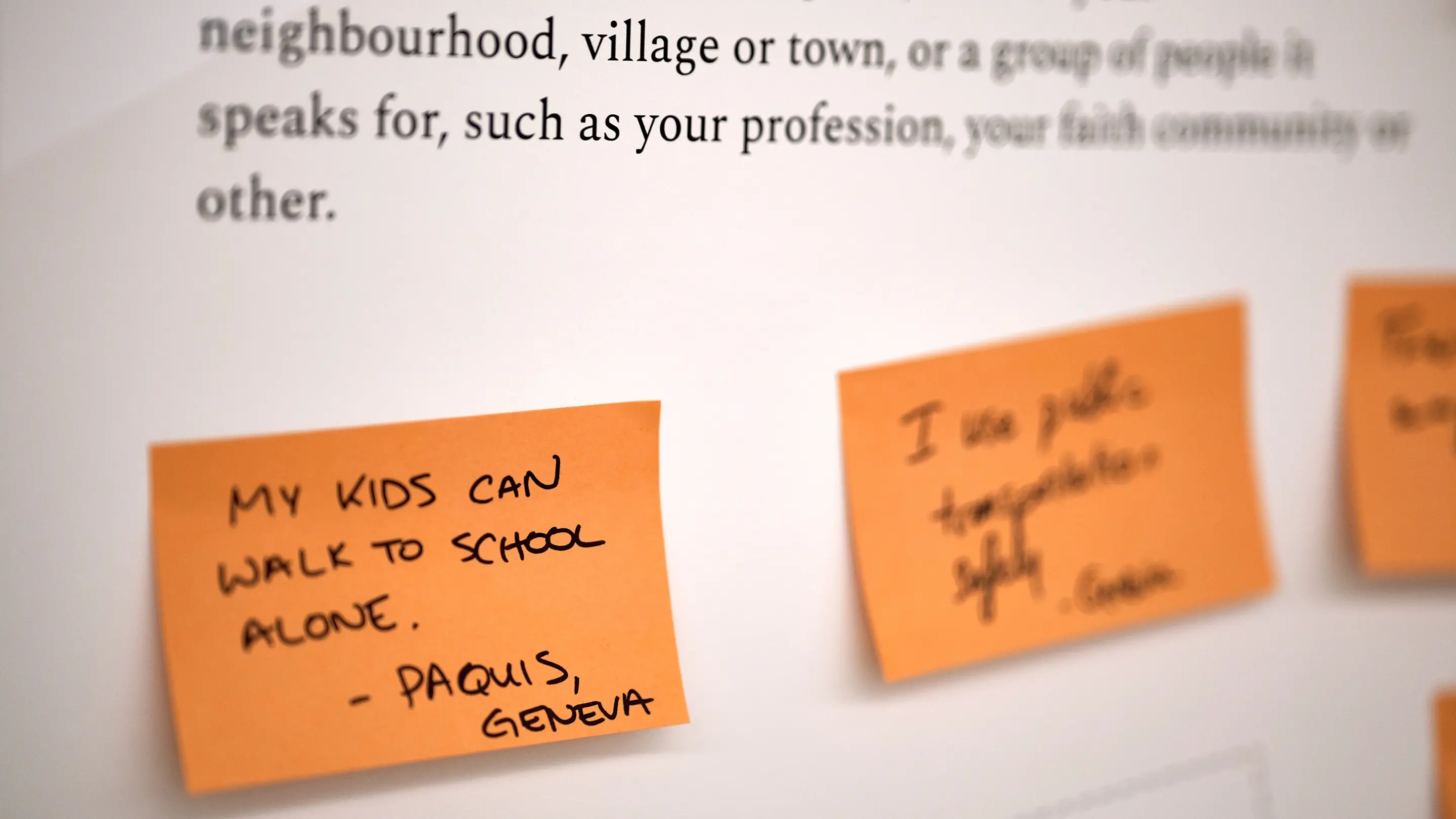
At the launch of the Voices of Peace exhibition at the Geneva Peace Forum, Eliza Urwin, Head of Research at the Centre on Conflict, Development and Peacebuilding (CCDP) at the Geneva Graduate Institute, asked this question, one commonly raised in Everyday Peace Indicators (EPI) focus groups to generate indicators with community members. Here, she invited visitors to contribute their own.
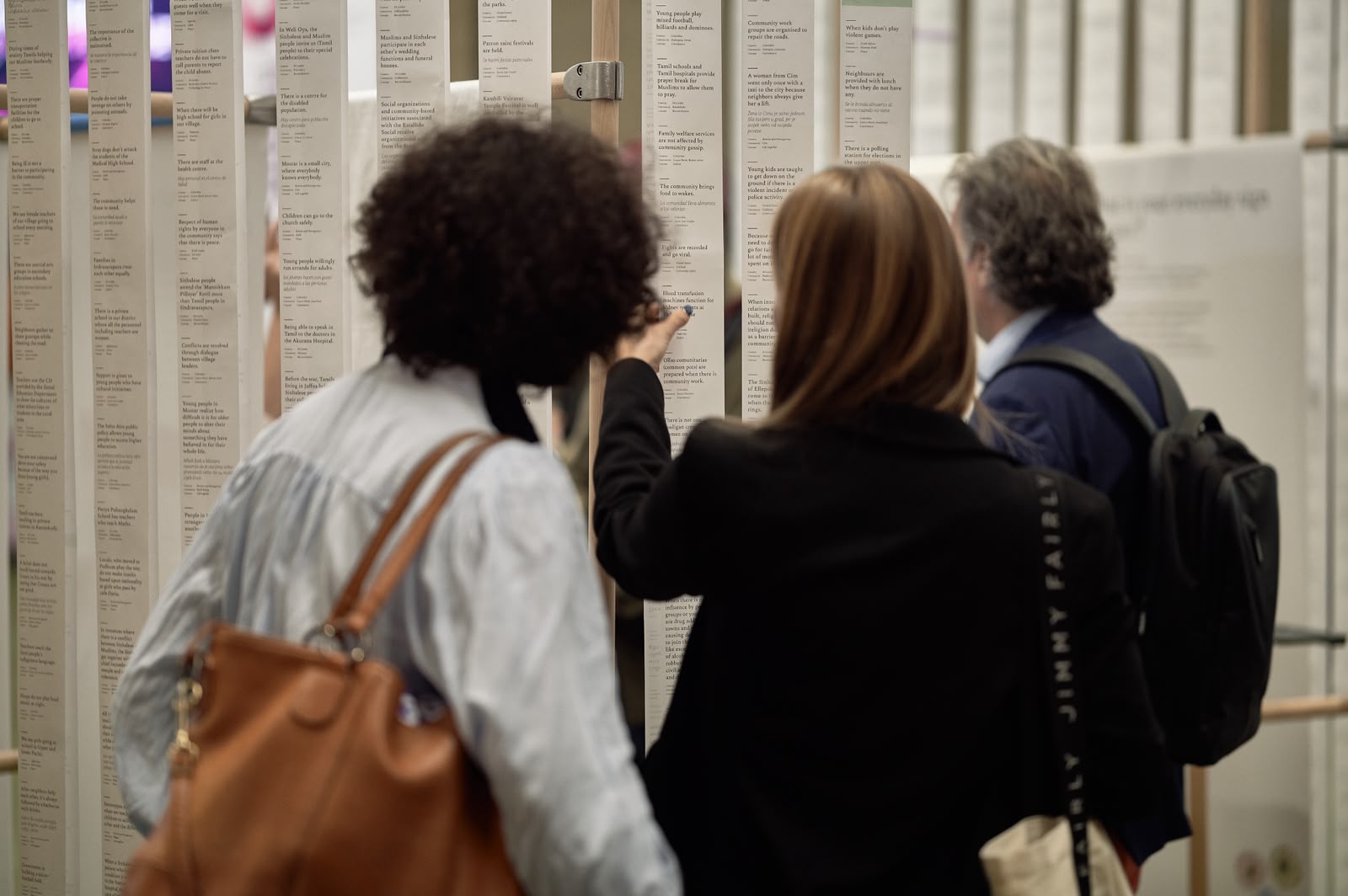
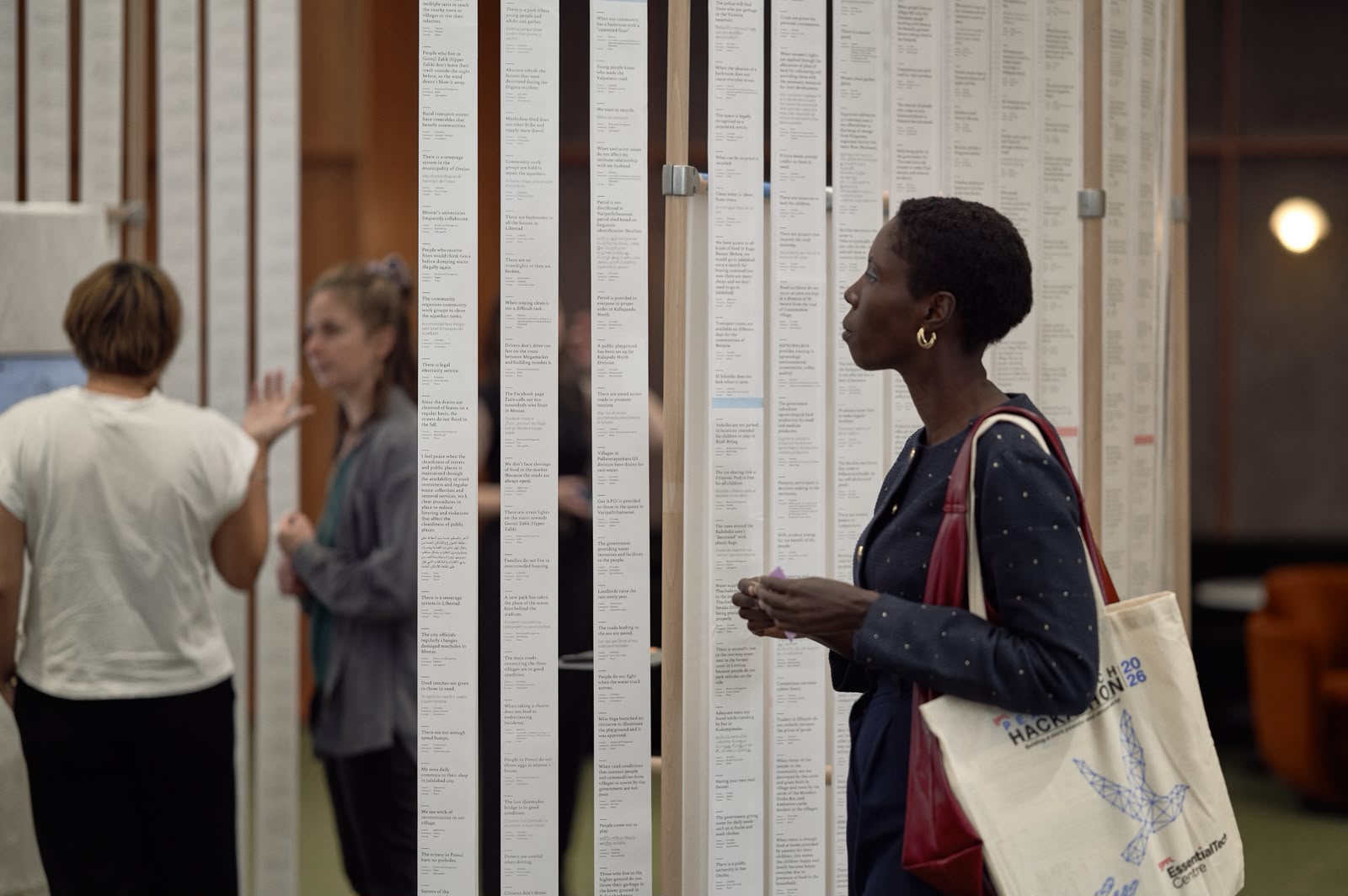
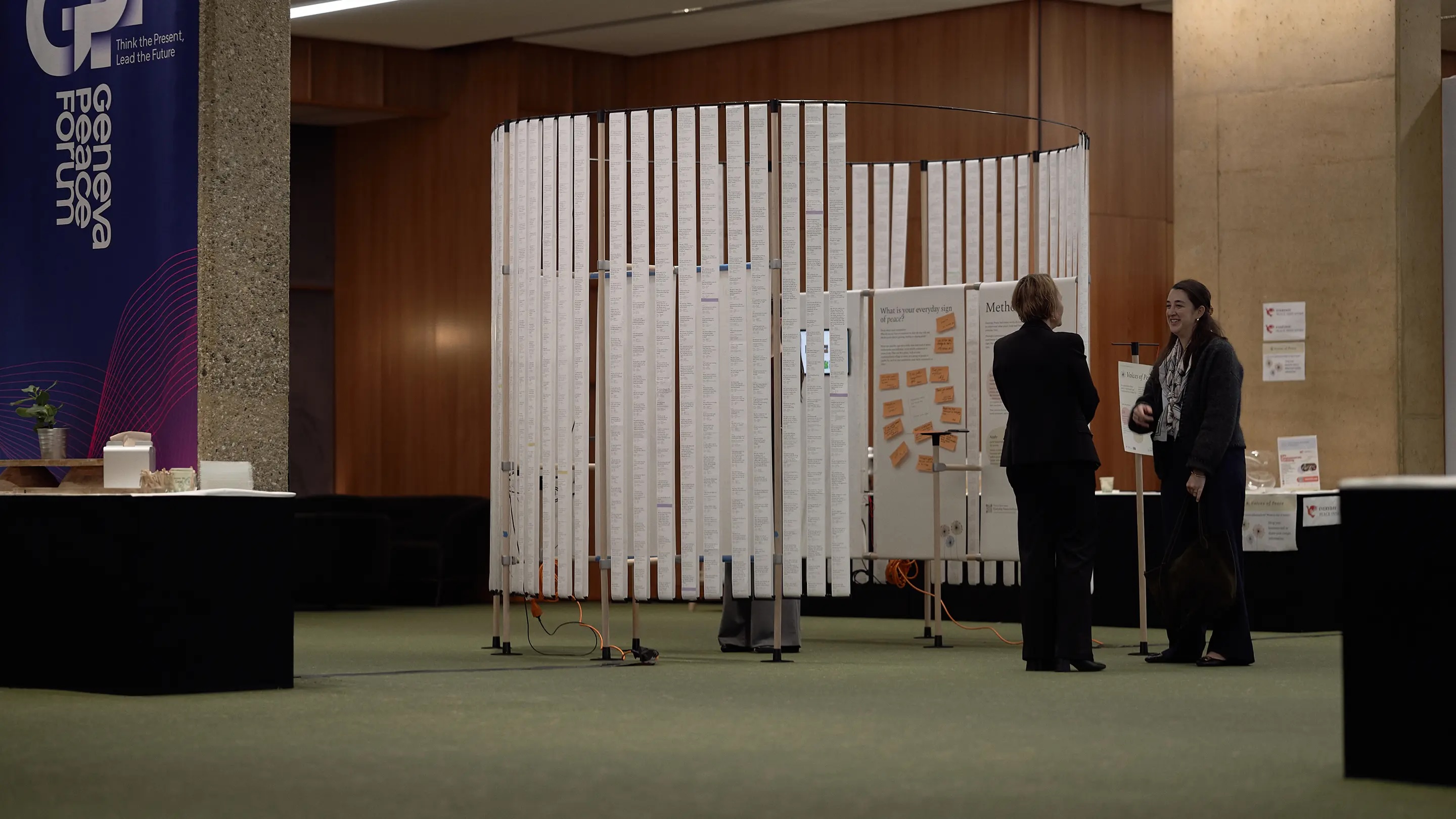
The exhibition also gave these voices a physical form. Thousands of indicators were printed on long strips of paper, or ribbons, suspended in a circle for visitors to unroll and read. As Eliza pointed out during the presentation: “These… scroll!” Visitors could also contribute their own indicators, using Post-it notes to describe the everyday signs by which they recognise peace in their communities.
I walked through the exhibition, watching people stop in front of the installation, unrolling the ribbons and reading the indicators. I wondered which words caught their attention. Did one indicator resonate more strongly than another? A person stopped to take a photograph, followed by another.
I watched people interact with the result of almost two years of work on this project, building on thirteen years of indicator collection, and found myself writing again, as I like to do. Words, always words. This time, I was surrounded by words collected from people describing what peace and related concepts mean in their everyday lives. Words that travel across languages and places. I thought again about their translation, but also about their reception. What happens when these words reach someone else? What do people recognise in them, and what do they understand differently? Perhaps this is also what the exhibition made possible: not simply displaying indicators of peace, but creating space for encounters, interpretations and connections around them.
Bringing the exhibition to life
On Sunday, we gathered to assemble the exhibition. We opened the boxes, unpacked the ribbons, and started clipping them into place, one by one. After months of discussions and decisions, it was wonderful to finally see everything come together. Over the following days, visitors made their way through the exhibition – quite literally, through the circle formed by the installation. At the launch, Pamina Firchow, co-founder and Founding Executive Director of Everyday Peace Indicators and Professor at Brandeis University, reminded the audience that Everyday Peace Indicators (EPI) is not only a methodology, but also an ethos. The ambition is to involve people in defining what matters and to bring their perspectives into conversations about peacebuilding. She pointed to Colombia, where locally generated indicators are already helping inform policy processes. Eliza then introduced the digital portal, inviting visitors to explore more than 20,000 indicators collected across 22 countries, search by theme or location, and discover the different ways peace, justice and coexistence are understood.
One large panel presented the Voices of Peace portal, with a sea of dots next to the image of a dandelion. I stopped in front of it. Throughout this project, one of our greatest challenges had been finding a way to convey the large number of indicators without losing sight of what each one represents: a unique voice, a particular understanding of peace. We explored different ways of presenting them, from dots conveying the scale of the collection to books revealing the meaning behind each indicator. Looking at the panel, I thought: It works. The dots revealed the immensity of the collection, while the portal invited us to discover the words behind them. Thousands of voices, gathered together, each with something distinctive to tell.
When words travel Throughout this series, I have returned to questions about how to make such a large collection accessible without losing the meaning of individual indicators, how to represent local experiences without detaching them from their contexts, and how to move between indicators as data and as stories. The launch did not resolve these questions. It gave them a new dimension. Until then, much of our work had focused on how to present the indicators. At the exhibition, people engaged with them in ways we could not entirely anticipate. I could observe visitors reading, scrolling, talking or taking photographs, but I could not know what resonated with them. An indicator that makes sense in one community may mean something very different elsewhere. Perhaps this is also part of sharing research: accepting that the meanings people find may differ from those we had in mind.
What matters now is what people do with these indicators, what questions they ask, and the conversations they inspire. Where might these voices travel next? Beyond this year’s forum, we hope to find other opportunities to share the indicators, and we look forward to hearing your thoughts. More indicators will also be added to the portal.
After almost two years spent thinking about how to share these words, it is rewarding to see them begin new conversations. I hope these conversations continue well beyond Geneva.
About the series
This blog series itself is a collaborative effort, shaped by CCDP Head of Research Eliza Urwin, Doctoral Researcher Apolline Foedit, and envisioned through the communications lens of CCDP specialist Jennifer Thornquest.
Launching THE project at the CCDP
Ethics and meaning
Data points or stories? Visualizing Everyday Peace
Reflections on Everyday Peace
More About the Project
21,271 community-defined indicators.
22 countries.
182 communities.
13 years of research.
What can more than a decade of community-defined indicators tell us about peace, justice and everyday life?
🔸 Across countries and communities, people identify signs of peace, justice, and other concepts that matter to them in everyday life, in their own words.
🔸 Collected since 2013 through the Everyday Peace Indicators approach, these indicators are now brought together in Voices of Peace, a new interactive digital portal launched at the Geneva Peace Forum 2026.
🔸 The platform brings this research into one searchable public resource, allowing users to explore indicators across locations, themes and concepts.
Developed together by Pamina Firchow, Eliza Urwin, Apolline Foedit, the CCDP, Everyday Peace Indicators and Interactive Things, and many researchers, with support from the SNSF Agora programme.
Learn More
- Learn more about EPI here: https://everydaypeaceindicators.org