

What motivated you to apply to the MINT programme in the first place?
My main motivation for applying to MINT was the fact that it is an interdisciplinary programme. It has a wide pool of courses to choose from. When I was applying, I had a background in law, but I wanted to try something different, something beyond my comfort zone and what I was used to. MINT has diverse courses in international development, and I wanted to challenge myself by trying courses I had never done before such as AI, diplomacy, LGBTQIA+ studies and statistics. These are very relevant courses in today’s world and I wanted to ensure I am knowledgeable in them. Another major reason was the Applied Research Project (ARP). Only MINT offers this unique opportunity to work with an organisation of your choice on a real time project that is very relevant in our world today. This was a huge factor for me. Finally, is the opportunity to learn French. I had no knowledge whatsoever in French, but I have always wanted to learn the language. I could learn it back in Kenya, but it was quite expensive for me. So, when I saw that MINT mandates me to learn French (and hoping I would get a scholarship to study at the Institute), applying was a no brainer.
You are doing the Gender, Race and Diversity specialisation. What drew you to this specialisation and had you previously studied anything similar?
I am very passionate about advancing LGBTQIA+ Rights globally. Choosing the GRD track was an easy choice because it was the only programme that touched on sexuality studies and queer rights. It is also the only course that really explores diversity, equity and inclusion, values which are close to my heart. When I was applying, I was very keen because I wanted to see a programme specifically and expressly mention that it covers these areas and not just in general terms. GRD track accurately captured my expectations.
In terms of whether I had studied something similar, during my law degree, I did a course on Gender studies. It was very vital in understanding key concept in Gender, and I am happy that it gave me the foundation I needed to explore gender studies in a broader sense at the Institute.
What do you hope to gain in skills, knowledge and perspective from the MINT programme over the next two years?
First of all, I am humbled to be taught by experts who are not only highly knowledgeable but also very passionate in what they teach. I hope to gain knowledge, skills and expertise in research and advocacy in LGBTQIA+ Rights globally. This has always been my primary goal. I also hope to understand other key issues relevant in our world today and in International Geneva, such as international diplomacy skills, AI negotiation skills, climate change advocacy and the broader gender rights advocacy. I also hope to sharpen my skills in networking. This is something I am still working on, and the MINT curriculum together with Careers Department are doing a fantastic job in helping me with this. The interdisciplinary nature of MINT means that at the end of my two years, I will have knowledge and skills in multiple areas in international development and I think these skills complement my previous legal background, enabling me to be an all-round scholar. Hopefully, these skills will also be vital for my masters thesis and consequently my PhD.
How have you found studying in International Geneva and has this supported your studies or professional ambitions?
Studying in International Geneva was at first, quite frankly daunting. I was seeing organisations which I had only read about. I wondered whether I would ever get a chance to even enter some of these buildings. I remember my first time walking from Grand Morillon to the school and walking past the UNOG (Palais des Nations), it was so unreal and I think I will never forget it! When I arrived here, I had to adjust a lot, especially mentally. I have had to move beyond my imposter syndrome and believe that I too belong here. I would say my ARP with OHCHR has really helped me adjust. I am learning how international human rights mechanisms actually work in real time and not just by reading. I still cannot believe I have been to the UN HQ in Geneva multiple times. I have always wanted to engage with LGBTQIA+ Rights on a global scale, hence my passion to work with OHCHR, so to actually do a project with them that is part of my academics still feels surreal and goes to show once again the importance and relevance of the MINT curriculum. My ARP with OHCHR has boosted my research skills in law and international affairs. This has also enabled me practice theoretical concepts taught in class.
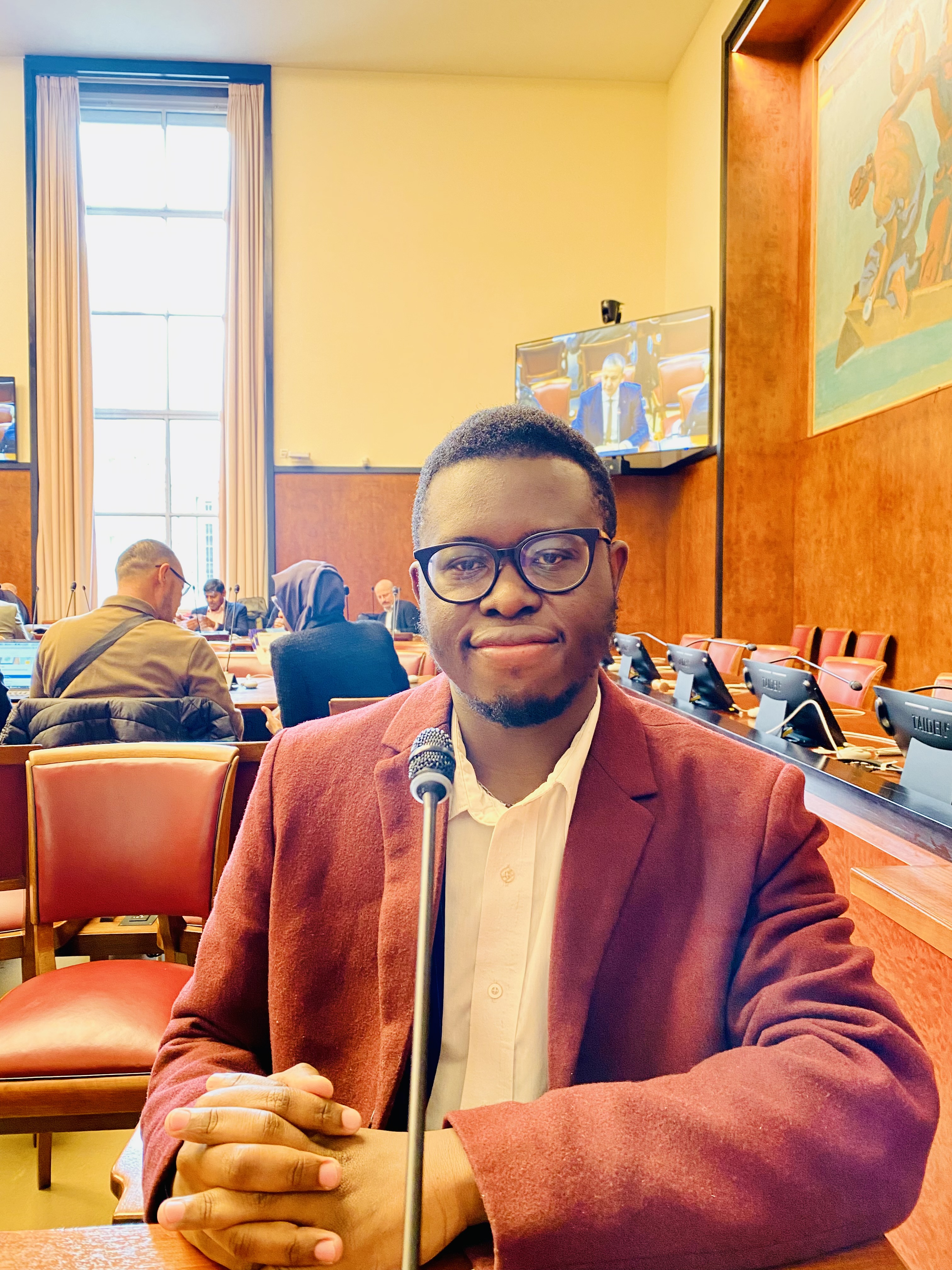
Studying here has also boosted my confidence to pursue my professional ambitions. Recently, at a forum at Palais des Nations, I took the floor and spoke about advancing LGBTQIA+ Rights in our world today that is becoming more and more hostile. I would say this has been the highlight of my time studying here, because I saw first-hand the unique benefits of being given an opportunity to study in International Geneva.
I also feel like studying next to all these amazing international organisations really inspires me to work harder in my studies, because I can look at a random organisation on my way to school and think to myself “I would like to work here someday”.
Beyond the academics and professional side of international Geneva, I would also add that the people here (both at the Institute and Geneva) are really kind.
I will always be grateful to the Institute for awarding me a full scholarship to study here, as it has unlocked so many opportunities I did not ever think I would get. Without support from the school, I would not have done any of these things or even stepped foot at an international organisation.
You have founded your own legal consulting group, how do you balance your professional ambitions and the course?
This is an interesting question. The MINT programme demands a lot of focus and discipline. I therefore decided to take a small break from my consultancy temporarily in order to give my best efforts to my academics. I have a small team in Kenya who have done well to continue with the work of the consultancy. However, during the winter break, I hope to get back right on track! This consultancy is close to my heart, as I get to do research and advocacy in thematic areas such as AI, LGBTQIA+ Rights, Gender Justice, Climate and environmental justice, among others. Already, MINT is equipping me with knowledge and research skills in these fields, so I hope that these skills boost my consultancy work.