



How did you choose your research topic?
I was immersed in the world of professional humanitarian action before starting my studies. I spent several years in South Sudan working as a humanitarian data analyst. Everywhere you looked, there were claims about need-based programming or reaching the “most” in need, but in practice it was often difficult to trace decisions about aid allocation. This made me curious about the fickle role of numbers and evidence, so I decided to pursue a PhD to better understand the allure, power, and consequences of how we represent the lives of people experiencing hardship. As a sector of humanitarian programming, food security has some of the most standardised frameworks for measuring “need”, so I began looking at practices of categorising people according to their relative levels of food insecurity.
While I was conducting my research, I kept my eye on evolving and emerging humanitarian crises, of which there has unfortunately been a steady supply. In 2023 and beyond, watching heated debates over whether Sudan or Gaza or others “counted” as famine or not unsettled my own thinking about what humanitarian evidence does in the world. There was something about famine that seemed to transcend humanitarian logics of need: categorising a situation or a population as experiencing famine was about much more than identifying who was most in need of humanitarian assistance. This prompted me to explore the entanglement of the technical, normative, and political stakes of this label and the practices around it. So having started with a more general inquiry of evidence and humanitarian need, I ended up focusing on the politics of evidence in famine.
Can you describe your research questions and the methodology?
The main research question of this project is: How and why are some situations of large-scale starvation-related suffering recognised as “famine” while others are not, and what work does that recognition (or denial) do?
I take inspiration from the field of science and technology studies, using a method of controversy mapping to examine episodes of competing claims about famine – particularly famine classifications. I draw on several data sources and methods, including public statements, institutional reports, interviews with practitioners and experts, and participant observations. Empirically, I focus on contemporary famine governance, particularly the consolidation of a dominant operational definition of famine through the Integrated Food Security Phase Classification (IPC), which is first and foremost meant to be a humanitarian diagnostic tool. I also examine renewed efforts to foreground starvation crimes, which increasingly integrate IPC classifications in claims about political, legal, and moral wrongdoing. I map famine classification controversies in South Sudan in 2016–2017 and 2020, as well as in Gaza from 2023 to 2025. These cases are compelling but also challenging because of intense public scrutiny of the experts and institutions involved as well as simultaneous developments in international legal debates around famine and starvation. I must emphasise that the point of controversy mapping is not to find out “the truth” (i.e. whether a given situation is “actually” famine or not). Instead, I’m interested in why famine is an object of expert knowledge in the first place and the political and moral work that famine recognition performs. Therefore, this was a process of examining how the authority of experts and institutions and their claims about the world are stabilised or contested, and of coming to terms with the unintended consequences.
What are your major findings?
There are two main premises that I build on in this research. First, our ways of recognising famine are entangled with the very efforts meant to prevent, respond to, and ultimately eradicate it; and second, the recognition of famine is a political act, no matter how “scientifically” the phenomenon has been delineated. There are many definitions, frameworks, and scales that try to define what famine is, and all reflect decisions about which dimensions of starvation suffering to highlight and (implicitly or explicitly) suggest what should be done about it. These insights are not new, but they’re easy to overlook with the rise of the IPC as the dominant “technical” definition of famine. What this research adds is an analysis of how the authority to recognise famine is assembled, stabilised, and contested. These starting premises are also prone to misreading. For me, saying that the recognition of famine is political does not mean that naming famine as such is moot, nor does it mean that the institutions who endeavour to do so should be rejected on the grounds of some impossible ideal of pure objectivity. Instead, I take this entanglement as a reason to be attentive to the role of knowledge production in our efforts to eradicate social blights like mass starvation.
To this end, I argue that famine recognition is a technopolitical achievement, meaning that it happens through ongoing work to stabilise the authority of institutions, procedures, and infrastructures, and that these systems have political goals that are embedded into technical systems. The technopolitics of famine recognition involves discourses and practices that draw boundaries between “political” and “technical” approaches to famine as a way of stabilising authority. These achievements are unstable and partial, and participants are highly reflexive about this fragility. For famine experts and expert institutions, there is an ongoing tension between trying to perform the ideals of technical rigor while also conveying the urgency of a situation. We see this fragility in contemporary situations when famine and near-famine classifications are challenged or reinterpreted. In extreme cases, classification practices can be co-opted to normalise extreme suffering and deny responsibility.
What could be the social and or political implications of your findings?
Current debates on accountability for famine and mass starvation focus on perpetrators, policymakers, and their decisions. While these certainly matter, what is largely missing is accountability for the production of famine knowledge. This includes the frameworks, values, and technopolitical arrangements through which famine is made real, along with the trade-offs and unintended consequences they produce. In other words, accountability must also encompass responsibility for the choices embedded in technical systems which can make some types of suffering invisible and can structure who can be held accountable. This requires sustained attention to the balance of good and harm produced through these systems, and a willingness to acknowledge that famine recognition is as much the product of ethical and political decisions as it is of methodological or technical ones.
What bearing will your doctoral experience have on your career plans?
Even though the long PhD journey has ended, I feel that I have just scratched the surface of the politics of knowledge in mass atrocity. While I learned a lot about famine from a (mainly) humanitarian perspective, I’d like to explore how claims about mass violence are shaped and contested in other spaces.
I’m still figuring out what comes next, but I’m leaving the programme with motivation and encouragement. This is thanks in large part to my stellar supervisors, committee members, and mentors. I give special thanks to my co-supervisors Anna Leander and Julie Billaud, who have consistently pushed me to take my contributions seriously. I am grateful to Annabelle Littoz-Monnet for nurturing my interest in the politics of expertise. I am intellectually indebted to Alex de Waal, whose scholarship is an enduring source of inspiration. Also, though he was not a formal committee member, I would be remiss not to acknowledge the kindness and support of Daniel Maxwell, another scholar whose work and ethos continue to motivate much of my own research. These scholars have positively shaped my doctoral experience and are role models for the type of researcher I aim to be: rigorous, courageous, insightful, and compassionate.
* * *
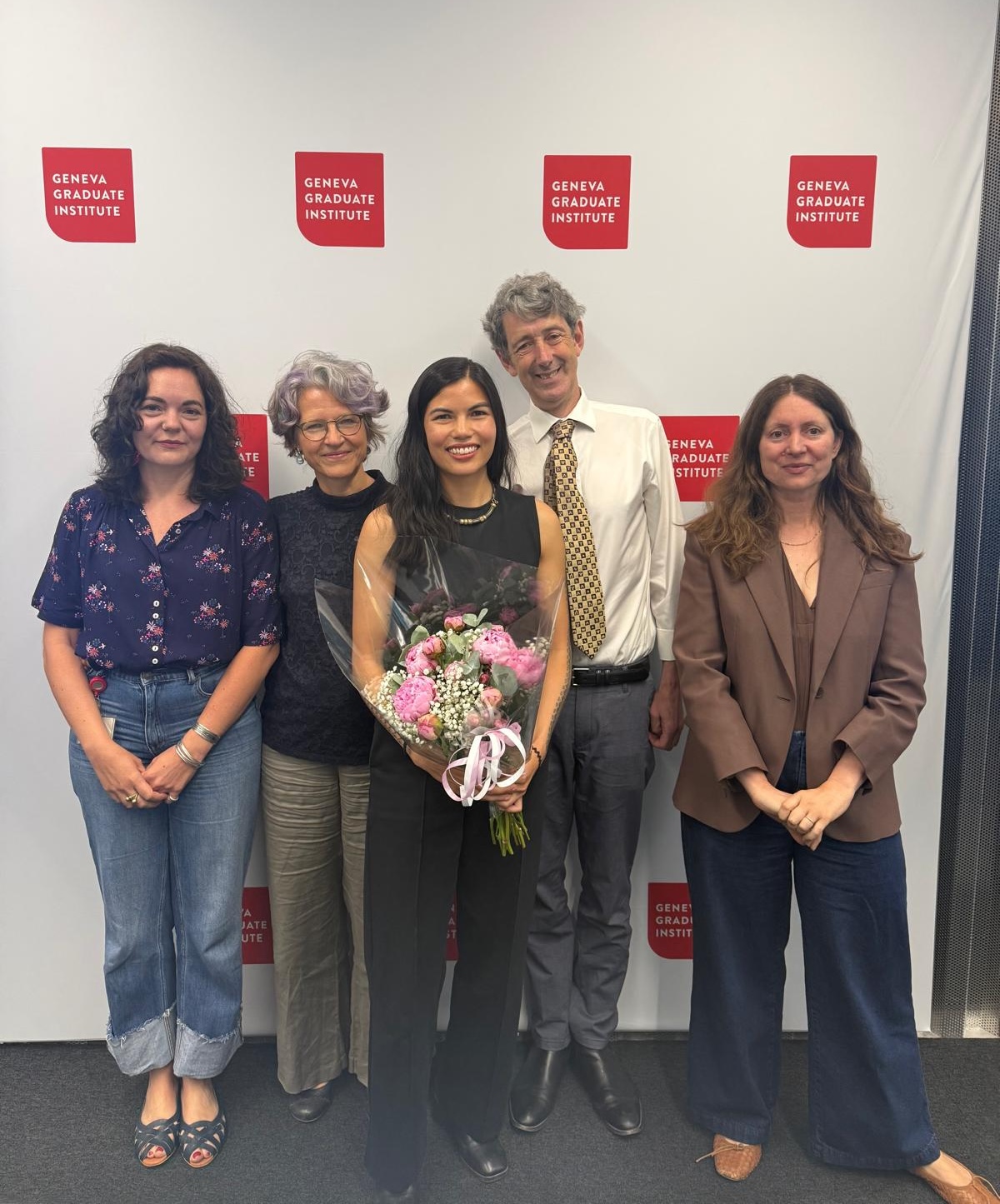
On 3 June 2026, Hayley Umayam defended her PhD thesis in International Relations/Political Science, titled “The Technopolitics of ‘Crying Famine’: Accountability, Expertise, and Controversy in the Recognition of Starvation-related Suffering”. The jury was presided over by Professor Annabelle Littoz-Monnet (right) and included Professor Anna Leander (second from the left), Thesis Co-Supervisor, Associate Professor Julie Billaud (left), Thesis Co-Supervisor, and Professor Alex de Waal (second from the right), The Graduate School of Global Affairs, Tufts University, Medford, USA.
Citation of the PhD thesis:
Umayam, Hayley. “The Technopolitics of Crying Famine: Accountability, Expertise, and Controversy in the Recognition of Starvation-related Suffering.” PhD thesis, Graduate Institute of International and Development Studies, Geneva, 2026.
Access to the PhD thesis:
An abstract of the PhD thesis is available on this page of the Geneva Graduate Institute’s repository. As the thesis itself is embargoed until September 2029, readers are welcome to contact Dr Umayam directly for access.
Banner image by Anas-Mohammed/Shutterstock
Interview by Nathalie Tanner, Research Office