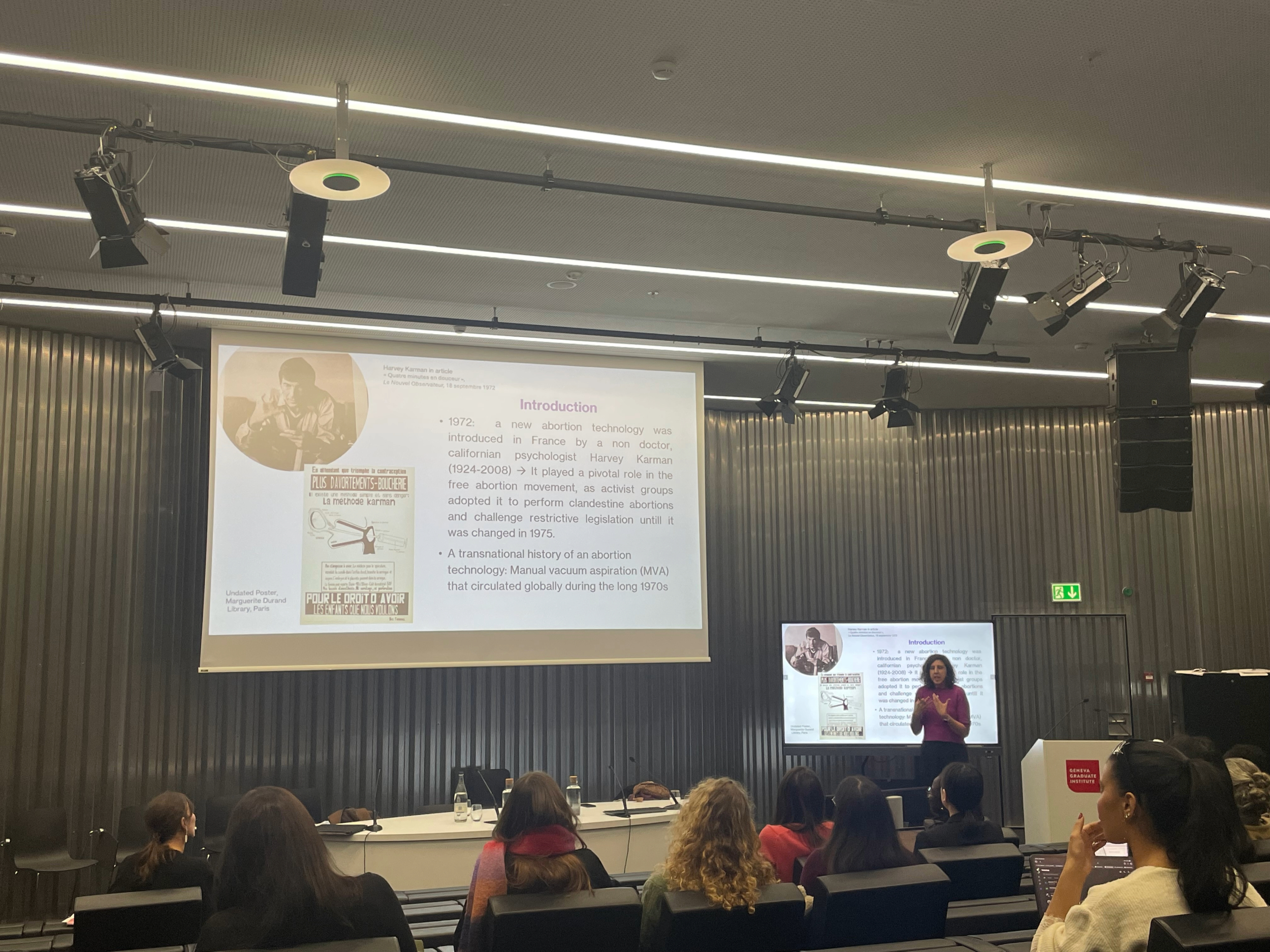


On 26 October, the Gender Centre welcomed historian Bibia Pavard for the launch of her latest book, Pain and Care: A Transnational History of Manual Vacuum Aspiration Abortion during the 1970s. The event brought together students and researchers for a discussion on the global circulation of abortion technologies, feminist activism and reproductive justice.
Introducing the event, Professor Caroline Rusterholz highlighted Bibia Pavard's longstanding contributions to the history of gender, feminism and reproductive politics. From her earlier work on contraception and abortion in contemporary France to her current role as scientific advisor to the French national commemoration of the 50th anniversary of the Veil Law, Pavard has consistently explored how reproductive rights are shaped by political struggles, social movements and lived experiences. Her new book expands this perspective beyond national borders, tracing the transnational travels of a medical technique that transformed abortion practices during the 1970s.
Far from telling the story of a single individual, Pavard's book follows the journey of an object: the manual vacuum aspiration (MVA) device. Drawing on archives from multiple countries, oral histories and material artefacts, she adopts what she describes as a "biography of objects" approach. Through syringes, cannulas, jars, pumps and medical kits, she reconstructs how technologies move across borders and how they acquire different meanings in different social and political contexts.
With remarkable energy and clarity, the author guided the audience through the unexpected trajectories of this technology. Introduced in France in 1972 by the controversial Californian activist Harvey Karman, manual vacuum aspiration quickly became associated with feminist struggles for abortion rights. Yet its history extends far beyond Western Europe. The same technology circulated through feminist self-help networks in the United States, international family-planning programmes in the Global South, and humanitarian interventions following the Bangladesh War of Independence.
One of the central contributions of the book is its exploration of the tensions embedded within these circulations. The very same technology could serve radically different agendas: feminist empowerment, population-control policies, public health initiatives or self-managed abortion activism. By following the object itself rather than institutional narratives alone, Bibia Pavard reveals the complex power relations, inequalities and conflicts that accompanied its global diffusion.
Particularly striking was her reflection on the gendered politics of innovation. While Harvey Karman came to be recognised as the inventor of the technique, feminist activists such as Lorraine Rothman, who developed their own devices and practices, often remained absent from official histories. The book thus offers a powerful reminder that recognition, expertise and authority are themselves historically produced and unevenly distributed.
The discussion also addressed questions of race, care and reproduction. Pavard examined how access to abortion technologies was shaped by racialised assumptions about which reproductive lives were valued and protected. At the same time, she highlighted how the material characteristics of manual vacuum aspiration contributed to a broader transformation in how abortion was imagined and practiced. Flexible plastic instruments, quieter procedures and new forms of emotional support helped shift perceptions of abortion away from violence and towards care.
For Pavard, this represented not merely a technical innovation but what she called a "sensory and affective revolution" – english’ translation for “révolution sensible” in french: a political project that challenged dominant understandings of pain, medical authority and reproductive autonomy.
The lively discussion that followed demonstrated the continued relevance of these historical questions. By tracing the social life of abortion technologies, Pain and Care invites us to reflect on how material objects, emotions and power relations continue to shape reproductive healthcare today.
Article written by Leticia Perez Torreiro