

How did you come to choose your research topic?
My research grew out of a larger project, Quiet Aid: Service and Salvation in the Balkans-to-Bengal Complex, which sought to move beyond Western-centred understandings of humanitarian aid. I wanted to explore how helping others is understood and practised in Kazakhstan, and what these practices could reveal about different ways of doing good. In particular, I was interested in what motivates people to devote their time, resources, and sometimes entire lives to helping others, and how their ideas about giving differ from the models of humanitarian action that dominate international debates.
I initially set out to study one specific humanitarian project in Kazakhstan. As I began my fieldwork, however, I realised that I could not understand this project in isolation. I kept encountering other forms of giving: people raising money for families in need, volunteers organising assistance, religious communities collecting donations, and people who understood helping as a duty to God, their community, or previous generations. I began to see giving not as a distinct activity confined to charitable organisations, but as something woven through many different areas of social life.
A turning point came in the spring of 2024, when devastating floods affected large parts of Kazakhstan. The scale of the disaster and the grassroots response to it prompted me to broaden my research. What struck me was not only how quickly people mobilised to help, but also how they explained their actions through longstanding ideas of mutual assistance, collective responsibility, and shared experiences of hardship. Historical references repeatedly surfaced in these accounts, connecting acts of help in the present to older experiences of suffering and survival.
This brought the different strands of my research together: everyday and crisis-related giving, local traditions of mutual assistance, religious and spiritual understandings of doing good, and the enduring legacies of the Russian and Ottomans Empires and the Soviet Union. I became interested in how giving allows people not only to respond to immediate needs, but also to navigate the histories, relationships, and uncertainties that shape their lives.
Can you describe your research questions and the methodology you used to approach them?
My central question was how people in Kazakhstan give to others and what meanings they attach to these acts. I wanted to understand not only what people give, but also the relationships, obligations, and expectations that giving creates. Why, for example, might someone regularly donate a substantial part of their income, devote their life or career to helping others, or travel to another country for a religious service? What do these actions mean to the people involved, and how do they connect their present lives to the past and future?
To explore these questions, I conducted approximately 16 months of ethnographic fieldwork between 2023 and 2025. I observed the everyday work of charitable organisations, interviewed donors, volunteers, aid recipients, and members of educational and religious networks. I also followed fundraising campaigns on social media and conducted archival research at the Central State Archive in Almaty. The archival materials I found helped me investigate how indigenous practices of mutual assistance and charitable giving were viewed and transformed under the Russian Empire and in the early Soviet period as well as through distant connections with the Ottoman Empire. Combining these different methods allowed me to move between contemporary experiences and older historical records and to establish giving as a meaningful social practice for people in Kazakhstan.
What are your major findings?
In my research, I show that giving and helping others can take forms that are difficult to recognise if we think of aid only as transferring resources in response to suffering. The people I studied also understood revival of traditions, teaching, professional work, mentoring, and even migration as ways of contributing to others or serving God. For some, helping was connected to a duty towards their community; for others, it involved religious devotion, national belonging, or responsibilities inherited from earlier generations. Some also understood their relationships with ancestral spirits as part of these responsibilities. These different understandings of giving do not always fit together neatly. People may disagree about what it means to do good, who deserves help, or what they owe to others. But their practices show that giving is closely connected to how people understand their place in the world and what makes life meaningful.
One of my central contributions is to challenge the assumption that humanitarian responses necessarily detach suffering from its history. In the settings I studied, giving often did the opposite: people mobilised memories of past violence, religious traditions, and inherited obligations to explain why they should help in the present. These memories can give people a sense of responsibility towards others, including people they have never met or those living beyond their own communities and national borders.
My archival research also showed that local traditions of mutual assistance were affected by successive imperial and state-led systems of governance and redistribution. Some practices were marginalised, reclassified, or displaced, but they did not simply disappear. They continued to change and re-emerge alongside projects of modernisation and secularisation, as well as religious traditions and beliefs that remained important in people’s lives.
Together, these findings led me to develop the idea of “giving in the wake of empires”. The concept describes giving to others as a central social practice that allows people continue to live with the consequences of imperial rule long after an empire has formally ended. At the same time, I do not argue that local traditions of giving are inherently better or more just than formal humanitarian aid. Giving can create meaningful connections, but it can also reinforce hierarchies, create obligations, or exclude certain people. Nor can it resolve the deeper inequalities that make assistance necessary in the first place.
What could be the social and/or political implications of your thesis?
I hope my research can help us better understand how people respond to crises, including natural disasters, displacement, economic hardship, and the lasting effects of historical violence. When people organise assistance, they do not necessarily act according to a single, universal model of humanitarianism. Their motivations may come from local traditions, religious beliefs, shared histories, or relationships that formal aid organisations may not fully recognise.
For governments and aid organisations, this means that understanding existing community networks and local ideas about responsibility can be just as important as identifying people’s material needs. People are not simply recipients of assistance, nor are volunteers merely filling gaps in public services. They bring their own knowledge, values, and ideas about what helping others should involve. Taking these seriously can help organisations understand how assistance is organised and what it means to the people involved.
However, my research does not suggest that grassroots giving can fully solve the problems associated with modern humanitarianism. Giving can acknowledge experiences of repression and displacement, but the narratives of gratitude and mutual indebtedness it produces may leave questions of responsibility less visible. For me, the political implication is that we need to understand what enables the imperative to help others, what relationships it creates, and what problems it leaves untouched. Taking grassroots initiatives seriously means recognising the agency of the people involved without romanticising their work or allowing the state to evade its responsibilities.
Finally, my research helps us understand how empires continue to shape modern societies long after imperial rule has formally ended. Their legacies persist not only through political institutions or economic inequalities, but also through the ways people understand responsibility, remember the past, and relate to one another. In Kazakhstan, people draw on traditions and forms of knowledge that have survived, changed, or become fragmented over time to make sense of their experiences and find their own ways of living. Recognising these connections will not, on its own, bring justice or reconciliation. But it can help us understand why certain acts of assistance carry such deep meaning for people, how historical experiences continue to influence social and political life, and how people create possibilities for living together in the aftermath of empire.
* * *
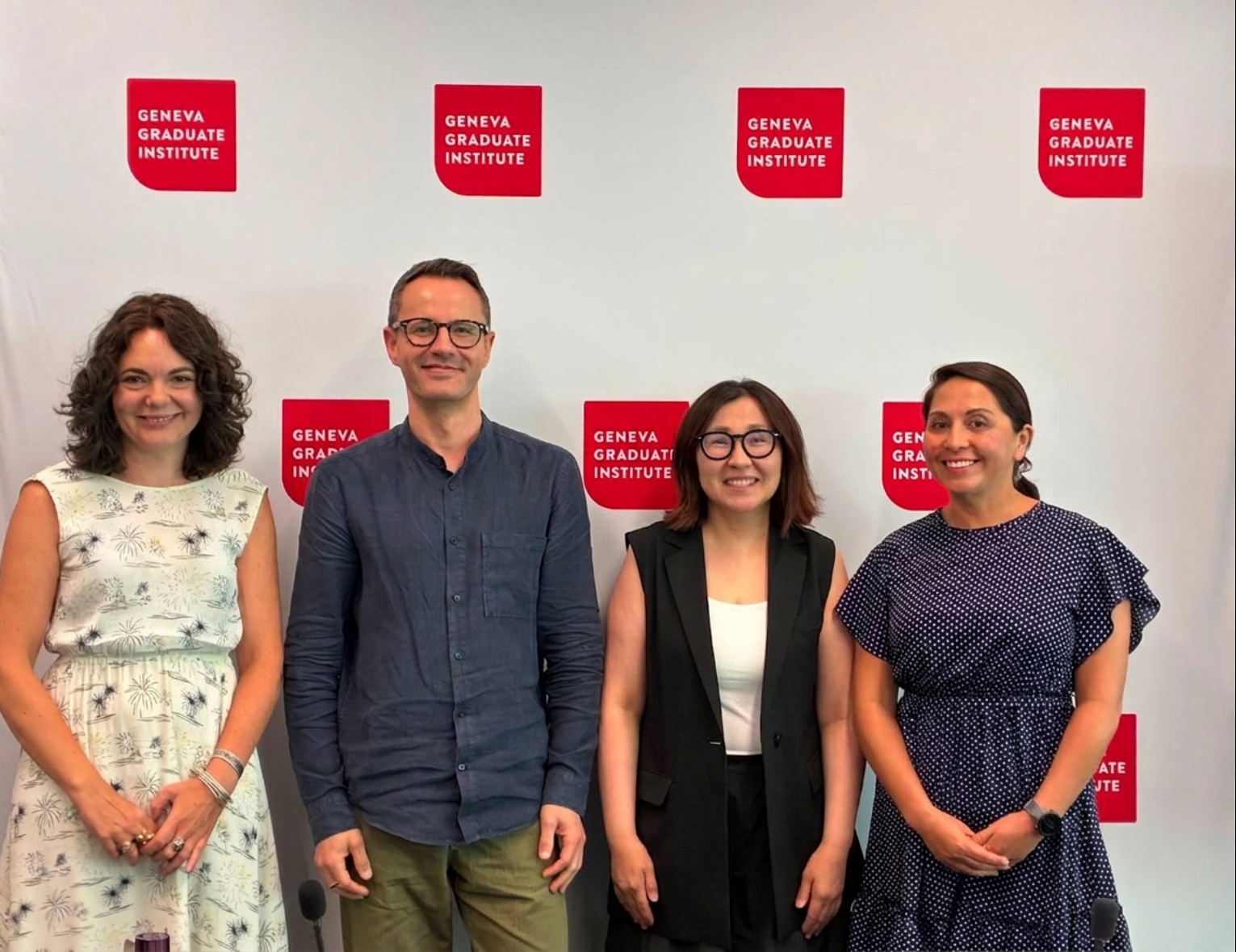
On 24 June 2026, Gulzhan Begeyeva (second from the right) defended her PhD thesis in Anthropology and Sociology, titled “Giving in the Wake of Empires: Reclaiming God and the Good in Kazakhstan”, and was awarded the distinction summa cum laude with commendations from the jury. The committee was presided over by Associate Professor Julie Billaud (left) and included Research Professor Till Mostowlansky (second from the left), Thesis Director, and Associate Professor Diana Ibanez-Tirado (right), University of Sussex, Brighton, UK.
Citation of the PhD thesis:
Begeyeva, Gulzhan. “Giving in the Wake of Empires: Reclaiming God and the Good in Kazakhstan.” PhD thesis, Graduate Institute of International and Development Studies, Geneva, 2026.
Access to the PhD thesis:
An abstract of the PhD thesis is available in the Geneva Graduate Institute’s repository. As the thesis itself is embargoed until June 2029, please contact Dr Begeyeva for access.
Banner image: part of a photo taken during Gulzhan Begeyeva’s fieldwork at a Ramadan fast-breaking (auyzashar) event in Astana organised to raise funds to build houses for low-income families. The Kazakh yurt (kiyiz ui), slowly assembled during the event, symbolises a renewed expression of asar, a historically marginalised tradition of collective mutual aid, now increasingly reconfigured through digital fundraising campaigns that mobilise thousands of small contributions to provide homes for those in need.
Interview by Nathalie Tanner, Research Office.