


How did you come to choose your research topic?
I chose this topic because I kept running into the same puzzle in my studies and early research: markets don’t deliver certain socially important outcomes when there’s no profit in them. Governments often step in, but we know surprisingly little about how effective these interventions actually are. They’re often labelled inefficient or politically distorted, and the debate is muddied by the fact that these policies are complex, long-run, and slow to show results.
This gap pushed me to dig deeper. I wanted to understand why some public investment programmes work while others fail, and how different institutional conditions shape those outcomes. Being Italian, I also knew there was a rich and complicated history of large public investment efforts in my country following World War II — a perfect setting to study this properly. The initial idea behind my thesis was to use this rich setting by collecting new long-run historical data on those programmes and uncovering real, generalisable evidence about the mechanisms that make these interventions succeed or fall short.
Your thesis is composed of three essays. Can you describe each of them?
Each essay examines a distinct form of public intervention: subsidised credit, infrastructure provision, and large-scale transport expansion.
The first paper, “Janus Faces of Progress: Evaluating the Dual Strategy of the Cassa per il Mezzogiorno for Regional Development, 1950–1984”, evaluates the Cassa per il Mezzogiorno — a state-led development agency created to promote economic growth in Southern Italy — through its dual funding streams: industrial and infrastructural. I use modern causal inference techniques addressing multiple treatments and time dependency in treatment assignment to examine how the two channels differently shaped local development outcomes. The study reveals a divergence in effectiveness: industrial funding consistently fostered industrial growth, but this came at the cost of slower development in public infrastructure; on the other hand, the success of infrastructure investments depended critically on implementation — particularly whether projects were coordinated across municipalities and targeted sectors with easily observable outputs.
The second paper, “Banking on the South: The Impact of CasMez’s Funding Strategies on Southern Italian Firms”, focuses on the firm-level effects of the Cassa per il Mezzogiorno’s subsidised credit programme. I developed an automated algorithm using natural-language-processing techniques to digitise and standardise historical financial records, creating a new 15-year panel of Southern Italian firms that allows me to track how public financing shaped their long-term trajectories. Using modern difference-in-differences estimators, I find that subsidised credit increased firms’ ability to leverage assets for profit generation, consistent with gains in scale and efficiency. At the same time, complementary evidence suggests that restrictive credit regulations limited the programme’s reach — excluding otherwise creditworthy firms and weakening its broader regional impact.
The third paper, “Paving the Way: Highway Access and the Reconfiguration of Local Labor Markets in Italy” (co-authored with Sara Bagagli from LSE), explores how transport network expansion reshaped Italy’s local economies, finding that improved connectivity reduced industrial specialisation and reinforced spatial integration within labour market communities. For this paper, I developed a custom image-processing algorithm that extracts road structure from historical road maps, allowing me to reconstruct the entire Italian road network for 40 years. Leveraging the reconstructed road network, the study shows that highway access anchored municipalities more firmly within stable economic regions, with industrial structures adapting to the characteristics of these integrated communities.
What is the key takeaway from your research?
Taken together, the three essays in my thesis challenge simple, linear stories about state-led development and point to three broader conclusions. First, public investment can trigger lasting economic change, but only when institutional design, implementation capacity, and the choice of financial tools are aligned with how the private sector actually operates. Second, development programmes that overlook who can access credit, infrastructure, or market opportunities risk reinforcing the very inequalities they are meant to address. Third, spatial interventions should be understood not just as improving access but as reshaping competitive hierarchies — creating winners and losers in ways that are often overlooked.
How do you see your thesis contributing to the existing literature in your field?
My thesis contributes to the literature in two ways. Substantively, it provides new evidence on the long-run effects of different types of public investment — credit, infrastructure, and connectivity — and shows that their impact depends far more on institutional conditions and access mechanisms than on spending levels alone. But the contribution is also methodological. To overcome the lack of consistent historical data, I developed custom computational tools and assembled a new, long-run dataset that simply didn’t exist before. This allowed me to evaluate public investment policies with a level of precision that earlier studies couldn’t reach. More broadly, the thesis shows how combining archival research with modern computational techniques can open up empirical questions that were previously out of reach in economic history and public-finance research.
* * *
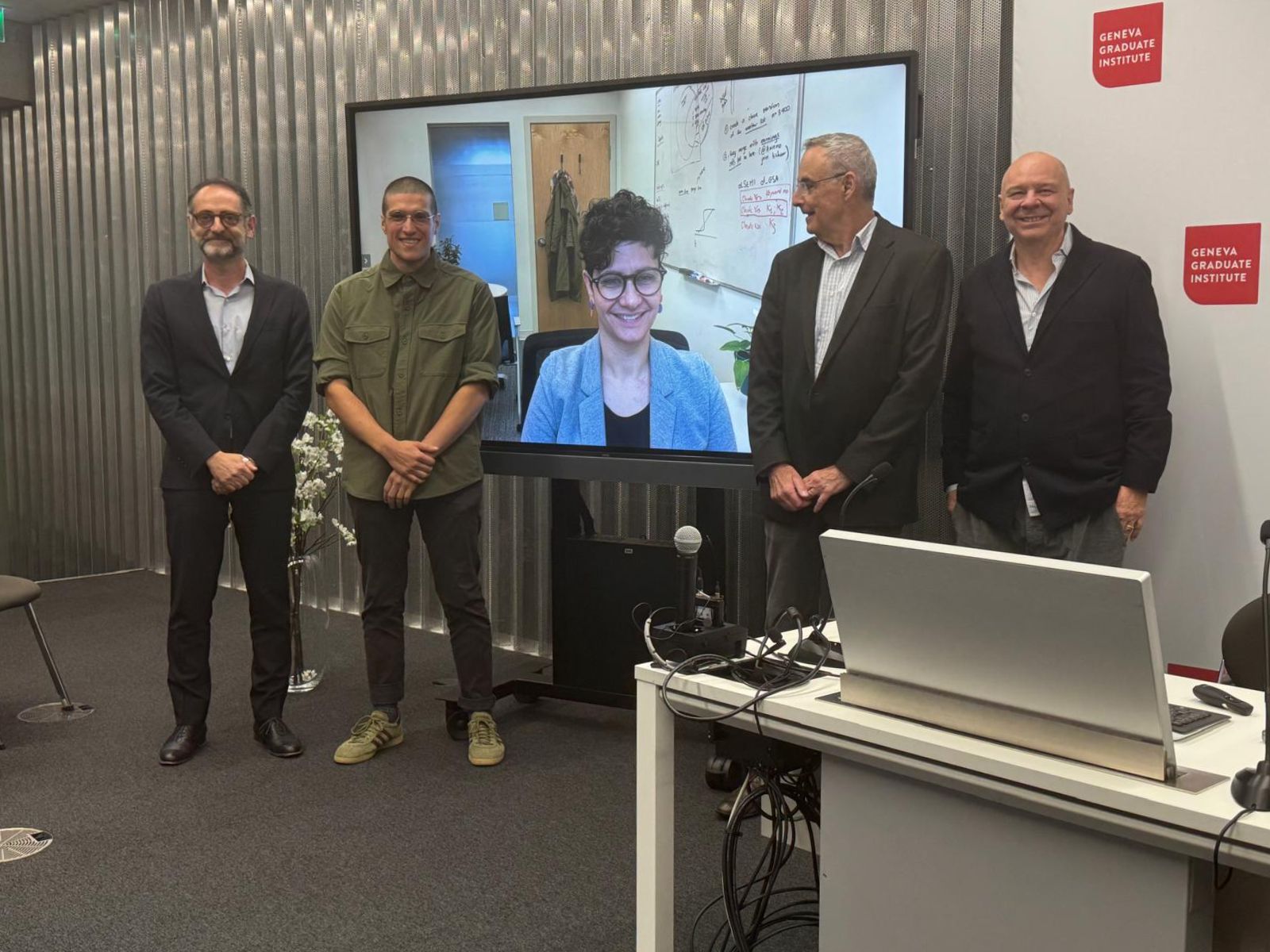
On 29 October 2025, Michele Zampa (second from the left) defended his PhD thesis in International History, titled “Essays on Public Investment and Economic Development in Postwar Italy”. He received summa cum laude with special commendations from the committee, which was presided by Professor Ugo Panizza (right) and which included Professor Rui Esteves, Thesis Co-Supervisor (left), Professor Nathan Sussman (second from the right), Thesis Co-Supervisor, and Assistant Professor Réka Juhász, Vancouver School of Economics, University of British Columbia, Canada.
Citation of the PhD thesis:
Zampa, Michele. “Essays on Public Investment and Economic Development in Postwar Italy.” PhD thesis, Graduate Institute of International and Development Studies, Geneva, 2025.
Access:
An abstract of the PhD thesis is available on the Geneva Graduate Institute’s repository. As the thesis itself is embargoed until November 2028, please contact Dr Zampa for access.
Banner image: Italy – Naples / erjk.amerjka / CC BY-NC-SA 2.0.
Interview by Nathalie Tanner, Research Office.