


How did you come to choose your research topic?
The research was born out of a few different strands. In 2017, at the end of my master’s programme, I worked with Prof. Moon on a project that looked at global health agenda-setting by corporate actors. Within this conversation, we started to talk about corporate rationales beyond the firm and the profit-motive, examining how capital markets, debt relationships and investor relationships drive the firm’s choices related to pursuing profit and organising it within the firm. We started to ask, How does the interest of financial actors complicate the way we look at the role of private actors in global health?
My background as a banking and finance lawyer (before my master’s in Global Health Law and International Institutions) also informed my interest in the topic. After my master’s, I worked for the WHO Western Pacific Regional Office (WPRO). This encouraged me to look at the broad topic of “financialisation in global health” from a development lens and to further understand the role of international actors and their approach to economic interventions. This was reinforced by the discussions about the allocation of resources during the Covid-19 pandemic, and the calls for innovative financing to address global health concerns at that time. I found myself thinking not about how to raise more money for health, but why is it that, after years of trying to raise financing through different mechanisms and sources, we were still asking the same questions.
Can you describe your research questions and the methodology you use to approach those questions
This thesis starts by asking broadly, What role does law play in the financialisation of global health? It evolves into several sub-questions:
- How does the increasing reliance on private sources of financing or blended finance in global health reshape international legal frameworks?
- To what extent do global health financial instruments align with or diverge from international human rights principles?
- How do innovative financing instruments prioritise investor returns over equity and impact the right to health, and specifically the aim of improving access to essential medicines?
The thesis uses a case study approach. It looks at three innovative financing instruments for health: Unitaid, the Pneumococcal Conjugate Vaccine Advanced Market Commitment, and the Affordable Medicines Facility for malaria. The methodology is grounded in law and political economy. It follows the tradition of historical institutionalists by examining the origins and transformations of these institutions and how they engage in political-economic relations. The thesis makes use of Pistor’s conclusion that law encodes finance. It also builds on the work of law and development scholars who explore law as both a material and discursive project, by exploring the genealogy of the three innovative financing instruments and tracing the structure and movement of funds through them.
What are your major findings?
The thesis argues that law assists in the financialisation of global health by establishing norms that prioritise financial actors, protecting assets as vehicles for extraction, and integrating financiers into global health governance. Though innovative financing instruments for health produced real health outcomes, they also entrenched systemic inequalities and marginalise rights-holders. The thesis challenges the managerial framing of resource mobilisation and calls attention to how legal architecture determines whose interests global health ultimately serves.
This thesis argues that innovative financing instruments for health, whilst attempting to address inequities of access to medicines, themselves reiterate, accept, and facilitate forms of exploitation and structural inequality embedded in modern economic systems. These instruments prolong the conditions of such inequities, mitigating suffering in the short term but leaving populations vulnerable. By interrogating the sources of private power and how these have been infused into the global health agenda, the thesis highlights the constitutive role that law plays in shaping economic systems, how legal norms and structures are not politically neutral but organise economic interactions. It also looks at the role of development in mainstreaming these structures. The global health development agenda provides a vehicle for protecting (and expanding) the profitability of corporate and financial actors, makes relative profitability a condition on which financing for access to medicines is provided, and naturalises the connection between markets, hierarchies of control, and access to medicines. Legal relationships underpin these positions.
The case studies explored in the thesis help to illustrate the privatisation of development and how this rests on the naturalisation of financialised norms and the power of financial institutions. The thesis explores the relationship of law to power, particularly: (1) the manifestation of power through the establishment of dominant frames, (2) the way in which law creates economic power, and creates links and ways of relating between individuals and institutions, and (3) the role of expertise in shaping both problems and solutions. It argues that law is a key tool in how economic value, and economic values, are produced and made salient, thus narrowing what is possible, permissible and desirable in global health. The thesis attempts to shift the conversation away from the aspirational sentiment of human rights and to focus on the aspects of law that are often taken for granted and remain in the background. Yet, it is these legal relationships that form the basis on which innovative financing instruments for health are constructed and legitimised. That is, the thesis challenges the claim that an improvement in human rights can be based on outcome alone.
What could be the social and political implications of your thesis?
The thesis engages in the contemporary conversations in global health and the political economy of the right to health. As the US and Argentina leave the WHO, as aid budgets are again reduced, the conversation of turning to “innovative” sources of financing to fill the gap is again emerging. The thesis presents a critique in both the form and substance of these types of initiatives. It argues that there is a need to re-politicise the conversation on access to medicines (and health more broadly) and expand this conversation on what the collective nature of the right to health means, versus an individual realisation. It argues for a re-examination of health as a rights question, not only as a question of technical optimisation by expert managers. It argues that the managerial turn in global health can and should be contested.
* * *
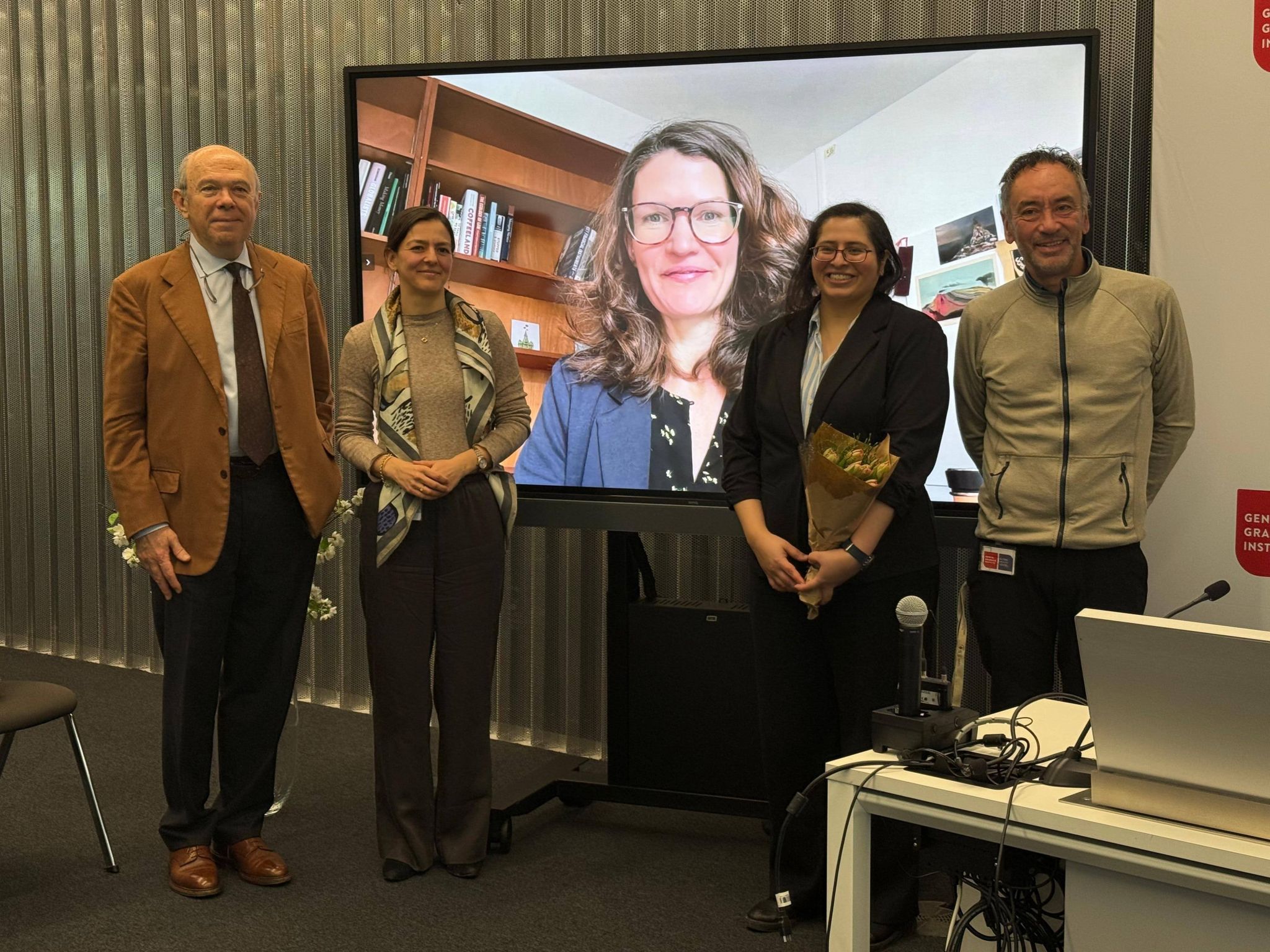
On 19 February 2026, Dena Kirpalani defended her PhD thesis in International Law, titled “International Law and the Financialization of Global Health”. Committee members were Associate Professor Anne Saab, Thesis Co-Supervisor; Professor Vinh-Kim Nguyen, Thesis Co-Supervisor; Senior Visiting Professor Gian Luca Burci, President of the Committee and Internal Member; and Senior Lecturer Anna Chadwick, School of Law, University of Glasgow, Scotland.
Citation of the PhD thesis:
Kirpalani, Dena. “International Law and the Financialization of Global Health.” PhD thesis, Graduate Institute of International and Development Studies, Geneva, 2026.
Access:
An abstract of the PhD thesis is available on the Geneva Graduate Institute’s repository. As the thesis itself is embargoed until May 2029, please contact Dr Kirpalani for access.
Banner image by Kapitula Olga/Shutterstock.
Interview by Nathalie Tanner, Research Office.