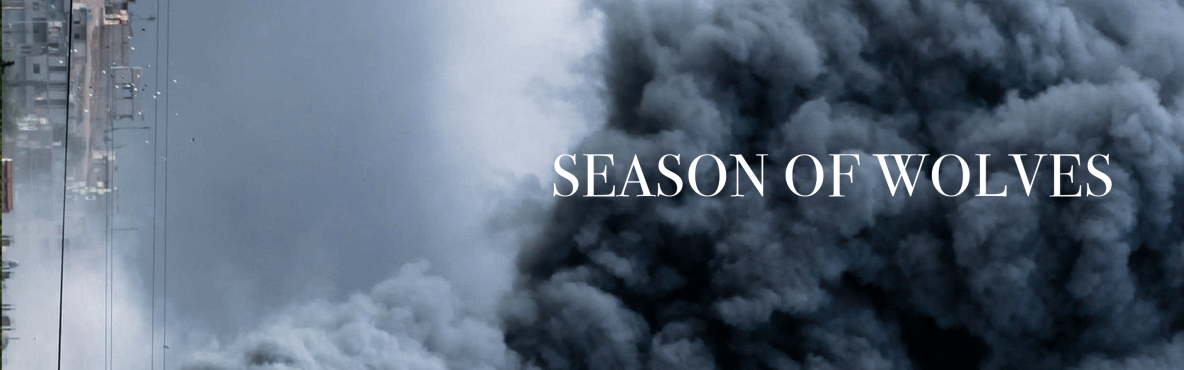


How did the idea for this book come about, and how long had your father been working on this project?
Our father developed Season of Wolves over the final years of his life. The work was a culmination of years of research, writing, and teaching on the principal subjects of the book.
He felt that too many seemingly disparate developments in international affairs were unfolding simultaneously without being adequately connected. This book was his attempt to bring them into a single history.
In many ways, it also represented a culmination of his intellectual trajectory. His earlier key books, Contre-Croisade, Understanding Al Qaeda, and A Theory of ISIS, had examined political violence and terrorism closely. Here, he widened the lens. He wanted to understand the entire period that followed 9/11 and the political, social, and technological forces that had come to define it.
He described the project himself as a “panoramic history” of the previous twenty-five years, written as both “cinematic history” and “deep history”. That combination was very much him: international history alongside film, music, literature, and art, all used to illuminate the world as he saw it.
How does he view the two decades that followed the attacks of 11 September 2001, and what, in your view, is the book’s central thesis?
He saw 9/11 as one of the defining ruptures of contemporary international history, but the book is ultimately about what followed. His argument is that the first quarter of the twenty-first century is a period that has been narrated too narrowly through terrorism, counter-terrorism, and security angles. Beneath that familiar history, he identified a deeper transformation of the international order.
He called its central dynamic “ambient degeneration”. Across the book, to illustrate this, he traces five interconnected developments: the militarisation of international affairs; racism and the normalisation of cruelty; the systematisation of propaganda; the advance of authoritarianism within formally democratic systems; and the advancement of surveillance technology.
Season of Wolves brings these developments together and asks what kind of world their convergence has produced.
Why was this subject so important to Professor Mohammad-Mahmoud Mohamedou? In what ways do his analyses remain particularly relevant today?
The events of September 11th remained at the centre of his intellectual life because he understood them as a hinge in the politics of the early twenty-first century.
He kept returning to several questions: What did 9/11 authorise? What did it reorder? What did it reveal about forms of power already in motion?
What makes the book particularly timely is that it carries this history through the wars in Afghanistan and Iraq, the transformations of the Sahel, the resurgence of authoritarian politics, the technological revolution and, finally, 7 October 2023 and the war in Gaza. Events that can appear disconnected emerge as parts of a longer historical trajectory. His purpose was also intergenerational.
As he wrote while preparing the manuscript: “Facts forgotten by those who lived through this history. Unknown to those born in it. And more importantly, facts for those to come.”
Following your father’s death, how did you decide to take on this publishing project? How was the collaboration with the twelve PhD students at the Institute organised?
For us, leaving the book unfinished was never an option. These pages contained the final work of his life and brought together questions he had pursued for more than two decades, many of which had also accompanied us as he raised us. We had grown up with these conversations. Dinner-table questions about our days could easily give way to discussions of international affairs, often prompted by a headline in the news or an image on our TV. He would seize on these moments to push us to understand what was really happening, what history lay behind what we were seeing, and what the prevailing account might be leaving out. We were, in that sense, among the (involuntary) recipients of a very long-running seminar.
Completing the book therefore felt both deeply personal and intellectually familiar. It brought us back to arguments, references, and ways of looking at the world that we had heard develop around us for years.
He had completed the structure, preface, introduction, and first two chapters (Chapter One, “The Age of War” and Chapter Two, “Geographies of Cruelty”). He left an extraordinary archive of research, outlines, sources, lectures, notes, and drafts for what remained.
With Professor Davide Rodogno, one of his closest friends and colleagues, we considered who could carry the remaining chapters forward. His students quickly became the natural answer to take on the task of completing the work. They had learned from him, debated with him, and understood his intellectual universe.
Beginning in late 2024, we worked collectively, dividing the remaining chapters according to expertise and working through his materials alongside his published scholarship and the films, music, literature, and art that populated his thinking and our household discussions. It became an exercise in scholarship, but also in friendship, transmission, memory, grief and, crucially, legacy. We wanted to honour him for all that he had given to us.
To what extent does the book faithfully reflect your father’s vision and thinking, despite the necessary interventions to complete the manuscript?
We were always conscious that nobody could reproduce his pen or his mind. Honouring him through this project therefore had to mean something more rigorous than imitation.
He had left the architecture of the book remarkably clear: its table of contents, chapter titles, argument, methodology, completed chapters, and extensive research files for those that remained. Our responsibility was to follow that intellectual design as faithfully as possible while allowing the co-authors to complete the work by writing honestly in their own voices.
There is consequently a clear distinction between what he completed and what others carried forward, which the book acknowledges openly. Yet the argument, structure, and intellectual destination remain his. He planted the seeds with precision and our task was to allow them to grow.
This collaborative work is also a tribute. What do you hope readers will take away from Mohammad-Mahmoud Ould Mohamedou’s intellectual and human legacy through this book?
We hope readers encounter first and foremost the intellectual seriousness with which he approached the world: his insistence on facts, his refusal of easy explanations and sweeping and convenient narratives, his curiosity and his belief that history had to be understood beyond conventional categories.
But there is also the professor behind the book: the one who gave his time and knowledge with extraordinary generosity. Teaching was a vocation for him, and the fact that former students ultimately helped complete his final work feels deeply appropriate. Many have since described him as le professeur gratuit, because teaching and intellectual exchange never really stopped at the classroom door.
There is something deeply fitting, then, in the way Season of Wolves ultimately came into the world. His final book was completed by the family he raised, the students he taught, and the colleagues with whom he thought and worked with.
For us, that is perhaps the clearest expression of his legacy: the ideas continued because he had spent his life investing them in others. The book is finished, but the thinking it carries forward is not.