


How did you come to choose your research topic?
I encountered discussions on transnational feminist literature and the engagement of feminist activism and mobilisation within the context of international governance just before applying for the doctoral programme. The topic immediately captured my interest, as I was deeply involved in feminist action in Brazil, particularly through the Ele Não (“Not Him”) mobilisation in 2018, which opposed the rise of a misogynistic, racist, homophobic, and authoritarian presidential candidate. At the same time, I was considering applying for a PhD abroad as a way to distance myself from that emerging political scenario. The intersection of theory and practical activism has always driven me, and I was excited about the prospect of writing from this perspective. At the same time, I became aware of an ongoing discussion on rural women and gender within the Committee on World Food Security (CFS), as well as the engagement of feminist movements in this international policy space. Not only were peasant and rural women’s movements from Brazil involved in these negotiations, but a Brazilian coordinator of one of these grassroots movements — whose organisation was also part of La Via Campesina — had been actively participating and taking on a leadership role in the process. That was when I began to recognise and genuinely appreciate the vibrancy of rural women’s movements in Brazil. The topic immediately resonated with me — not only because their anticapitalist struggle defines them, but also because, given my background in international political economy, it aligned closely with my own standpoints.
Can you describe your thesis questions and the methodology you used to approach those questions?
My research questions were: How do grassroots peasant and rural women’s movements transnationally weave together a counter-hegemonic project in opposition to the dominant capitalist model? How does this process unfold within the Brazilian context? And how is this alternative project reflected in global food governance, particularly within the context of the CFS?
Guided by a qualitative and interpretive methodological perspective, I adopted a self-reflexive stance in analysing the specificities of political and historical events, which are essential for contextualising the subject of research. I recognised my own positionality — the privileges I hold and the structures that shape my perspective, both as a person and as a researcher. This awareness guided my methodological choices, which are rooted in feminist epistemology, self-reflexivity, and decolonial critique.
To capture the complexity of the process studied, I employed a multi-sited ethnography, following movements, ideas, and people across spaces, from rural communities in Brazil to international negotiations in Rome. I traced the circulation of knowledge — how local experiences, epistemologies, and political strategies move, transform, and reverberate across different levels of engagement. Through this approach, I sought to challenge the binary between “local” and “global”, showing that multiple, nonlinear, and (dis)continuous interactions among people, movements, and organisations take place in between.
I participated in meetings, assemblies, and mobilisations of the Peasant Women’s Movement (MMC) and the Rural Working Women’s Movement of the Northeast (MMTR-NE), spending time in the homes of some of their members. These are two of the most active peasant and rural women’s movements in Brazil, known for their strong capacity to organise and mobilise. With them, I joined the Margaridas’ March, a national mobilisation that brings together diverse movements and activists around the demands of peasant and rural women.
I also became part of the Women and Gender Diversities Working Group within the Civil Society and Indigenous Peoples’ Mechanism for Relations with the UN Committee on World Food Security (CSIPM). This allowed me to experience and analyse from within how grassroots women navigate these global spaces.
What are your major findings?
My thesis reveals that peasant and rural women are not passive participants in food governance but rather subjects with agency in global political agendas. I draw on the experiences and contexts of Brazilian peasant and rural women’s movements to illustrate a transnational mode of mobilisation and articulation aimed at developing an alternative political project. Through their collective mobilisation, they construct what I call a counter-hegemonic project, which challenges the capitalist, patriarchal, and colonial logic dominating global food systems. This alternative project is grounded in food sovereignty — the right of peoples to define their own food systems — and it builds upon feminist, decolonial, and ecological principles.
To analyse these complex, layered relationships — and by embracing a decolonial commitment — I developed what I call the “patchwork weaving framework.”
A patchwork quilt is created by stitching different pieces of fabric together. In Brazil, fuxico is a traditional craft technique that involves reusing leftover fabric scraps, cutting them into circular shapes, and gathering the edges to form small fabric bundles that, when assembled, resemble flowers. When woven together, these bundles create various materials while retaining their own colour, texture, and pattern.
The process of stitching fuxicos begins on the ground, with peasant and rural women: guided by ancestral knowledge, everyday experiences, and practices deeply connected to their own epistemologies, which differ from those rationally imposed by the modern, colonial, gender system. The stitching of the fuxico patchwork continues as the grassroots movements come together to build collective action, such as organising the Margaridas’ March, and the March itself, which I had the opportunity to experience.
In the same way that peasant and rural women weave connections among themselves, they also do so across Latin America, and into transnational spaces like the CSIPM, where they continue stitching their collective political project.
I analysed this process empirically through the gender negotiations within the CFS, where the CSIPM Women and Gender Diversities Working Group actively participated by advocating for rural and peasant women’s rights, questioning neoliberal policies, while testing their stitched-together project. Their actions and subversive engagement provoked strong reactions from conservative states and neoliberal governments that sought to weaken these proposals by, respectively, attacking gender diversity and protecting agribusiness interests. Such reactions were felt as violence by the members of the CSIPM, and I interpret them as a continued effort to perpetuate the hegemonic capitalist system. Nevertheless, I suggest that this backlash reveals the transformative potential of the counter-hegemonic project: when grassroots feminist ideas provoke opposition, it is because they threaten existing systems of power — patriarchal, capitalist, and colonial structures that depend on the control of women’s bodies and nature.
* * *
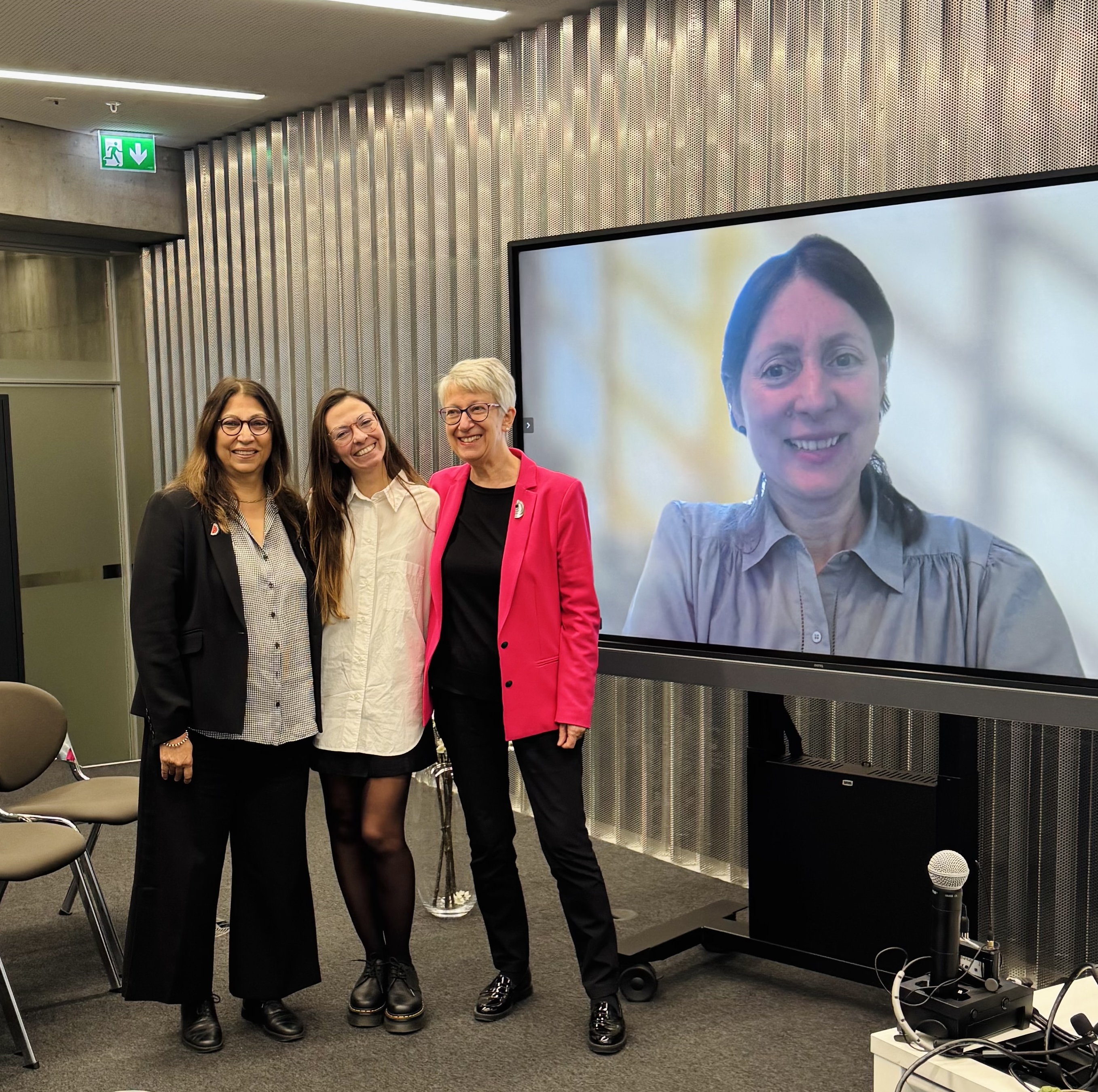
On 24 October 2025, Carolina Fontes dos Santos (second from the left) defended her PhD thesis in International Relations/Political Science, titled “Weaving a Patchwork Political Project: Transnational Feminist Mobilization and the Struggles of Peasant and Rural Women in Brazil”. Professor Annabelle Littoz-Monnet (right) presided over the committee, which included Honorary Professor Elisabeth Prügl (second from the right), Thesis Director, and Professor Shirin Rai (left), Department of Politics and International Studies, SOAS University of London, UK.
Citation of the PhD thesis:
Fontes dos Santos, Carolina. “Weaving a Patchwork Political Project: Transnational Feminist Mobilization and the Struggles of Peasant and Rural Women in Brazil.” PhD thesis, Graduate Institute of International and Development Studies, Geneva, 2025.
Access:
The thesis can be accessed via this page of the Geneva Graduate Institute’s repository.
Banner image by Marco Tulio / Shutterstock.
Interview by Nathalie Tanner, Research Office.