


How did you come to choose your research topic?
I first thought of this research topic in 2019 when I was contemplating what topic to write about for my LLM thesis and PhD research proposal. At that time, there was a huge measles outbreak in the Philippines, which the World Health Organization (WHO) attributed to the country’s low immunisation coverage due to vaccine hesitancy caused by misinformation. What I initially thought was an isolated case in the Philippines turned out to be a problem occurring in different parts of the world. By the end of 2019, both the WHO and UNICEF declared a global measles crisis, which these organisations attributed to the alarming rise of vaccine hesitancy due to misinformation. The WHO also listed vaccine hesitancy among the top ten threats to global health. The following year, in 2020, the COVID-19 pandemic happened, and it was also compounded by vaccine hesitancy and misinformation. This prompted me to ask what international law got to do, if at all, with the issues of vaccine hesitancy and misinformation.
Can you describe your thesis questions and the methodology you use to approach them?
Drawing upon law and language studies, critical legal studies, law and communication studies, and science and technology studies, my PhD thesis critically examines the role of international law in science communication and how it contributes to the problem of vaccine hesitancy. Its main argument is that international law, through the way it communicates science, contributes to mistrust of science. Indeed, the language of international law communicates specific depictions of scientific knowledge and expertise that shape the framing of global problems such as vaccine hesitancy.
My research specifically looks at the language and rhetoric of the WHO. Based on an examination of the guidelines, recommendations, position papers, resolutions, and statements issued by the WHO, my study argues that the way the WHO communicates science contribute to a setting wherein people become distrustful of scientific knowledge and experts, and sceptical of how health risks and crises are problematised. This then leads to a ripe ecosystem for vaccine hesitancy and misinformation to thrive.
What are your major findings?
The issue of vaccine hesitancy is often linked to misinformation. However, when efforts to solve vaccine hesitancy are too narrowly concentrated at the level of misinformation, it becomes too easy to miss the bigger picture where misinformation is only a symptom of the bigger problem that is the mistrust of science and scientific expertise. When scientific issues are rigidly and narrowly framed, this promotes an elitist and exclusionary view of science and scientific experts that leads to people distrusting them and becoming more open to believing information that has no scientific basis. This distrust of science and scientific experts is then amplified on social media platforms, where people share different types of content that include misinformation.
What could be the social and political implications of your thesis?
Vaccine hesitancy continues to be a big problem. I hope this study sheds light on the complexity and multifaceted nature of this problem. More importantly, I hope this research successfully conveys how science communication in international law can shape public trust in science. While misinformation can instigate or amplify mistrust, the representation of scientific knowledge and expertise in international law as authoritative yet opaque also contributes to a context in which mistrust of scientific knowledge and backlash against expert authority can thrive.
* * *
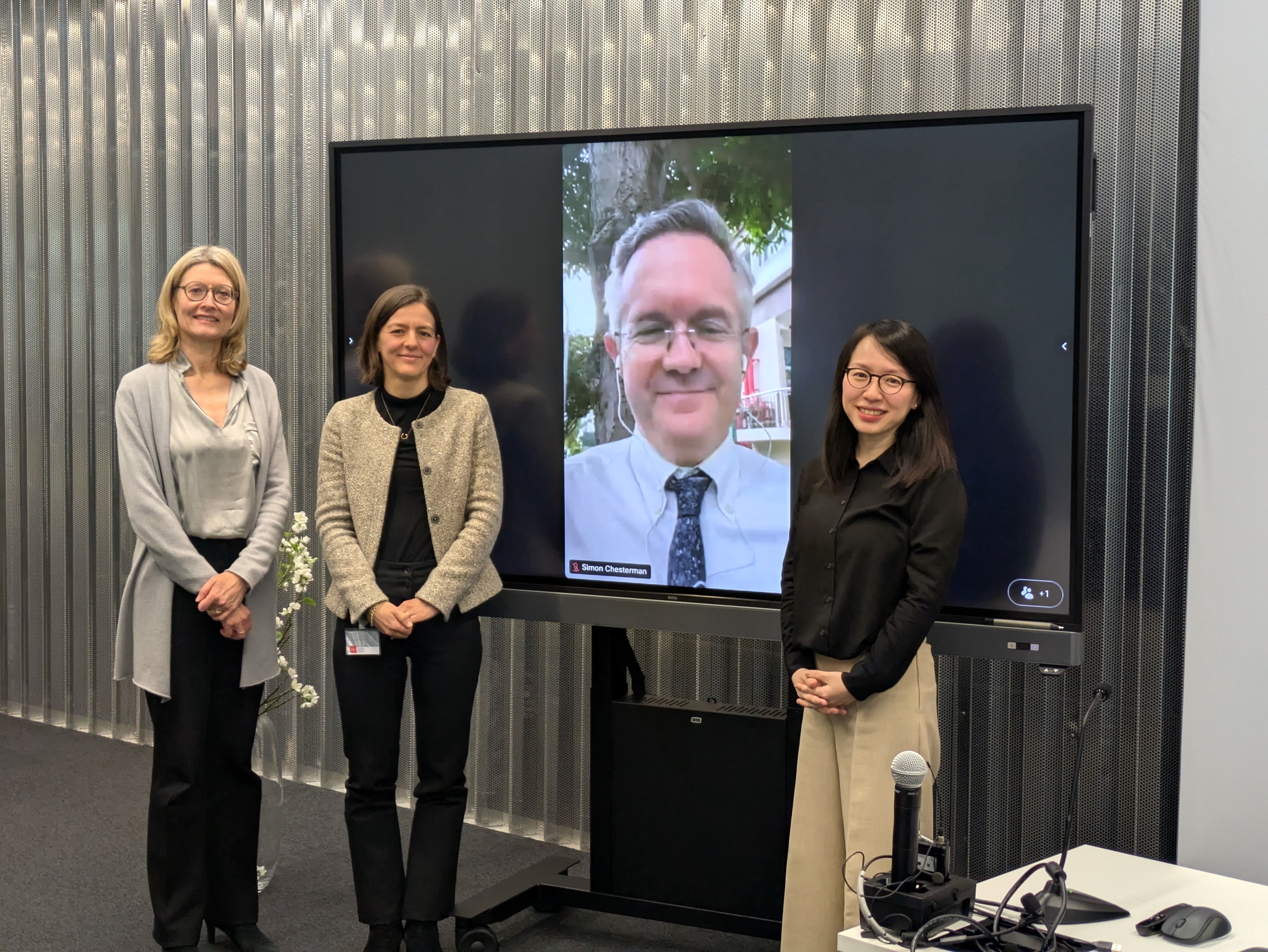
On 24 November 2025, Sophia Mo defended her PhD thesis in International Law, titled “Understanding Vaccine Hesitancy: A Critique of How International Law Communicates Science”. Committee members were Associate Professor Anne Saab (second from the left), Thesis Supervisor; Professor Janne Nijman (left), President of the Committee and Internal Member; and Professor Simon Chesterman, National University of Singapore.
Citation of the PhD thesis:
Mo, Sophia. “Understanding Vaccine Hesitancy: A Critique of How International Law Communicates Science”. PhD thesis, Graduate Institute of International and Development Studies, Geneva, 2025.
Access:
An abstract of the PhD thesis is available on the Geneva Graduate Institute’s repository. As the thesis itself is embargoed until December 2028, please contact Dr Mo for access.
Banner image: “Broken syringe; horizontal frame”, generated by Shutterstock AI Generator, 30 January 2026.
Interview by Nathalie Tanner, Research Office.