


Geneva occupies a distinctive position as both a city and a global hub. It is neither simply a centre of multilateral governance nor merely a local arena of mobilisation. Rather, it functions as a ‘glocal’ space: a dense institutional and policy ecosystem in which international organisations (IOs) and youth actors from different localities interact, shaping how ideas about climate action, justice, and democracy are articulated, negotiated, and contested.
This blog draws on research conducted within the project Youth Climate Activism and Local Institutions: Reframing Democratic Spaces at a Time of Polarisation, and in particular its stream on ‘Just transition discourses, youth mobilisations, and impacts on policy and politics’.
Against this backdrop, the core question examined is not whether youth movements ‘influence’ policy in a linear or instrumental way, but how just transition functions as a political and policy discourse: one that travels across ‘glocal’ scales, is reinterpreted by different actors, and - through specific glocal mechanisms - shapes how youth-driven just transition claims are taken up, translated, or left unresolved.
Geneva as a glocal laboratory
This analytical lens is grounded in Geneva’s distinctive institutional landscape. Geneva hosts major IOs shaping global debates on climate, labour and sustainable development - notably the International Labour Organization and multiple other UN agencies - while also sustaining a high concentration of internationally connected youth climate groups from different countries and localities.
Youth climate activists operating in Geneva are rarely ‘local’ in a narrow sense. Many operate simultaneously in city-level mobilisations, national political debates, and international forums. This multi-scalar positioning allows global discourses - such as just transition, climate justice, and the Sustainable Development Goals - to circulate rapidly between international policy spaces and grassroots activism. Crucially, these discourses are not simply adopted: they are contested, reinterpreted, and politicised.
Just transition as articulated by youth movements
It is within this glocal setting that youth movements articulate their understanding of just transition. Across interviews and policy analysis, youth climate activists consistently frame just transition as far more than an adjustment or compensation strategy linked to decarbonisation. Their discourse is explicitly holistic and political, connecting climate action to economic redistribution, social inclusion, democratic participation, and intergenerational justice.
Here, the climate crisis is understood not only as an environmental emergency, but as a systemic and democratic crisis. Emission reduction is inseparable from demands for power redistribution and new forms of collective decision-making. Youth movements articulate climate justice along three interrelated dimensions: Distributional justice: who bears the costs and who reaps the benefits of transition, across class, geography, and generations; procedural justice: who participates in decision-making, and under what conditions; Justice as recognition: whose voices, experiences, and vulnerabilities are acknowledged as politically relevant. Taken together, youth movements articulate claims across all three dimensions. Their demands encompass the redistribution of resources and risks, forms of participation that extend beyond consultative inclusion, and the recognition of young people not only as stakeholders but as political actors and as representatives of future generations.
Just transition within international organisations: how do they respond to the three claims?
These youth articulations provide a useful point of reference for examining how IOs respond. IOs based in Geneva have increasingly incorporated the language of just transition into their policy frameworks, alongside a growing emphasis on youth engagement. Within institutional settings, however, just transition is most often operationalised through policy coherence, institutional reform, and incremental feasibility, with social dialogue mechanisms, labour market adjustment measures, and managed transition pathways structuring much of the policy response. The approach of the International Labour Organization, in particular, centres on employment impacts, skills development, and labour market transitions, with a strong focus on young workers’ exposure to structural change. This is reflected not only in the ILO’s Just Transition Guidelines and resolutions, but also in initiatives such as the Green Jobs for Youth Pact—an interagency partnership with UNEP and UNICEF launched in 2022 - designed to support a just transition while boosting decent work opportunities for youth, particularly in vulnerable contexts.
Across the UN system more broadly, youth engagement has become increasingly institutionalised through formal mechanisms, such as the UN Youth Office and ‘Youth2030’, that structure how youth participation is solicited and channelled. UN Trade and Development (UNCTAD), moreover, engages youth through the UNCTAD Youth Network (ages 18–30), which supports youth contributions to trade and development debates, including by preparing inputs to UNCTAD meetings and amplifying youth participation in major events. World Health Organization (WHO) has created comparable channels through the WHO Youth Council, including its Planetary Health Working Group, which explicitly frames youth engagement around the interconnected challenges of climate change, pollution, and health, and seeks to inform global agendas such as planetary health and One Health. World Intellectual Property Organization (WIPO), through WIPO GREEN, has pursued youth-facing engagement in the innovation space, including the Young and Green initiative (launched in 2020) to raise the visibility of young eco-entrepreneurs and innovators. World Meteorological Organization (WMO) has moved toward a more structured approach by adopting its first WMO Youth Action Plan in October 2025, with immediate priorities including establishing a WMO Youth Network and expanding training and mentorship opportunities. At the regional level, the Europe Office of the United Nations Environment Programme (UNEP) hosts the Geneva Environment Network, which closely interacts youth-focused events and dialogues. Concurrently, UNEP’s longer-standing youth engagement architecture in Europe and globally - ranging from formal youth constituencies (such as the Children and Youth Major Group) to programmes like Young Champions of the Earth and initiatives such as the Young Talent Pipeline (launched in 2023) - further illustrates the institutionalisation of youth participation and recognition within environmental governance, with ongoing cross-fertilisation between Geneva-based activities and global UNEP processes.
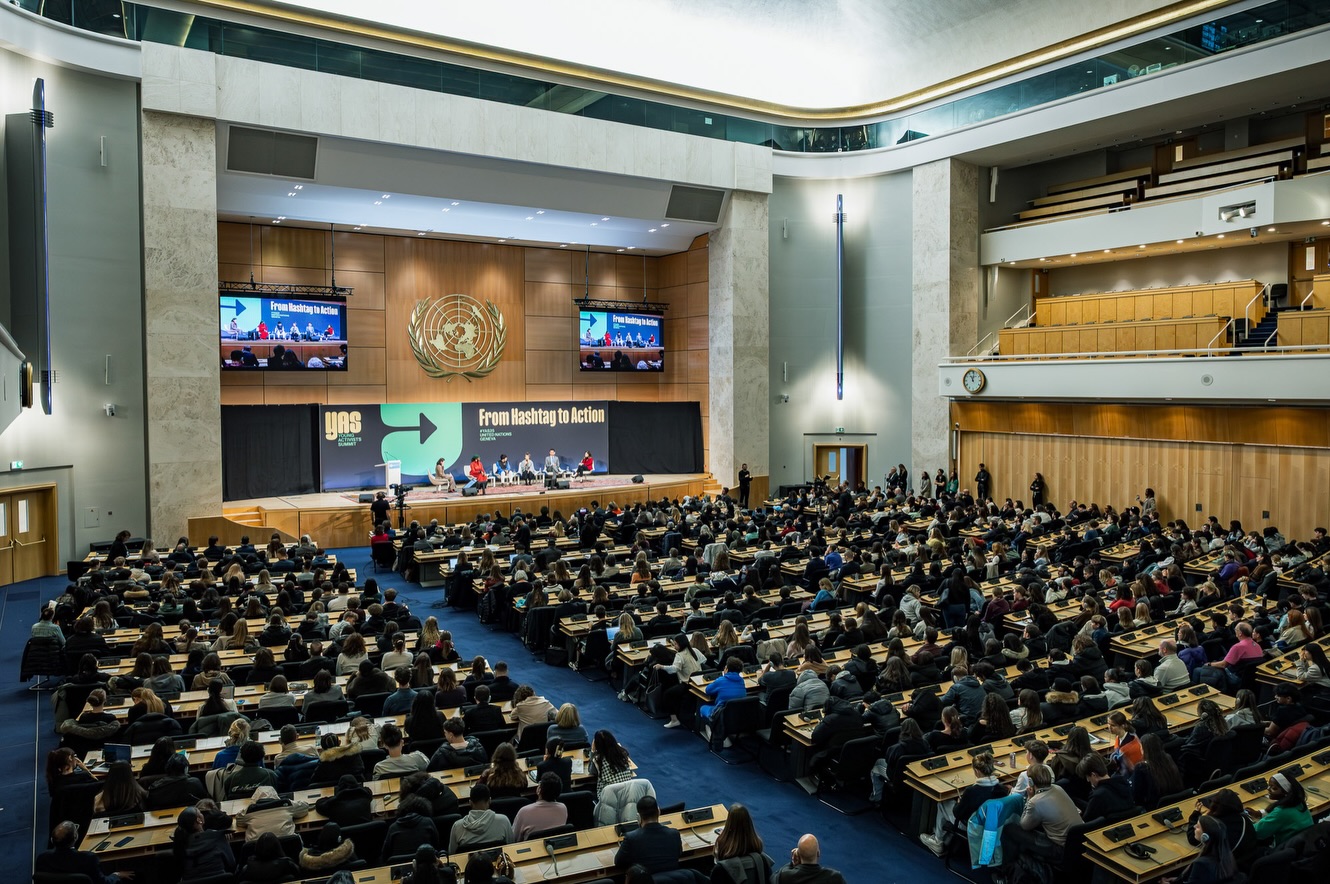
In Geneva in particular, such institutional arrangements are reinforced by events and platforms that bring youth activists and young professionals into direct interaction with international policy actors. Convenings such as the Young Activists Summit 2025 (“From Hashtag to Action”) explicitly frame this engagement around connecting local experience to global action, illustrating how youth claims circulate across levels and are rearticulated within international policy spaces.
Seen through this lens, IOs have been more effective in engaging with youth claims related to procedural justice and justice as recognition. While distributional concerns are increasingly acknowledged in principle, they are rarely addressed in the systemic and holistic manner articulated by youth movements, and remain primarily mediated through national policy-making arenas. This asymmetry does not preclude engagement, but it shapes its scope and helps explain the persistent tensions observed in Geneva-based just transition debates, where youth participation is both enabled and constrained by the limits of multilateral policy authority and political reach.