Research page
Final Research Project Results

Alternative Innovation Models for Medicines in the Public Interest

A seven-year SNSF-funded research project analysing new business models for innovation and global access to medicines


Discontent with the mainstream commercial pharmaceutical innovation system’s shortcomings (e.g. missing innovation, high prices, limited availability) has catalyzed experimentation with alternative innovation models (AIMs). However, the study of AIMs was conceptually and empirically fragmented, with open questions regarding definitions, therapeutic focus, functioning, achievements, and comparison with the mainstream. This project defined AIMs as having a public interest mission, and differing from the mainstream model, for instance, in organizational form, financing, priority-setting, role in R&D phases, knowledge management, and regulatory, manufacturing, or pricing strategy. We constructed a database of 148 initiatives, conducted interviews with 47 and case studies of three. We iteratively developed novel conceptual frameworks at the system, model and initiative-levels, and used framework analysis to analyze the data. We found ample evidence AIMs can develop new medicines addressing unmet health needs. However, they remain small-scale and relatively fragile. Institutionalizing them requires stable, expanded public and philanthropic financing; enhanced sharing of scientific, regulatory and manufacturing knowledge; and legal and policy changes that secure the resources they need to deliver.

Research work conducted and main research results


The original objective of the project was to deepen understanding of the political, economic and organizational factors required to implement alternative innovation models (AIMs) of pharmaceutical R&D that could jointly achieve innovation and global access to medicines. By its conclusion, the project had clarified the concept of alternative pharmaceutical innovation models, substantially expanded the evidence base on such models, increased understanding of the diversity and functioning of such models, and developed a conceptual framework of how such models co-exist with traditional innovation models in niches within the broader innovation ecosystem, and a theory of what would be required to scale-up further and/or to institutionalize them. Throughout the project, we iteratively engaged with practitioners and policymakers. 
Project Results Publications

AIM | intro article


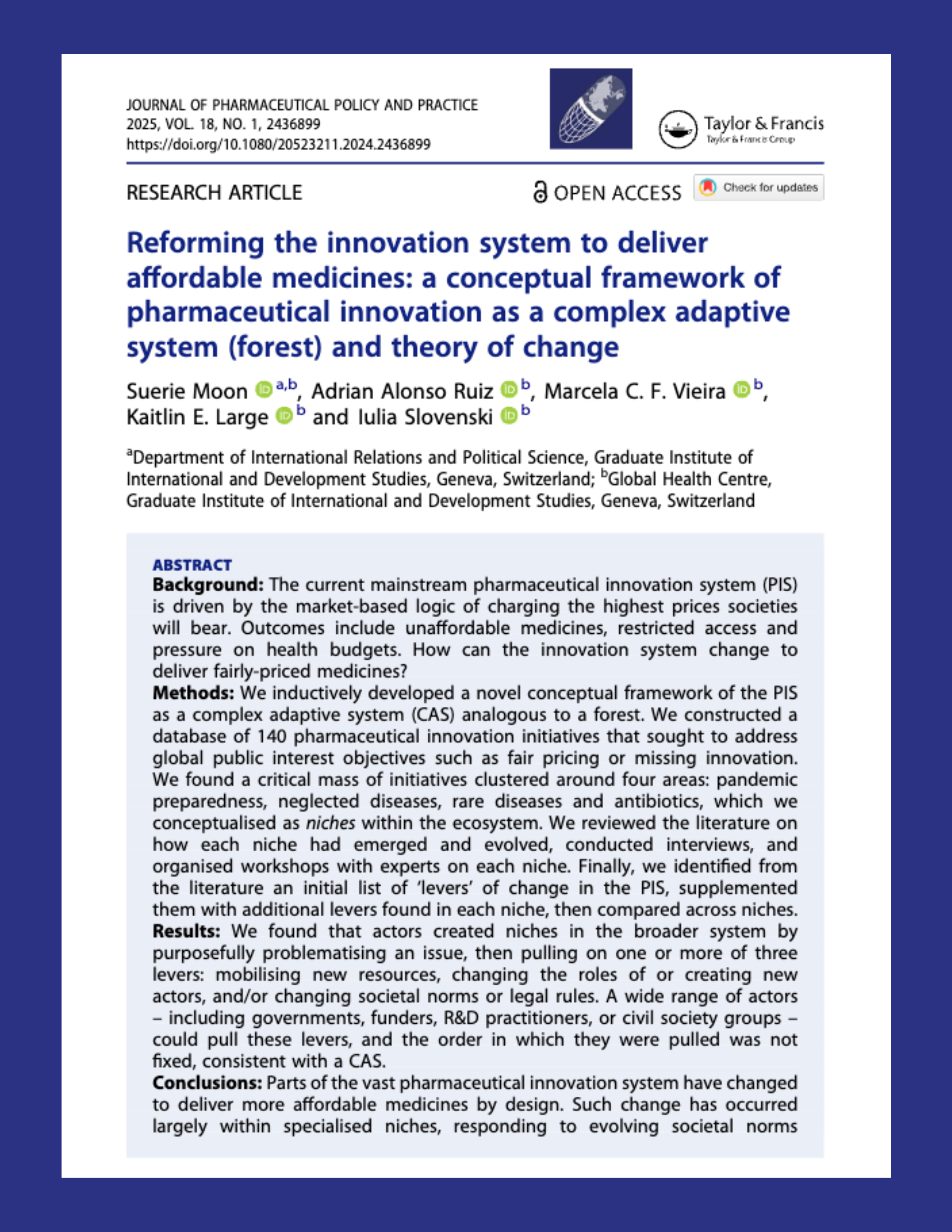
A conceptual framework of pharmaceutical innovation and theory of system change.


Reforming the innovation system to deliver affordable medicines: a conceptual framework of pharmaceutical innovation as a complex adaptive system (forest) and theory of change


By Moon, S., Ruiz, A. A., Vieira, M. C. F., Large, K. E., & Slovenski, I. in the Journal of Pharmaceutical Policy and Practice (2025).

Descriptive analysis of four niches where alternative innovation models are clustered:


Pandemic preparedness (biosecurity)

Developing globally-accessible medicines for pandemic preparedness: An analysis of three alternative innovation models


Antibiotics 

Beyond resistance: alternative innovation models for global access and stewardship of new antibiotics. Nature: Humanities and Social Sciences Communications


By Slovenski I, Alonso Ruiz A, Vieira M, Large KE, Strobeyko A, Liu Y, Moon S. in Nature: Humanities and Social Sciences Communications (2025).


Neglected diseases 

(manuscript under review)


Rare diseases

(manuscript under review)

Case studies of initiatives adopting alternative innovation models


Oral cholera vaccines

The 30-year evolution of oral cholera vaccines: A case study of a collaborative network alternative innovation model

By Large, K., Ruiz, A. A., Slovenski, I., Vieira, M., & Moon, S in PLOS Global Public Health (2025).


Ravidasvir to treat hepatitis C

Alternative pharmaceutical innovation models in competitive markets: A collaborative approach to develop a novel drug for Hepatitis C

By Vieira, M., Slovenski, I., Large, K., Alonso Ruiz, A., & Moon, S. in Tropical Medicine and Infectious Disease (2024).


ARI-0001 CAR-T to treat acute lymphoblastic leukemia  

By Alonso Ruiz, A., Shinabargar, E., Slovenski I., Large, K., Vieira, M., & Moon, S. in Orphanet Journal of Rare Diseases (2026, in press).

Increasing access to CAR-T therapy: a case study of an academic hospital’s alternative innovation model


BPaL/M regimen to treat drug-resistant tuberculosis

Orchestrating faster access to products of non-profit R&D: a case study of a novel regimen for drug-resistant tuberculosis 

By Moon, S., Vieira, M., & Large, K. in BMJ Global Health (2026).


Alternative innovation models for medicines in the public interest: A typology, evidence, and comparison with the mainstream model

by Moon, S., Slovenski, I., Alonso Ruiz, A., Vieira, M., Large, K. in BMJ Innovations (2026, in press). 

FInal output data


Access SNSF Data Portal 

COVID-19 INNOVATION MODELS

When the COVID-19 pandemic emerged in 2020, it became clear the pandemic was driving the development and testing of various innovation models, and we pivoted to allocate some resources towards capturing what was happening.


We focused our work on Covid-19 vaccines, and developed three online resources in which we made data and analysis publicly available on: 1) COVID-19 Vaccine Access; 2) COVID-19 Vaccine Manufacturing and 3) COVID-19 Vaccine R&D Funding.  We argued in two articles analysing the COVID-19 data that averting vaccine injustice would require embedding global access into the R&D model itself. Given the wealth of analysis on access to Western vaccines, but not those developed elsewhere, we conducted and published an analysis of the role of Chinese and Russian vaccines in global vaccination efforts. These efforts sought to further understanding of the role of emerging powers in the development and global distribution of health technologies, and examined the extent to which they adopt mainstream or alternative innovation models. The analysis and interpretation of this data, combined with other publicly available databases, yielded an article that painted the most comprehensive picture to date on how Covid-19 vaccines were developed, produced, and supplied internationally. Finally, we also analysed the global governance of vaccines, drugs and diagnostics for pandemics in a paper commissioned by the WHO-World Bank Global Preparedness Monitoring Board on how to strengthen the global governance of access to countermeasures, which also informed an article on reimagining global health governance in light of COVID-19.

RESEARCH WORK PACKAGES 

CONCEPTUAL ADVANCES 


In this workstream, we focused on developing conceptual frameworks that would guide the research activities of the project. We began by articulating the yardstick against which alternative innovation models could be measured, by defining what pharmaceutical R&D in the global public interest means, in collaboration with heads of major research institutions from around the world. We also co-authored a paper on the need for new business models to achieve fair pricing of medicines as well as a concrete conceptualization of what ‘fair pricing’ means. We also clarified the concepts of “new/alternative” and “traditional/mainstream” “business models”, and iteratively defined and re-defined these as we collected and analyzed the data; as a result, in 2023 we shifted the project’s terminology from “new business model” to “alternative innovation model (AIM)”, which better captured the key concepts of interest. . We also developed a conceptual framework of the overall pharmaceutical innovation system and the place of AIMs within it, drawing insights from the literature on complex adaptive systems, alongside a theory of how AIM niches emerge and could be solidified.

Mainstream R&D Systems


In this workstream, we deepened our understanding of the mainstream R&D business model, including how this model has evolved over time. We developed conceptualizations of how the mainstream business model operates, building from the literature available, which we published as part of a technical report for the WHO European Region’s Oslo Medicines Initiative. 

In this report, we conceptualized the mainstream business model as a multi-player relay race that increasingly involves small- and medium-enterprises and non-commercial actors such as academic institutions, in contrast to the more traditional vertically-integrated private-sector model of pharmaceutical R&D. 

We also conducted literature reviews on 11 strategically-selected topics on pharmaceutical innovation (4 of which focus on the current R&D system (R&D Costs, R&D Time and Success Rate, the Role of Small and Medium Enterprises, Public Funding of R&D; the remaining 7 are described under Alternative Innovation Models (Advanced Market Commitments, Biosecurity R&D, Patent Pools, Priority Review Vouchers, Product Development PartnershipsBenefit Corporations, Rare Diseases ). 

We made these publicly available (together with 18 other literature reviews on medicines-related issues) at a website we built to make data and literature syntheses more accessible, the Knowledge Portal for Innovation and Access to Medicines

ALTERNATIVE INNOVATION MODELS 


In this workstream, we focused on original empirical data collection and analysis. We began by synthesizing what is already known about alternative innovation models via literature reviews and created spaces for broader discussion in the policy/practice communities through a webinar series. We published literature reviews on seven approaches to alternative innovation models: Advanced Market Commitments, Biosecurity R&D, Patent Pools, Priority Review Vouchers, Product Development PartnershipsBenefit Corporations, Rare Diseases . We also organized 15 webinars (as part of a broader webinar series) with external experts, including on antibiotics, biosecurity (e.g. outbreaks, potential and actual pandemics), public funding of R&D, R&D costs of cancer medicines, drug development costs, and non-commercial pharmaceutical R&D (full list at knowledgportalia.org/webinars). In total, our webinar series was attended by almost 1,400 unique participants from 98 countries, with a mix of scholars, advocates and practitioners often having a high degree of expertise on medicines policy. 

Project Contributors 


Keywords: Access to medicines, global governance, global health, new business models, pharmaceuticals, medicines, research and development, technological innovation