


How did you come to choose your research topic?
I identified my research topic because of my interest in two fields: sociology and international law. Since I was a master student, I have always been interested in studying international courts and tribunals. At the same time, I believe that international law is not isolated but embedded in the broader society; thus, if there are changes in the society, international courts and tribunals are necessarily influenced.
I see my topic as a timely reflection of the ongoing changes in the international legal community. We are currently witnessing some dramatic changes in the global legal order — multilateral institutions are increasingly challenged, and some private institutions are getting more and more influential in global governance. Against this context, international courts have to obtain and maintain their position as the governing bodies in the global community. In order to do so, they must compete with other governing bodies or among themselves for resources, such as funding, reputation, authority. Once I noticed such ongoing changes in the society, I came to realise that competition among international courts and tribunals is a very promising topic for a PhD thesis.
Speaking of my research topic, I would also like to thank my supervisor, Professor Fuad Zarbiyev, for his guidance in helping me identify and narrow down my research topic.
Can you describe your research questions and the methodology you use to approach those questions?
There are three research questions. First, why do international courts and tribunals compete? Second, how do they compete with each other? Third, what are the consequences of this competition?
This research adopts a hybrid methodology that combines doctrinal inquiry and empirical investigation together with a sociological analysis. In addition to drawing insights from existing literature, I also rely on archives, formal legal documents, and meeting records to interpret the institutional practices of international courts. Primary materials, such as statutes, procedural rules, judgments, orders, advisory opinions, press releases, annual reports and other statements made by the courts and their staff, are examined in detail in order to capture the courts’ behavioural patterns. Moreover, my research also draws evidence from sociological observations. The observations were primarily obtained through interviews and my own participation in the courts’ working process.
What are your major findings?
My thesis presents three key findings related to inter-court competition. First, as being the first mover entails significant advantages for a court, international courts have adopted several strategic measures to compete for “first-movership” (the race to become the “first one” in different settings). Second, international courts and tribunals have used differentiation strategies to win scarce resources in the international community. As a result, many courts have become increasingly market-driven. They tend to accommodate the diverse demands of their clients (e.g. states, civil society, and general public), and each court endeavours to emphasize that it is different from other courts. Third, international courts mimic each other (i.e., emulation). When international courts are in competition, disadvantaged courts tend to mimic the ones in privileged positions. The emulation process is intertwined with the differentiation process, in the sense that those who previously possessed advantages may lose their outstanding status due to emulation, and thus have to re-engage in differentiation in order to find new aspects that can make them distinctive.
What could be the social and/or political implications of your thesis?
Competition is one form of conflicts. By revealing the competition among international courts, my thesis demonstrates that social conflicts and struggles persist in many aspects of our society, even between institutions that are not supposed to engage in any conflicts. It could raise awareness among policymakers and the general public about the existing conflicts in our society.
What bearing will your doctoral experience have on your career plans?
My doctoral experience lets me see the potential of applying sociology to legal research. Even though I always had an interest in sociology before I started my PhD, I did not have the courage and knowledge to embark on this path. With the support of faculty members and the training I received during my PhD, I am now confident enough to explore more topics that go beyond traditional legal research and to conduct other interdisciplinary research.
* * *
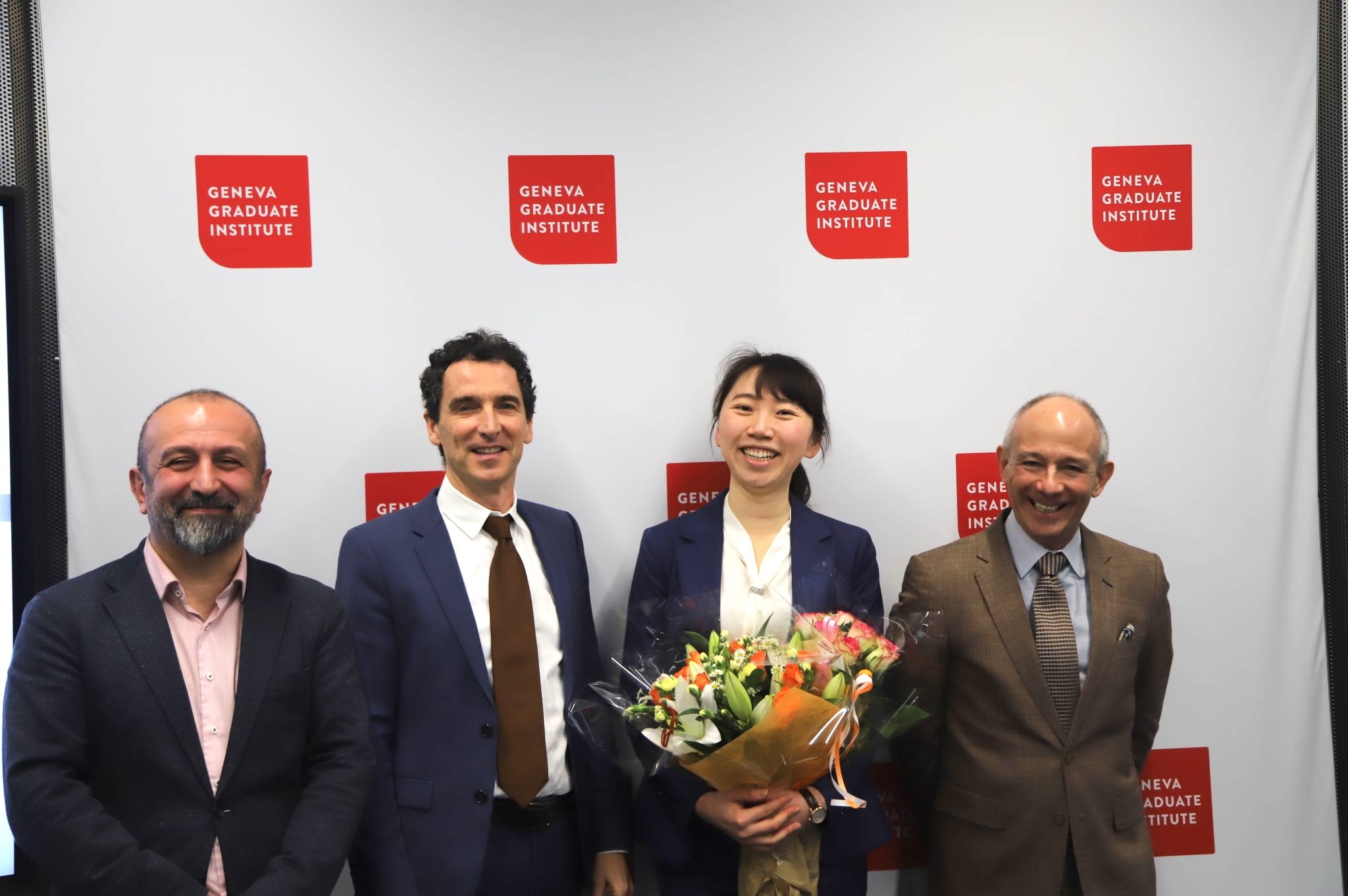
On 3 March 2026, Zelin Li defended magna cum laude her PhD thesis in International Law, titled “Competition among International Courts and Tribunals”. Committee members were Professor Fuad Zarbiyev (left), Thesis Supervisor; Professor Joost Pauwelyn (2nd from the left), President of the Committee and Internal Member; and Professor Laurence R. Helfer, Duke University, School of Law, Durham, USA.
Citation of the PhD thesis:
Li, Zelin. “Competition among International Courts and Tribunals.” PhD thesis, Graduate Institute of International and Development Studies, Geneva, 2026.
Access:
An abstract of the PhD thesis is available in the Geneva Graduate Institute’s repository. As the thesis itself is embargoed until May 2029, please contact Dr Li for access.
Banner image: photo by ArtMari/Shutterstock.
Interview by Nathalie Tanner, Research Office.