

becoming a generalist of a specific kind
Deepening inequalities, environmental crises, shifting geopolitical realities and rapid technological change require a rigorous understanding of global interdependencies and the capacity to translate it into action.
The Master in International and Development Studies (MINT) draws on the Geneva Graduate Institute's five disciplines (anthropology and sociology, international economics, international history and politics, international law, and international relations and political science) to train you to zoom in on a specialised theme and zoom out to the bigger picture. Over four semesters, you combine interdisciplinary foundations, one of seven specialisations, applied research with partner organisations, and a final semester dedicated to your professional development, in the heart of International Geneva.
WHY MINT?
- Being prepared to advancing international cooperation: MINT prepares professionals committed to a more just, sustainable and peaceful world, through critical thinking and solution-oriented analysis.
- Decide how far you specialise: choose one of seven areas that reflect the Institute's expertise, while learning to connect them to the wider picture.
- Understand how global issues connect: shared programme foundations give you the analytical framework and research methods to examine systemic interdependencies from several disciplinary perspectives.
- Learn by doing: carry out policy-relevant research for a partner organisation, build skills in workshops, and dedicate your final semester to professional development alongside practitioners.
MINT prepares you for a career in:
- International cooperation: intergovernmental and non-governmental organisations.
- Public administration and diplomacy.
- The private sector: multinational companies, finance, law firms, consulting and public relations.
- Research and analysis: academic institutions, think tanks, foundations and the media, or as an analyst or consultant.
STRUCTURE OF THE CURRICULUM
* Students who wish to pursue independent research instead of the professional development semester may be admitted, through a selection, to write a 30 ECTS Master's thesis. The thesis replaces the professional development semester and one specialisation elective. Besides, the optional internship is replaced by one specialisation elective and one workshop.
TRANSVERSAL THEME ELECTIVES
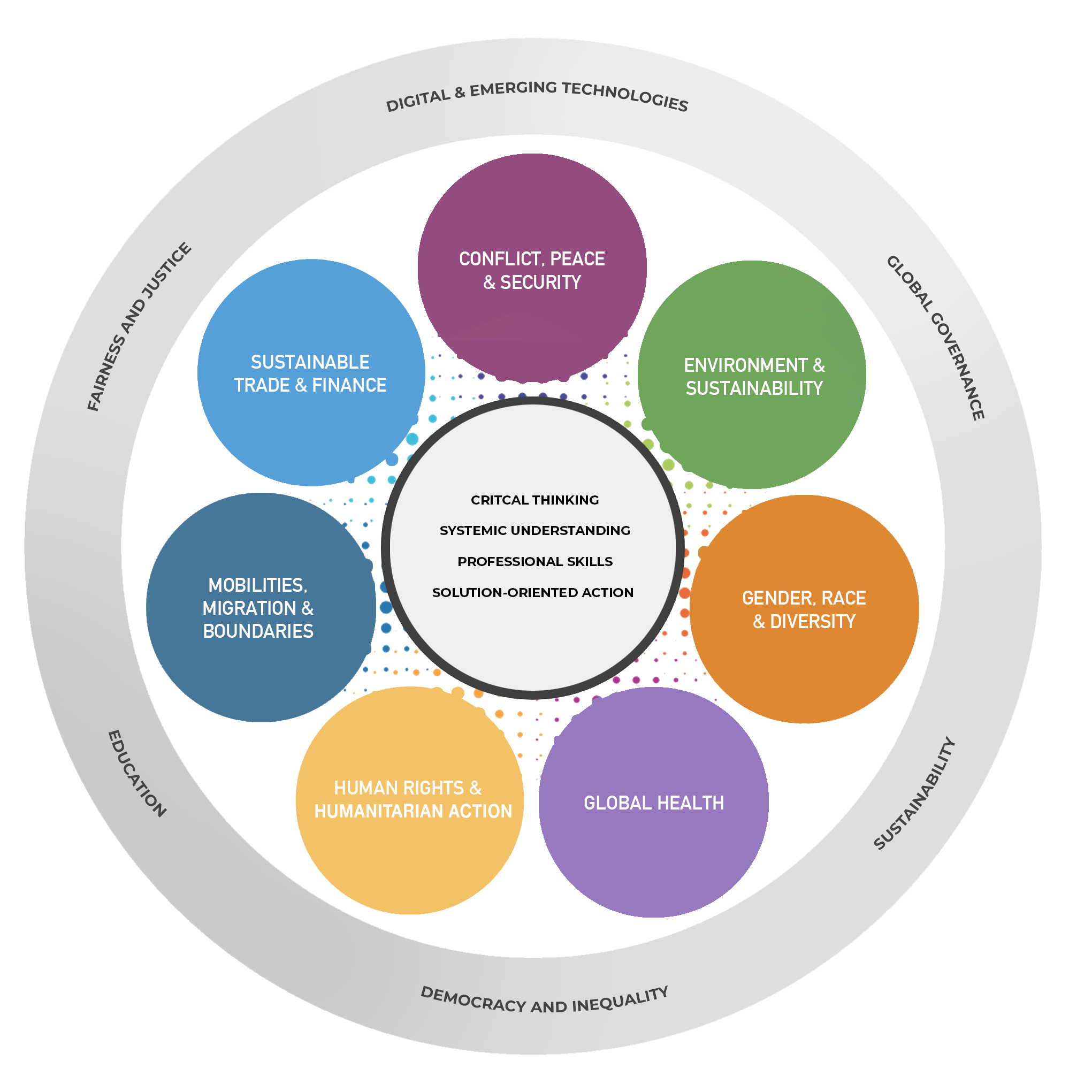
They provide a unique opportunity to engage in an interdisciplinary manner with issues which transcend specialisations. Students take one, in semesters 1 or 2. These courses are part of our programme foundations. The transversal themes are as follows:
- Sustainability;
- Democracy and Inequality;
- Fairness and Justice;
- Digital and Emerging Technologies;
- Global Governance;
- Education
RESEARCH METHODS ELECTIVES
As part of the programme's foundations, they offer students different ways to analyse a given reality and introduce new ways of thinking. Students take two, in semesters 1 and / or 2, taught by experts from different disciplines. They encompass qualitative, quantitative, hybrid, legal and philosophical methods.
SPECIALISATIONS
They enable students to dive into one of the following seven areas, with a compulsory course in semester 1 and specialisation electives in semesters 1 to 3:
- Conflict, Peace and Security;
- Environment and Sustainability;
- Gender, Race and Diversity;
- Human Rights and Humanitarian Action;
- Mobilities, Migration and Boundaries;
- Sustainable Trade and Finance;
- Global Health.
Students can choose the extent to which they specialise. However, because today's global issues are intertwined and can't be confined to a specific field, students will be encouraged to learn beyond a specialisation and explore their interlinkages.
WORKSHOPS
They provide students with skills needed for their studies and professional lives. They take place in semesters 1 to 3; students can also take the Institute's French course.
APPLIED RESEARCH PROJECTS (ARP)
A compulsory course in semester 1 prepares students for the Applied Research Projects (semesters 1 and 2), in which small teams carry out policy-relevant research for a partner organisation, under the supervision of a Faculty Lead. The ARPs allow for the synthetic and practical mobilisation of knowledge, methods, tools and skills acquired in the programme.
PROFESSIONAL DEVELOPMENT SEMESTER
In semester 4, a common seminar, the Career Forum and practitioner-led professional development courses prepare students for what comes next.
INTERNSHIPS (optional)
They provide students the opportunity to connect, to gain professional experience in International Geneva or around the world and to put their knowledge into practice.
EXCHANGE SEMESTER (optional)
Through our global network of prestigious academic partnerships, the Institute has established exchange programmes providing our students and students from other universities around the globe with the opportunity to participate in culturally stimulating educational experiences. Learn more
MINT offers a common core and seven specialisations. Each of them follows an interdisciplinary approach, informed by the rich expertise of the Institute in five disciplines: anthropology and sociology, international economics, international history and politics, international law, and international relations and political science. Specialisations are not self-standing silos: they are interconnected curricula, so students can tailor the programme to their interests.
1 | CONFLICT, PEACE AND SECURITY
This specialisation focuses on the issues of conflict, peace and security and the interactions among them. It examines the drivers and manifestations of conflict, the nature and conditions of peace, and the determinants of security. Within an interdisciplinary approach, we survey the various historical and contemporary manifestations of these processes.
Selected courses 2026 – 27:
- Critical Security Studies
- Geoeconomics
- Mediation in Conflict Resolution and Political Transitions
- Predicting Crises
- The Arab-Israeli Conflict
Head: Prof. Stephanie Hofmann
2 | ENVIRONMENT AND SUSTAINABILITY
This specialisation focuses on global environmental challenges, which lie at the heart of the search for a sustainable human future on Earth. It examines the impacts of contemporary political economies locally and at the planetary scale. It adopts an interdisciplinary approach to the understanding of the economics and politics of decisions about the environment, from the global scale (e.g. climate change or global ecology) to the local (e.g. agrarian change, biodiversity conservation, urbanisation or mining).
Selected courses 2026 – 27:
- Environmental Economics and Policy
- Environment and Media
- International Environmental Law
- Political Economy and Geopolitics of International Diplomacy
- Water-Peace Diplomacy
Head: Prof. Shaila Seshia Galvin
3 | GENDER, RACE AND DIVERSITY
This specialisation addresses how power relations based on gender, race, and other forms of difference structure international affairs. The goal is to provide students with the knowledge, skills, and tools to help redress intersecting inequalities and oppressions globally. Students gain interdisciplinary training that addresses a broad range of topics, including histories of colonialism and decoloniality; anthropologies and sociologies of (anti)racism, sexuality and gender; the economics of gender and development; and the gendered and racialised politics of international governance and international law.
Selected courses 2026 – 27:
- Elites and Inequality
- Gender Politics in Global Health: Negotiating Bodies
- Global and Critical Approaches to Diversity
- Public Policy, Economic Development and Gender
- Questioning Migration, Gender and Development
Head: Prof. Aditya Bharadwaj
4 | GLOBAL HEALTH
This specialisation focuses on power, politics and governance in global health. Students will learn how global health issues affect, and are affected by, geopolitics through global institutions and transnational actors, political economy, and epistemological and regulatory regimes. Students will also learn how to work across professional disciplines, how to obtain meaningful input from different stakeholders including affected communities, and how to translate knowledge into policy.
Selected courses 2026 - 27:
- Embodied Inequalities: Disability and Global Health
- Global Governance and Health: Problems, Politics, Policies
- Global Health Law
- Global Mental Health
- Innovative Finance in Global Health and Development
Head: Prof. Vinh-Kim Nguyen
5 | HUMAN RIGHTS AND HUMANITARIAN Action
This specialisation will introduce students to these inter-related ethical / legal topics, and their changing relationship. The overall aim of the specialisation is to equip students with a mix of theoretical insights and practical skills that are essential for reflection and effective participation in these two fields of activity.
Selected courses 2026 - 27:
- Business and Human Rights: Law, Politics, Policy
- Contemporary Just War Philosophy
- Education in Complex Environments
- Global Justice and International Law
- Inside the UN Human Rights System: Power, Politics and Influence
Head: Prof. Fuad Zarbiyev
6 | MOBILITIES, MIGRATIONS AND BOUNDARIES
This specialisation aims to provide a comprehensive and nuanced understanding of mobility, its centrality in our societies, the governance of mobility, and its centrality for modern-day governance.
Selected courses 2026 - 27:
- Borders of Justice: Migration, Labour and the Struggle for Rights
- Critical Refugee Studies
- Development, Displacement, Human Rights
- Policy Approaches to Address Irregular Migration: A Critical Exploration
- The Urban in International Law and Governance
Head: Prof. Alessandro Monsutti
7 | SUSTAINABLE TRADE AND FINANCE
This specialisation focuses on the challenges and opportunities of financial deepening and international economic integration, with a spotlight on sustainability and inclusiveness.
Selected courses 2026 - 27:
- Climate Change Economics
- Corporate Finance
- Law and Economics of Trade Policy: “Trade Wars”, Trade Clubs and the New Normal
- The Economics of Energy Transition: Impacts and Regulations
- Social Finance for Sustainable Development
Head: Prof. Ugo Panizza
The fourth semester is the culmination of the MINT programme, and your bridge to what comes next. It builds on the knowledge, research skills and competencies you have developed over three semesters, and turns them into a strong professional profile.
It combines:
- A common seminar, with 3 parts, one on ethics, one on civic engagement and one on eloquence.
- A Career Forum: build your competency portfolio and engage with practitioners from International Geneva and beyond.
- Professional development courses: choose two practitioner-led courses among thirteen: Diplomacy · Public-private partnerships, fundraising and philanthropy · Advocacy · Negotiation and mediation · Project management · Data and information management · Digital transformation and technologies · Financial and resource management · Arts and culture · Diversity, equity and inclusion · Social entrepreneurship · Leadership · Media.
You leave the programme with the skills, network and experience to pursue a career in international organisations, public administrations, NGOs, the private sector or research.
Master's thesis (selective)
Students who wish to pursue independent research instead of the professional development semester may be admitted, through a selection process, to write a 30 ECTS Master's thesis.
All MINT graduates obtain the same degree (irrespective of whether they follow the professional development semester or a Master Thesis instead): the Master of Arts in International and Development Studies (120 ECTS).
BUILDING A CAREER
Where our alumni are employed one year after graduation (2023 cohort):
A cosmopolitan ENVIRONMENT
With roughly 1'000 students from 100 countries enrolled in our various programmes per year, the Institute is home to students from around the world. We are serving a very diverse community in the heart of International Geneva: nearly 20-25% of people in this Swiss city are connected to an international institution. The Institute’s close ties with the international community are reflected in the five social science disciplines taught here, all imbued with a global perspective.