




The Graduate Institute's Centre for Finance and Development and a consortium of sixteen other universities and institutions are launching a Europe-wide virtual seminar in Macroeconomic History. At a time when general confinement had led to university closures and widespread cancellations of seminar series, workshops and conferences, this initiative aims to keep the flow of intellectual debate active.
A virtual format has important advantages, namely, by abolishing physical constraints, so we can have more participants joining in from compatible time zones than the conventional seminars. This is good for the presenters, who are exposed to a broader audience and also for the audience, who can choose to attend seminar series closer to their own research interests. This advantage is greater for specialized sub-disciplines. This is the reason why we launched a seminar in macro history. Finally, co-ordinating a joint seminar series provides economies of scale in time use.
Registration Recordings of past sessions
Programme:
-
12 May: Napoleon’s Gift: Labor Shortages and Technology Adoption in England, 1790-1815 by Hans-Joachim Voth
-
19 May: The economic effects of the English enclosures by James A. Robinson
-
26 May: Export Booms and Labor Coercion: Evidence from the Lancashire Cotton Famine by Mohamed Saleh
-
9 June: International Banks: Re-Agents of Globalization? by Christopher Meissner
Contact: macrohist@graduateinstitute.ch
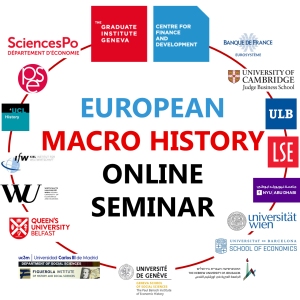
Participant institutions: Banque de France, The Graduate Institute, Hebrew University of Jerusalem, Judge Business School Cambridge, Kiel Institute for the World Economy, London School of Economics, NYU-Abu Dhabi, Paris School of Economics, Queen’s University Belfast, Sciences Po, Solvay Business School, Universitat de Barcelona, University Carlos III Madrid, University College London, University of Geneva, University of Vienna and Vienna University of Economics and Business.