

Explorer Geneve: Democratie, Philanthropie Et Institutions Internationales
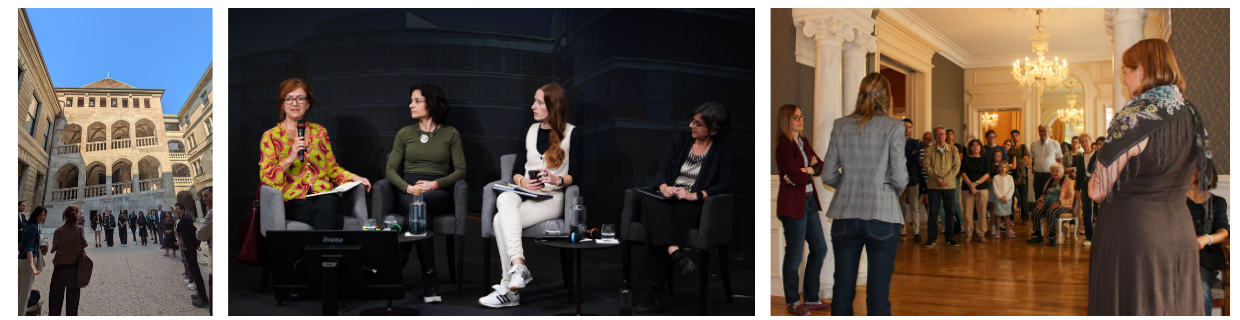
To kick off Democracy Week, a group of 30 people joined the immersive tour "Explorer Geneve: Democratie, Philanthropie Et Institutions Internationales" to explore democracy beyond the ballot box, through philanthropy, civil society, media, research and international cooperation. Proving that democracy is about institutions and participation, but above all, it is about people.
AI, DISINFORMATION AND EDUCATION: WHAT CHALLENGES FOR DEMOCRACY?
This workshop held on October 5th and organized as part of the of the De.Co.De project at the Albert Hirschman Centre, gathered 20 experts on the topics of AI, disinformation and education. The participants, hailing from various relevant backgrounds (academia, policymakers, teachers, students), discussed transformations of the information landscape, how to act in a fast-paced evolving education environment, and how to build capacity in media literacy both for the students but also the trainers and the governing instances.
The event was also an opportunity to take stock on new and upcoming challenges either faced by a specific group of actors, or shared obstacles and the need for more interdisciplinary and longitudinal problem-solving approaches.
MÉDIAS: QUELLE CONFIANCE À L’ÈRE DE L’INTELLIGENCE ARTIFICIELLE ?
On Monday, October 5th at the Palais Eynard, a roundtable hosted by the Mayor of Geneva Christina Kitsos, brought together an expert panel to take stock of the hurdles the legacy media and new forms of media face when dealing with AI, disinformation and an increasingly cost-cutting information landscape.
The panel, moderated by Olga Baranova from the Media Forward Fund, included Mounir Krichane from Wikimedia CH, Christine Lutringer, Executive Director at the Hirschman Centre, and independent journalist Thibaud Mabut. They presented varying perspectives on the use of AI in content and news creation, eroding trust in media by the public, constantly changing guidelines to adapt to current realities, and the looming threat of disinformation. Discussions covered large language models, massive media company layoffs, creativity in news content, information as data, community, democratic participation, and the necessity of prioritized education for youths and the elderly.
HOW DOES SWISS DEMOCRACY WORK ? AN INTERACTIVE VISIT TO GENEVA'S HOTEL DE VILLE
Members of the Graduate Institute and International Geneva communities took part in an interactive visit and workshop, organised by the Albert Hirschman Centre on Democracy in collaboration with the Chancellery of State of Geneva. Held on 6 October at the Hôtel-de-Ville, the historic seat of Geneva’s political institutions, the event offered participants an opportunity to explore Swiss democracy from within its institutional home. The programme began with a guided visit, led by the Chancellery’s Protocol service, followed by an interactive workshop with Marceau Schroeter, author of the book Swiss Made Democracy.
YES, POLARISATION CAN BE MAPPED! DEVELOPING A DIAGNOSTIC TOOL -UNDERSTANDING AND ADDRESSING AFFECTIVE POLARISATION
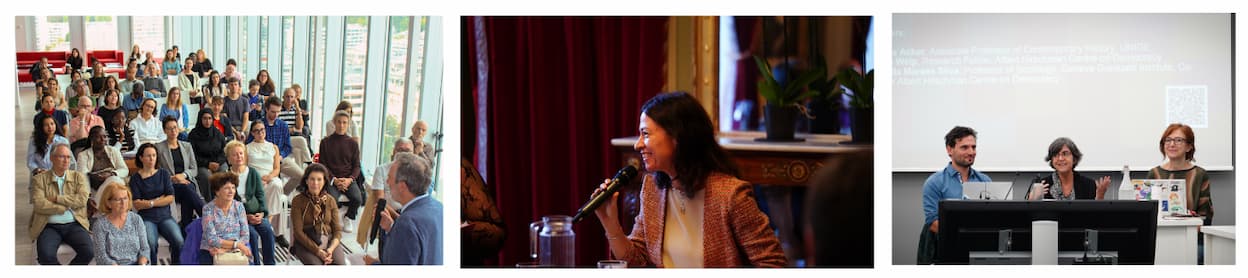
The two back-to-back bilingual Spanish-English panels featuring Albert Hirschman Centre Fellow Yanina Welp, accompanied by Natalia Aruguete (Universidad Austral, Argentina) and Palmira Chavero Ramirez (FLACSO Ecuador), presented a diagnostic matrix that enables the assessment of affective polarisation, produces comparative explanatory results, and provides pathways towards depolarization.
One key finding showed how political disagreements can deepen polarization among political leaders and lead them to question the legitimacy of their opponents. This was observed in Argentina and Ecuador, but similar patterns may also apply to other countries, including the US and Brazil. During the second panel, University of Geneva discussants Juan Huitzilihuitl Flores Zendejas and Maxime Walder discussed the strengths and weaknesses of the assessment framework and how it could be improved.
The Q&A was moderated by Graziella Moraes Silva, Co-Director of the Albert Hirschman Centre and a collaborator on the Democratising Public Debate project.
EXPLORING THE CO-CREATION PROCESS OF THE EXHIBIT “WHAT IS THE FUTURE?”
The Centre welcomed a group of students and participants to the Museum of Ethnography of Geneva (MEG) for a special guided tour of the temporary exhibit “Le Futur c'est Quoi?”, co-created by schoolchildren in collaboration with the MEG.
Damien Kunik, curator and conservationist at the museum, guided the group, alongside Nataliya Tchermalykh, Research Professor at the Institute. The exhibit included pieces on the perception of time and idealized representations of the future. The guided tour provided context on the co-creative process, where children hand-picked pieces from the MEG’s archives and were consulted in the construction of the dedicated museum area.
You can explore the exhibit at the MEG, ongoing until January 10th, 2027.
The 2026 Brazilian Elections: What Is at Stake?
The panel discussion brought together experts to examine the political and democratic implications of Brazil’s upcoming elections, focusing on political polarisation, democratic institutions, and the country’s role in Latin America and beyond.
Yanina Welp, Research Fellow at the Centre; and Antoine Acker, Associate Professor of Contemporary History at the University of Geneva joined Graziella Moraes Silva, Professor of Sociology at the Geneva Graduate Institute and co-director of the Albert Hirschman Centre on Democracy. Their exchange explored the challenges facing Brazilian democracy and the broader implications of the elections for democratic governance and international relations.